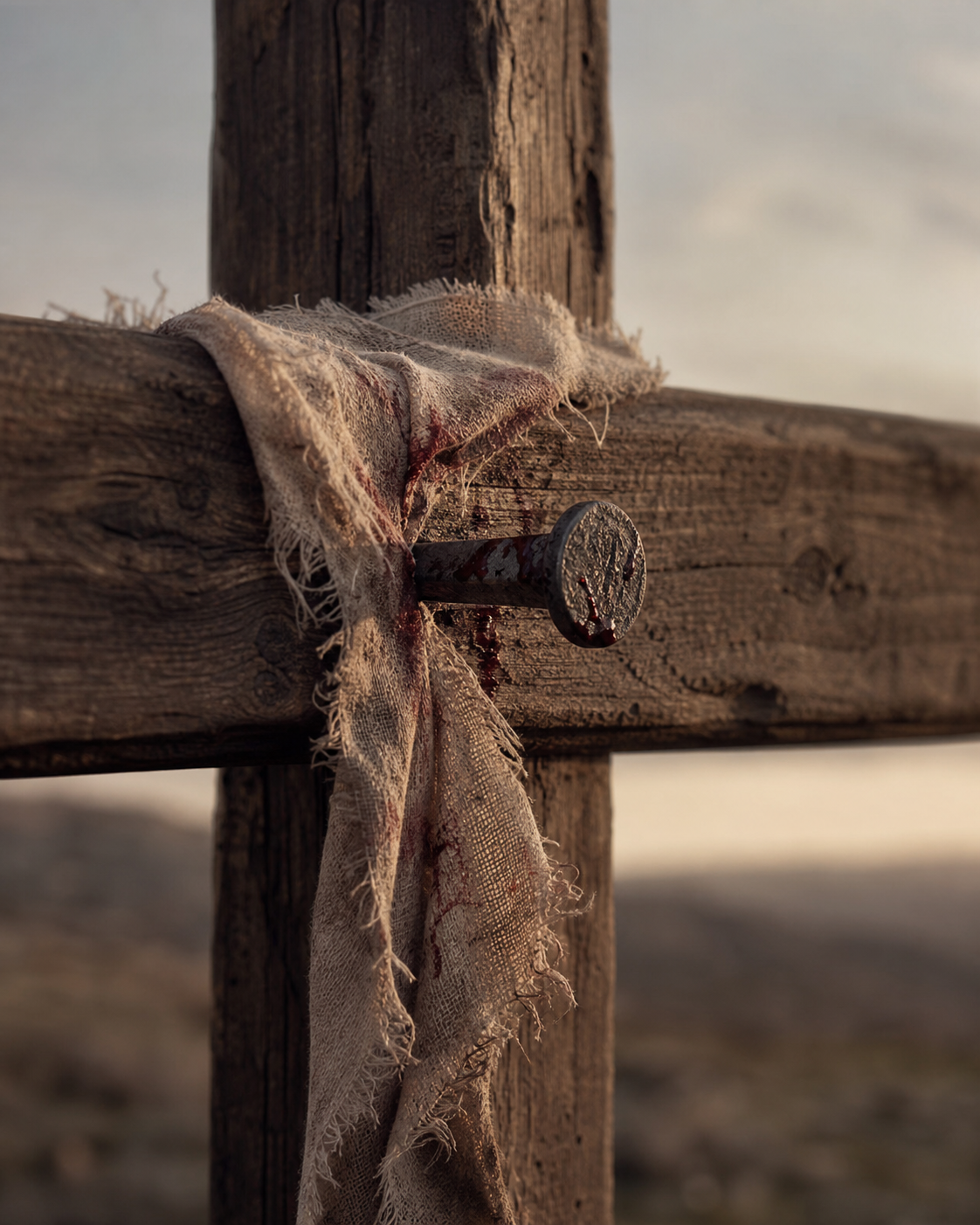
The Wilderness Was Not a Waste
1 Samuel 16:7
"The Lord does not look at the things people look at. People look at the outward appearance, but the Lord looks at the heart."
On David, Saul, Church Hurt, and the Long Road to the Throne
The Boy Nobody Sent For
There is a moment in the ancient story that most people read past without stopping — a quiet, almost embarrassing detail buried in the middle of what should have been a momentous occasion. The prophet Samuel arrives in Bethlehem carrying a horn of oil and a quiet mandate from God: to anoint Israel’s next king from among the sons of Jesse. A feast is prepared. The elders of the city tremble at Samuel’s appearance, for prophets do not arrive unannounced without weight behind them. This is sacred business. This is the next chapter of a nation.
Jesse parades seven sons before the prophet. Seven. Strong, able-bodied, impressive young men. Surely one of them is the chosen. Eliab steps forward first — tall, broad, the kind of man a nation wants standing at its front. Samuel looks at him and feels something stir. Surely this is the one. And then God speaks: Do not consider his appearance or his height, for I have rejected him. Six more sons pass. Six more silences from heaven. Six more times the oil stays in the horn.
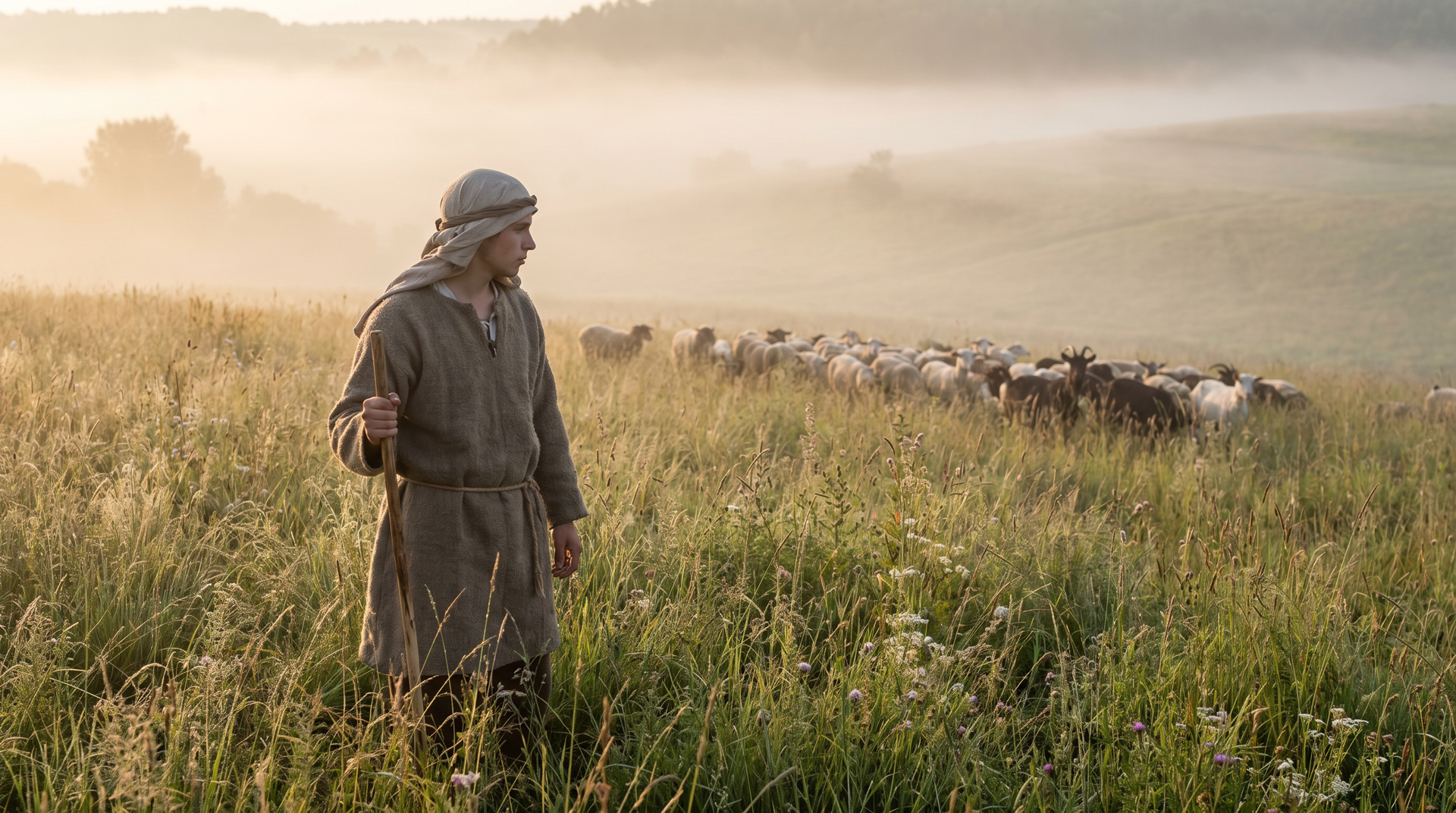
And then — only then — does someone remember there is a youngest son. He hasn’t even been invited to the gathering. Nobody sent for him. He is out in the fields because that is where the forgotten are kept. His name is David, and he smells of sheep and sweat and the long Judean afternoon. He is likely still a teenager. His cheeks are flushed from the sun. He looks like what he is: a boy whom nobody considered important enough to call in from the pasture.
“So he sent for him and had him brought in. He was glowing with health and had a fine appearance and handsome features. Then the Lord said, ‘Rise and anoint him; this is the one.’”
1 Samuel 16:12 · NIV
And in that moment — that obscure, unhurried, unwitnessed moment — the Holy Spirit settled on David like oil running warm and fragrant from the prophet’s horn, down across his forehead, pooling at the corners of his jawline. He had no idea what was being placed on him. He had no conference to attend, no platform to steward, no mentor preparing him for this. He was anointed alone, in the presence of his family, and then sent back to the fields.
Nobody announced it. No herald blew a trumpet. No crowd erupted. The sheep needed tending. The day continued as it always had. But the anointing of God had landed, and it does not land lightly. It carries the full weight of divine intention. It does not ask permission from institutions or men. It simply comes.
This is always how God builds kings. Not in the spotlight. Not with fanfare. In the fields. In the long, unseen years of faithfulness that nobody is applauding, nobody is recording, nobody considers worth mentioning. The boy who learns to worship alone will be the man who worships when the walls are closing in.
II
The Lion, the Bear, and the Valley of Elah
Before we can understand what David did in the valley of Elah, we have to understand what he had already done in the wilderness alone. Because Goliath was not where his faith began. Goliath was where his faith was made visible.
In the fields outside Bethlehem, David kept his father’s sheep. It was not glamorous work. It was repetitive, isolating, and relentless. Sheep do not take days off. They wander at night. They fall into ravines. They scatter at the sound of a predator and need to be gathered back, one by one, in the dark. A shepherd’s life is not the life of a warrior — and yet it was precisely in that life that David became one.
At some point — no crowd, no witnesses, no record beyond his own testimony — a lion came. We don’t know the hour. We don’t know if David had been awake all night or had just sat down to eat. What we know is that the lion seized one of his lambs by the throat and began to drag it away. And David did not freeze. He did not calculate the odds. He ran after it, grabbed it by the mane, struck it, and killed it. And when a bear came, he did the same.
“Your servant has killed both the lion and the bear; this uncircumcised Philistine will be like one of them, because he has defied the armies of the living God.”
1 Samuel 17:36 · NIV
That is a staggering sentence. David is not boasting about physical strength. He is making a theological argument. He is saying: I have a track record with God. I have tested this before. When I was alone in the dark with something that wanted to kill what I was protecting, God showed up. And He will show up again. The Philistine is just another lion.
The Valley · Circa 1025 BC
Picture the valley of Elah on that morning. The Philistine army arrayed on one ridge. Israel’s army on the other. And in the valley between them, forty days of this — forty mornings of the same humiliation, the same enormous shadow stepping forward, the same thunderous voice rolling across the ravine and draining the color from the face of every soldier in Saul’s army.
Goliath stands over nine feet tall. He wears bronze armor weighing more than most men can lift. He has been doing this for forty days. He is not afraid of Israel’s army. He is contemptuous of it. He shouts his challenge like a man who has already won, because he essentially has. Nobody moves. Not even the king.
And then a shepherd boy walks down the ridge with a bag of smooth stones and says, quietly but without any trembling, that he is going to kill this man.
The courage it took to do what David did in that valley cannot be separated from the obedience it took to do what nobody saw him do in those fields for years before. You do not manufacture that kind of faith in a moment. It is deposited, slowly, one lion at a time. One dark night at a time. One prayer breathed into the empty sky over a sleeping flock at a time.
Five smooth stones. One throw. The giant fell face-forward into the dirt — not backward, as if surprised, but face-forward, like something being planted. Israel erupted. The women poured into the streets and sang. And somewhere in the crowd, a king named Saul watched this teenager receive what Saul himself had forfeited — the full, unbridled love of a nation — and something inside him began to curdle.
III
The Honeymoon, the Song, and the First Javelin
What followed the valley was not a coronation. It was something almost more dangerous: approval. Saul brought David into the palace. He gave him command of his armies. He gave him his son Jonathan as a covenant brother. For a season, the palace felt like a home, and Saul felt like the spiritual father David perhaps never had.
This is important to understand, because we tend to cast Saul as a villain from the beginning. But he wasn’t. He was a father figure who genuinely loved David. He was a king who recognized greatness and wanted to be near it. The honeymoon was real. The warmth was real. And that is precisely what makes what follows so devastating — not just for David, but for Saul himself.
“Whatever mission Saul sent him on, David was so successful that Saul gave him a high rank in the army. This pleased all the troops, and Saul’s officers as well.”
1 Samuel 18:5 · NIV
Then came the song. The women of Israel danced through the towns with tambourines and lyres, singing the victory chorus: “Saul has slain his thousands, and David his tens of thousands.” It was thoughtless. It was careless. It was probably just a song, the kind of thing crowds sing without thinking about who is standing nearby. But for Saul, it landed like a lit torch dropped into a room full of dry wood.
The Bible records what happened inside him with disturbing precision. He was very angry. This refrain displeased him greatly. And then the sentence that explains everything: “They have credited David with tens of thousands, but me with only thousands. What more can he get but the kingdom?” And from that day, Saul kept a jealous eye on him.
Notice that nobody did anything to him. David did not campaign against Saul. He did not lobby for the throne. He did not undermine the king or gather allies or whisper in corners. He simply kept winning, kept being faithful, kept being excellent — and that faithfulness became, to a man whose security was built on being the most important person in the room, a form of slow torture.
The Palace · A Day Like Any Other
David is playing the harp in Saul’s court. This was his role — the music that quieted the dark spirit that tormented Saul. He is playing something gentle, perhaps a psalm still forming in his mind, his fingers finding the melody the way they always do, with ease, with devotion.
Saul is sitting across the room, and the darkness is on him again. But this time it doesn’t lift with the music. This time the music seems to make it worse. Because the music is undeniably, painfully good, and the boy playing it is good, and Saul is watching him and thinking about the song the women sang, and the thought that has been eating at him for weeks rises up again like a tide: This is the one who will replace me.
And without announcement, without a word, Saul picks up his spear.
“Saul had a spear in his hand and he hurled it, saying to himself, ‘I’ll pin David to the wall.’ But David eluded him twice.”
1 Samuel 18:10–11 · NIV
David eluded him. Twice. The word eluded implies something quick, instinctive — as if David had developed, over those years in the fields, the reflexes of a man accustomed to things coming at him fast from the dark. He survived the first javelin. He survived the second. And then he was gone from the palace, gone from the warmth and the music and the family he thought he had found, out into a night that would stretch into years.
Saul’s anger was not the clean, hot anger of a man who has been wronged. It was the smoldering, irrational fury of a man who is afraid. Afraid of being replaced. Afraid of being forgotten. Afraid of the evidence accumulating that God’s hand had shifted. Jealousy is the grief of the ego — and Saul was grieving. But instead of bringing that grief to God, he aimed it at David.
IV
The Years in the Wilderness: What the Caves Were Actually Like
We have to stop here and resist the urge to read past the wilderness years the way we read past the boring parts of a chapter. Because the wilderness years were not background. They were the story. They were the decade-plus of David’s life during which everything was stripped away — the palace, the title, the father figure, the home, the safety, the certainty — and what remained underneath was either going to become something beautiful or something broken.
David fled first to Samuel in Ramah, then to Jonathan for a desperate, heartbreaking farewell, then to the priest Ahimelech at Nob, who gave him consecrated bread and the sword of Goliath because it was all he had. Then to the Philistine city of Gath, where David pretended to be insane — scratching at the gate, letting drool run down his beard — to avoid being killed. Think about that. The man who slew Goliath, pretending to be mad at the gate of a Philistine city to survive another night. The humiliation of that moment. The desperation.
The Cave of Adullam
The cave of Adullam is real. You can visit the site today in the Shephelah lowlands of Israel — a limestone cave complex carved into the hill country, dark and cool and vast enough to hide hundreds of men. In David’s time it would have been the smell of unwashed bodies and cook fires. The sound of men coughing through the night. Children crying, because eventually families came too.
David arrives here alone. He has nothing. No army, no palace, no title, no plan. Just his harp, his sling, and the memory of an anointing that — in the cold dark of this cave — must have seemed like something he imagined.
And then they start to come. Not the brave. Not the celebrated. The broken. The distressed. The indebted. Men who had failed in ways they couldn’t speak out loud. Men who had been crushed by the system and had nowhere left to go. Four hundred of them, gathering around this hunted young man in a cave because something about him made them believe that maybe God had not forgotten people like them.
David becomes their captain. He has no military academy training for this. He has the fields, and the lion, and the bear, and the certainty — fragile some days, ironclad on others — that the God who anointed him in Bethlehem had not abandoned him in Adullam.
From Adullam they moved constantly. The wilderness of Ziph, where the Ziphites — his own tribe, men of Judah — betrayed his location to Saul not once but twice. The wilderness of Maon, where Saul and his army were so close that David and his men were circling one side of a mountain while Saul’s forces circled the other, closing in. The desert of En Gedi, with its waterfalls and its ibex and its stark, beautiful desolation.
He lived like this for years. Not months. Years. Moving at night sometimes. Eating what the land provided. Managing hundreds of increasingly desperate men. Watching for informants within his own circle. Receiving word through scouts that Saul was coming again, always coming again, with thousands of men and the resources of a kingdom aimed at finding and killing one person — him.
Night in the Wilderness of Ziph
Imagine the weight of a night like this. You are thirty years old, perhaps. You were anointed to be king of Israel when you were a teenager. You have done nothing wrong — nothing. You served faithfully. You loved well. You fought with honor. You played music to quiet a man’s demons. And that man is now three miles away with three thousand soldiers hunting you.
Your men are asleep around you. Some of them snore. One of them muttered something in his sleep about his wife. You can hear the wind moving across the rocky highlands, and somewhere in the dark a dog is barking at something it cannot see.
And you pick up your harp, and you begin to write.
“Have mercy on me, my God, have mercy on me, for in you I take refuge. I will take refuge in the shadow of your wings until the disaster has passed.”
Psalm 57:1 · NIV
Psalm 57 has a superscription that most readers skip. It says: A miktam of David. When he had fled from Saul into the cave. This is not a psalm written after the deliverance, looking back from safety. This is a psalm written inside the cave, from within the fear, while the disaster is still present and the enemy is still coming. It begins with Have mercy on me — which is not the opening line of a man who has it figured out. It is the cry of a man who does not know how this ends but has decided, in the middle of not knowing, to trust anyway.
This is what worship in the wilderness looks like. Not polished. Not certain. Not the cleaned-up version you perform on a stage. It is the gasping, dirt-under-the-fingernails, forehead-pressed-to-the-cave-wall kind of worship that says: I do not understand what is happening to me, and I choose You anyway.
V
Saul’s Darkness: The Portrait of a Man Consumed
We cannot fully understand David’s wilderness without understanding what was driving Saul — because what hunted David was not simply a man. It was a man who had been hollowed out. A man who had started with genuine anointing, genuine calling, genuine potential, and had slowly, through pride and disobedience and the worship of his own position, become something running on fear and rage.
Read the arc of Saul’s life carefully. He begins as the most unlikely king — humble almost to a fault, hiding among the baggage when the time came for his coronation. The Spirit of God came on him. He prophesied. He showed real military brilliance. And then, at two critical moments, he chose his own judgment over God’s command — first at Gilgal, where he offered a sacrifice he had no authority to offer rather than wait for Samuel, and then with the Amalekites, where he spared what God had commanded him to destroy. Each time, his reason was self-preservation. Each time, it cost him something irreplaceable.
“Because you have rejected the word of the Lord, he has rejected you as king.”
1 Samuel 15:23 · NIV
The Spirit of the Lord departed from Saul. The text says it plainly, without apology: the Spirit of the Lord had departed from Saul, and an evil spirit from the Lord tormented him. This is one of the most chilling sentences in the Old Testament. What fills the space when the Spirit departs? What moves into the rooms of a man that the presence of God has vacated? Something dark. Something that drives a man to fits of rage, to suspicion that cannot be reasoned with, to a jealousy so deep it becomes a kind of obsession.
Inside Saul’s Deterioration
Saul’s jealousy of David was not a personality quirk. It was a theological crisis wearing the mask of an emotion. Every success David had was, for Saul, a reminder of what he had lost. Every time the crowd loved David, Saul heard the echo of a voice saying: You are no longer the man I chose. He couldn’t separate the two. David’s blessing had become the most visible evidence of his own rejection.
So he tried to kill it. This is what men do when they cannot process grief — they externalize it. If he could eliminate David, maybe the feeling would stop. Maybe the evidence would disappear. And when David escaped, Saul did not reconsider. He doubled down, because a man being destroyed from the inside by shame and fear does not respond to failure with reflection. He responds with escalation.
He killed eighty-five priests at Nob because one of them helped David. Eighty-five priests. Men who served at the altar of God. And their families — men, women, children, infants, cattle. Wiped out. Because Saul needed to punish someone for what he could not catch.
“Then the king said to Doeg, ‘You turn and strike down the priests.’ So Doeg the Edomite turned and struck them down. That day he killed eighty-five men who wore the linen ephod.”
1 Samuel 22:18 · NIV
Let that land for a moment. The man who was supposed to be the shepherd of Israel was slaughtering the priests of God because they fed a fugitive. This was not a king with a policy disagreement. This was a man in spiritual free-fall, grasping at control with both hands as everything slipped through his fingers — and blaming David for every loss that was actually the consequence of his own choices.
This is the portrait of what unprocessed shame and unrepented sin produce over time. Not a sudden monster, but a gradual erosion. Saul did not wake up one morning and decide to become the villain of this story. He arrived at that massacre through a series of small choices — each one a little more self-serving, each one a little more divorced from the character of the God he claimed to serve — until the man who once hid among the baggage in humility was ordering the execution of priests and hunting a shepherd boy across the desert.
The saddest part is that somewhere in Saul, he may have known. There are moments in the text where he weeps, where he confesses to David that he has been wrong, that David is more righteous than he is. But confession without transformation is just grief without change. He would weep, and then send more soldiers.
VI
The Cave of En Gedi: The Moment Everything Was Decided
There is one scene in this long story that every wounded believer needs to sit inside for a long time. Not read past. Sit inside. Because this is the moment that reveals who David had chosen — not just once, but ten or fifteen years into a relentless, exhausting pursuit — to be.
En Gedi · The Cave · Midday
En Gedi is staggeringly beautiful, even in its danger. Waterfalls pour down rust-colored limestone cliffs above the Dead Sea. Ibex pick their way across the rock face. The caves here go deep — cool, dark, labyrinthine. David and his men are hiding in one of them, far back in the darkness where the daylight does not reach.
And then Saul walks in.
He does not know they are there. He has stopped to relieve himself, alone — his armor-bearers and soldiers waiting outside. He is unarmed. He is exposed. He is, in this one moment, completely vulnerable to the man he has spent years trying to kill.
The men around David see it immediately. They grab each other’s arms. They mouth the words without making sound: This is it. This is the day. God has delivered him into your hands. They have been running and hiding and eating field rations and watching their families struggle for over a decade. They are done. They want this to end. They believe God has arranged this very moment as permission.
David moves forward through the dark. Silently. The way a man moves who has learned to move silently over years of survival. He comes close enough to Saul to reach him. Close enough to end it. Close enough to feel the heat of him.
And he cuts the hem of his robe.
What happens next is extraordinary. David walks back to his men — and then the text does something it almost never does. It takes us inside his conscience: Afterward, David was conscience-stricken for having cut off a corner of his robe. Not triumphant. Not relieved. Conscience-stricken. His heart troubled him for the smallest possible violation of the honor he had decided to maintain toward the man hunting him.
“The Lord forbid that I should do such a thing to my master, the Lord’s anointed, or lay my hand on him; for he is the anointed of the Lord.”
1 Samuel 24:6 · NIV
Ten to fifteen years. Javelins. Betrayals. The massacre at Nob. The constant moving, the constant running, the constant grief of a man who has been given a promise he cannot yet hold in his hands. And his response, in the one moment when nobody would have blamed him for anything — was to pull back. To protect the anointing on a man who had forfeited any claim to David’s protection years ago.
Because David had settled something in his spirit that most of us never fully settle: that the position of judge belongs to God alone, and the moment we take it from Him — even when we have every earthly right to — we lose something in ourselves that is very hard to recover. He was not protecting Saul. He was protecting his own soul. He was refusing to let what Saul had done to him determine what he would become.
“David understood something that takes most of us a lifetime to learn: you cannot become the king God promised while becoming the thing that wounded you. The wound will not produce the throne. Only the surrender will.”
He walks out of the cave after Saul has gone, calls to him across the ravine, bows his face to the ground and holds up the corner of the robe. Look what I had in my hand. Look what I chose not to do with it. And Saul — for one of the few times in the narrative — weeps. He says: You are more righteous than I am. You have treated me well, but I have treated you badly. He knows. He has always known. And yet the next chapter, he is hunting David again.
This is the face of unhealed wounding in authority. It is not consistent. It is not logical. It will apologize and weep and then come back with the same spear. You cannot reason your way to safety with it. You can only choose, again and again, what you will carry in your own hands and what you will leave in God’s.
VII
What We Now Call Church Hurt
In our time, we have given this a name. We call it church hurt. And it is real — devastatingly, bone-deeply real. It is the particular species of wound that comes not from the world, which we expect to fail us, but from the house of God. From the people who held authority over our formation. From the father figure who turned into the hunter.
It carries a weight that secular wounds do not, because it is layered. Underneath the personal betrayal is a theological crisis: If God is good, why did He let this happen in His own house? If this person was anointed, how did they become capable of this? If I was called, why am I in the wilderness? The javelin is bad enough. The javelin thrown by a spiritual father is a different category of wound entirely.
There are people reading this who were genuinely gifted, genuinely called, genuinely faithful — who poured themselves into a church or a ministry or a spiritual community and watched a leader who once championed them slowly, systematically turn against them. Maybe it was when your gifts started outgrowing their comfort. Maybe it was when you asked a question that threatened the structure. Maybe it was simply that you reminded them of something they had lost. The reasons, in the end, almost don’t matter. What matters is that you ended up in the cave. And it has been longer than a week. Longer than a season.
This is the place where millions of believers have made a quiet, exhausted, understandable decision — to stay in the cave permanently. Not to go back to church, not to trust leadership, not to offer their gifts again, not to believe that the promise God spoke over them was real. The wound becomes the worldview. The cave becomes the home.
“My soul is in deep anguish. How long, Lord, how long?”
Psalm 6:3 · NIV
“God does not minimize what was done to you. He is not asking you to pretend it didn’t happen. He is asking you not to let it be the last word about who you are and where you are going.”
David did not build his identity around what Saul did to him. He could have. The psalms give us a window into his grief — it was not sanitized, it was not managed, it was raw and loud and sometimes felt like accusation aimed directly at heaven. But the psalms always pivot. They pivot from the complaint to the covenant. From the wound to the worship. Not because the wound stopped hurting, but because David had a deeper memory than his pain: the memory of a God who found him in a field when nobody sent for him, and put something on his life that no man’s rejection could remove.
“I cried out to God Most High, to God who vindicates me. He sends from heaven and saves me, rebuking those who hotly pursue me — God sends forth his love and his faithfulness.”
Psalm 57:2–3 · NIV
Psalm 57 was written in a cave. Psalm 142 was written in a cave. Psalm 13 — How long, Lord? Will you forget me forever? — was almost certainly written in the wilderness. Read them slowly. Not as ancient religious poetry, but as the actual interior monologue of a man who has been hunted for years and is pressing his forehead to the limestone wall and choosing, for the thousandth time, to believe that the God who made a promise is still holding it.
VIII
What the Wilderness Was Actually Building
We have to reframe the wilderness years, because we have been reading them wrong. We call them the lost years — the detour years, the gap between the anointing and the fulfillment. They were not. They were the most essential years of David’s formation.
Consider who came to him at Adullam: the distressed, the indebted, the discontented. Four hundred broken men. These were not impressive recruits. These were the leftovers, the overlooked, the people the system had chewed up and discarded. And David — who knew exactly what it felt like to be overlooked, to be hunted, to have no one advocate for you in the halls of power — did not look at them as a burden. He led them. He taught them. He organized them. He turned four hundred outcasts into the core of one of the most formidable armies in the ancient Near East.
The generals who would one day secure Jerusalem, who would win the battles that built Israel’s golden age — Joab, Abishai, Benaiah — all of them were forged in the cave. They were shaped not by military academy but by years of survival alongside a man who refused to become bitter. That is what made them capable of following him into anything. Not his military strategy. His character.
And the psalms. We must not rush past the psalms. The book of Psalms is the most read, most loved, most personally claimed piece of literature in all of human history. It has been pressed into the hands of the dying. It has been whispered by prisoners in cells. It has been memorized by children and wept over by the elderly. The majority of it — the rawest, most honest, most enduring poetry in the collection — was written by a man hiding in a cave while a king hunted him. Saul intended the wilderness to destroy David. God was using it to produce something that would outlast both of them by three thousand years and counting.
“You intended to harm me, but God intended it for good to accomplish what is now being done.”
Genesis 50:20 · NIV
The throne was always coming. But a king shaped only by success, only by the palace, only by the applause of crowds — that king would not have been ready for what the throne actually demands. He needed to know what it felt like to be wrongly accused. He needed to know what it felt like to lead people who had nothing. He needed to know what it felt like to hold a weapon in the dark against the man who had wronged him and choose — choose — to put it down. That knowledge cannot be taught. It can only be lived.
IX
For Those in the Cave Right Now
Perhaps you recognize yourself somewhere in this story. Perhaps the wilderness you are sitting in is not metaphorical — it is the real, heavy, daily weight of having been wounded by the very people who were supposed to carry you. Maybe you gave your best years. Maybe you were faithful in ways nobody saw. Maybe you loved a house that eventually cast you out, or a spiritual father who eventually picked up a javelin.
And maybe it has been longer than you ever thought you’d be here. Maybe the cave has started to feel less like a hiding place and more like a permanent address.
He is here. He was in the field in Bethlehem when nobody sent for you. He was in the cave at Adullam. He was in the wilderness of Ziph when the people you trusted most handed your location to the enemy. He has not left. He has not closed His eyes. The anointing He placed on your life did not expire the day someone with authority tried to bury it.
“I look for someone to come and help me, but no one gives me a passing thought! No one will help me; no one cares a bit what happens to me. Then I pray to you, O Lord. I say, ‘You are my place of refuge. You are all I really want in life.’”
Psalm 142:4–5 · NLT
Living It Out · For the Wounded and the Waiting
- Grieve honestly, but don’t build your home in the grief. David wept openly. He poured his unfiltered anguish into psalms he did not sanitize. But grieving and dwelling are different things. Grief is a passage through pain — and it is a necessary one. Name the wound. Feel the weight of it. And then let God begin to lead you through it rather than around it.
- Guard what you say about the Sauls in your story. David had every opportunity to turn public opinion against Saul. He had the story, the evidence, the sympathy. He refused. There is a place for appropriate truth-telling — and then there is the bitterness-driven exposure that is really just trying to make Saul pay a cost God hasn’t called you to collect. Know the difference. Your character in the wilderness will follow you to the throne.
- Don’t disqualify yourself from the promise because the road looks wrong. A decade in the cave does not mean God changed His mind. David’s calling did not become less real when it became more costly — it became more established. The wilderness is not evidence that the anointing was revoked. It may be the very place the anointing is being deepened.
- Find your Jonathan. Even in the most isolated seasons, David had one covenant friendship that kept breathing life into his destiny when everything around him was trying to suffocate it. Jonathan came to him in the wilderness of Ziph and strengthened his hand in God. You were not designed to survive the wilderness alone. Find the person who will say your name to God when you cannot say it for yourself.
- Return to the original anointing — not the institution’s endorsement of it. What did God say over you before any church confirmed or denied it? Before any leader recognized or dismissed it? Go back to that moment. Build your identity there. The anointing came from God before it was validated by any human structure — and it does not need that structure’s permission to remain.
- Refuse, at every cost, to become what wounded you. This is the deepest call of the wilderness. The most dangerous outcome of church hurt is not cynicism or isolation — it is becoming the kind of leader who perpetuates the wound in others. David’s decade in the caves gave him a tenderness for the broken that no classroom could produce. Let the wound make you more gentle. Not harder. Not closed. More gentle.
X
The Throne Always Comes After the Wilderness
Saul died on Mount Gilboa. The Philistines pressed hard against him in the battle, and his sons fell around him, and finally the archers found him. Wounded, he turned to his armor-bearer and asked him to run him through. The armor-bearer refused, overwhelmed with fear. And so Saul took his own sword and fell on it. The man who had once hidden among the baggage in humility ended his life on a battlefield of his own making, consumed by the exact fear that had consumed his entire reign.
When David heard the news, he did not celebrate. He tore his clothes. He wept. He fasted. He composed a lament — one of the most beautiful and heartbreaking in all of Scripture — for Saul and Jonathan both. How the mighty have fallen. He grieved the man who had spent a decade trying to kill him, because he understood something that bitterness never allows: Saul was a tragedy, not a villain. He was a man who had been given everything and lost it, not because he was evil, but because he was afraid and proud and unwilling to repent. And there is grief in that, even when you are the one who nearly died because of it.
“David was thirty years old when he became king, and he reigned forty years.”
2 Samuel 5:4 · NIV
Thirty years old. He had been anointed at approximately fifteen. Fifteen years. Half his life to that point had been the wilderness. And when the throne finally came — not seized, not stolen, not leveraged, but given — it came with clean hands and a clear conscience and a character that had been forged in the most demanding conditions possible. It came to a man who knew what it felt like to be forgotten, because he would never forget his people. It came to a man who had worshipped when there was nothing to gain from worship and everything to lose, because that kind of worship is the only foundation a kingdom can actually stand on.
The anointing that settled on that shepherd boy in Bethlehem was not diminished by fifteen years of running. It was not weakened by the caves. It was not canceled by the javelins. Every single thing Saul threw at him simply proved that it could not be undone by human hands. Because it did not come from human hands.
And neither does yours.
Your wilderness is not the end of your story. The cave of Adullam is not your final address. The anointing placed on your life before any institution recognized it — before the wound came — is still active. God is still building. The throne always comes after the wilderness. And when it does, you will understand — as David understood — that even the years of running were not wasted. They were the making of a king.
A Prayer from the Cave
Father, I bring You my cave. I bring You the years I cannot account for, the wounds that arrived from places I considered safe, the javelins I never saw coming from hands I trusted. I will not pretend that it did not hurt. I will not perform a recovery I have not yet experienced. But I choose today — from inside the cave, not after I leave it — to trust that You have not lost the thread. That the anointing You placed on my life before anyone else saw it is still there. That this wilderness is not evidence of Your absence but of Your deeper work.
I release the Sauls in my story. Not because what they did was right, but because You are the Judge and I am not, and I refuse to carry what was never mine to carry. Heal what has been broken in me by hands that were supposed to protect me. Restore my capacity to trust — not blind trust, but the deep, rooted, costly trust of a man who has survived the wilderness with You and knows, without any doubt, that You were present in every moment of it.
Keep my hands clean. Keep my heart tender. And let the years I spent running become the very thing that makes me gentle enough, strong enough, and humble enough to lead. In the name of Jesus. Amen.
The Adopted Son · Romans 8:15
“For you did not receive a spirit of slavery to fall back into fear, but you received the Spirit of adoption.”
Written by
Wes ShinnWes Shinn is a visual storyteller, photojournalist, filmmaker, and minister whose life and calling have been forged in some of the most demanding arenas a creative can inhabit.