He Walks on What Would Sink You
Mark 6:46-56
" After leaving them, he went up on a mountainside to pray. 47 Later that night, the boat was in the middle of the lake, and he was alone on land. 48 He saw the disciples straining at the oars, because the wind was against them. Shortly before dawn he went out to them, walking on the lake. He was about to pass by them, 49 but when they saw him walking on the lake, they thought he was a ghost. They cried out, 50 because they all saw him and were terrified. Immediately he spoke to them and said, “Take courage! It is I. Don’t be afraid.” 51 Then he climbed into the boat with them, and the wind died down. They were completely amazed, 52 for they had not understood about the loaves; their hearts were hardened. 53 When they had crossed over, they landed at Gennesaret and anchored there. 54 As soon as they got out of the boat, people recognized Jesus. 55 They ran throughout that whole region and carried the sick on mats to wherever they heard he was. 56 And wherever he went—into villages, towns or countryside—they placed the sick in the marketplaces. They begged him to let them touch even the edge of his cloak, and all who touched it were healed."
The darkness is real. The wind is real. The loneliness is real. But here is what we must not skip past: Jesus told them to get in that boat.
Based on Mark 6:46-56
Close your eyes for a moment and put yourself in that boat.
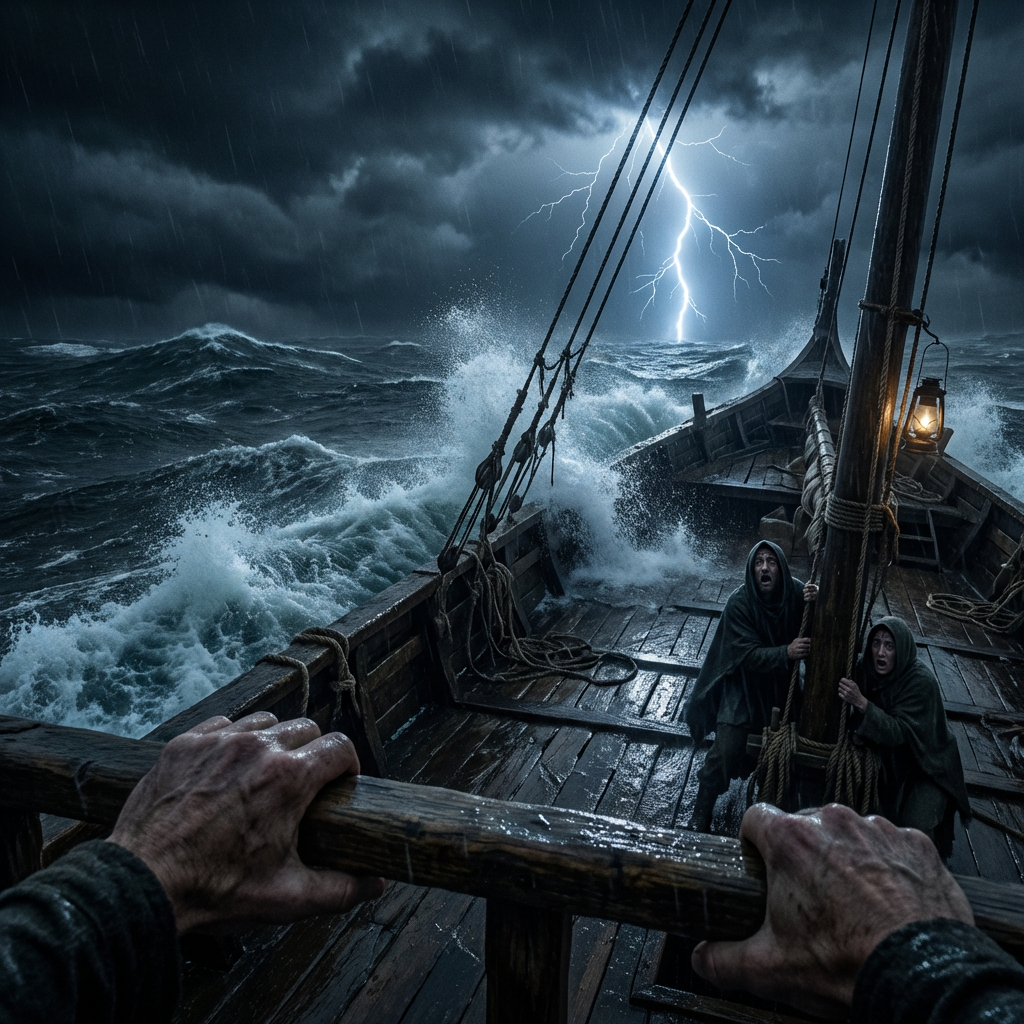
It is somewhere between three and six in the morning. The sky offers no comfort — no moon, no stars visible through the storm. Just darkness pressing down on darker water. You are miles from shore, and the shore itself has disappeared completely into the night behind you. There is no landmark. No light. No reference point to tell you how far you’ve come or how far you still have to go. There is only the wind — and it is against you.
Your hands are raw — not sore, raw — the kind of pain that starts as a burn and settles into something deeper, something that makes you grip the oar differently because the skin has given up protesting and gone numb. Your shoulders stopped aching an hour ago. Now they just feel wrong, like something that was meant to move freely has been pulled past its limit and left there. Your back is a dull, constant fire. Every muscle in your arms is shaking with the particular exhaustion that comes not from one hard moment but from hour after hour of the same impossible effort with nothing to show for it.
You pull the oar. The boat moves. The wind hits. The boat stops.
You pull again. Harder this time. Leaning into it with weight you’re not sure you have left. The wood bites into your palms and you feel it in your teeth. The boat lurches forward — inches, maybe — and then the wind comes back like it was waiting for you, like it is personal, like it has decided that you will not reach the other side tonight.
The spray hits your face and it is cold in the way that dark water is always cold — not refreshing, not bracing, just relentless. Your clothes are heavy with it. Your eyes are stinging. You can’t see the shore you left and you can’t see the shore you’re heading toward. There is nothing in any direction but black water and black sky and the sound of wind that doesn’t care how hard you’re trying.
Scripture calls it making headway painfully — and that word painfully is doing real work here. This is not inconvenience. This is not difficulty. This is the specific, demoralizing exhaustion of a person who has given everything they have to move forward and is still, somehow, barely moving. Of effort that disappears into resistance without a trace. Of fighting with your whole body and your whole will and looking up to find that the distance hasn’t changed.
And the worst part — the part that breaks something quiet inside you — is that you don’t know how much longer you can keep going. And you don’t know if it matters.
And you are doing it in the dark. Alone.
There is a loneliness that lives in the middle of a struggle that no one can see.
Not the loneliness of being in an empty room — that’s manageable. This is the loneliness of being in the middle of something hard, in the dark, with no certainty that anyone knows where you are or what it’s costing you. The disciples weren’t alone in the boat — there were several of them — and yet every person reading this knows exactly the feeling this scene is describing. Because we have all been there. Straining against something that won’t yield. Going in a direction that feels right but is brutally difficult. Surrounded by people who are just as overwhelmed as we are. Far from shore. In the dark. Wondering if anyone sees.
That is not a metaphor. That is Tuesday morning. That is the middle of a season that has gone on longer than you thought you could endure. That is the marriage that is taking everything you have. The job that is grinding you down. The illness that doesn’t resolve. The calling that feels like it’s moving backward. The prayer that seems to dissolve into silence the moment it leaves your lips.
The darkness is real. The wind is real. The loneliness is real.
But here is what we must not skip past: Jesus told them to get in that boat.
He sent them ahead. He had a plan. They were not out of His will — they were in the middle of it. And yet somewhere between the shore and the middle of the sea, something shifted. Jesus went to pray. They went to row. And without His tangible presence in the boat with them, the wind became louder than His last word to them. The distance became more real than His authority. The storm became the dominant reality — and they forgot, not theologically but experientially, that they belonged to Someone who ruled over every wave beneath them.
This is the part of the passage that should make us uncomfortably honest.
These were not strangers. These were His disciples — men who had walked with Him, eaten with Him, watched Him heal lepers and cast out demons and feed thousands with nearly nothing. They knew Jesus. And yet there they are, in the dark, on the water, straining with everything they had, completely alone — and when He actually shows up, they don’t recognize Him. They think He’s a ghost.
That is not a failure of knowledge. That is a failure of presence.
There is a difference between knowing Jesus and having Jesus present with you in the storm. And that gap — the space between theology and lived communion — is exactly where so many believers find themselves exhausted and losing ground. We know the doctrine. We’ve read the Word. We’ve seen Him provide before. But in the grinding middle of the hard season, we are rowing on our own strength, in our own wisdom, toward a destination we can no longer see — and we’ve been doing it long enough that we’ve stopped expecting Him to show up. We’ve normalized the struggle. We’ve accepted the wind as just the way things are.
And when He comes, we almost miss Him.
That is what a hardened heart looks like in practice. It isn’t outright rebellion. It’s the slow drift that happens when we are busy doing — even doing things He told us to do — without staying connected to His presence. The disciples weren’t being disobedient. They were being industrious. They were rowing hard toward the right destination. But industriousness without intimacy will always leave you straining in the dark, wondering why the wind won’t stop.
How much of your life right now is effort without presence? How much of your straining is you in the boat, doing the right things, heading the right direction — but without Him actually in the boat with you?
And Jesus saw them.
Sit with that before you move past it.
He is on land. They are miles out to sea. It is the fourth watch of the night — the darkest stretch, the hours when human endurance is at its lowest and hope is hardest to hold. There are no lights on that water. No way for human eyes to distinguish a struggling boat from the black surface of the sea. And yet Scripture says without qualification or explanation: He saw that they were making headway painfully.
He saw them. In the dark. In the storm. In the distance. Through conditions that should have made them invisible to anyone standing on shore.
This is not incidental. This is the entire passage in one sentence. The God who created light looked through the darkness and found them. The God who made the sea read its surface like a map and located twelve exhausted men who had no idea they were being watched. He saw not just that they were out there — He saw how they were out there. He saw the pain of it. He saw the fight in it. He saw the wind that was against them and the distance they still had to cover and the toll it was taking.
He sees you that way. Right now. In whatever darkness you are navigating. In whatever storm has swallowed the landmarks and left you straining and alone. Before you’ve found the words to pray it, before you’ve had the courage to admit how hard it is — He already sees it. All of it. In detail that would undo you if you understood it fully.
You are not invisible. You are not forgotten. You are not too far out for Him to find.
And here is the grace that should break you open: even when your drift is the reason you feel alone, even when the hardness of your own heart has created the distance — He still sees you. He still comes. He does not wait for you to row back to shore and get yourself together before He moves toward you. He walks out to where you are, over the very water that is defeating you, and He comes to you in the dark.
And then He comes.
Not in a boat. Not along the shore calling out to them. He comes walking on the water. Moving across the surface of the very thing that is threatening to swallow them. What holds dominion over ordinary men simply holds Him up. The storm that is their enemy is His pavement. The waves that are fighting them are not even a consideration to Him. He walks on what would sink you — and He walks on it toward you.
Imagine looking up from your oar in that moment. Eyes burning. Arms failing. Heart somewhere between fear and despair. And you see a figure moving across the water in the dark. Not struggling. Not sinking. Walking. Calm. Coming closer.
The disciples cried out in terror. That response makes complete human sense. Nothing in their experience had a category for this. Their minds reached for the only explanation available — a ghost — because the truth was too large to immediately receive. And this is important: even men who had walked with Jesus, who had watched Him heal the sick and feed thousands, were not prepared for this version of Him. They had seen His authority on land. They had not yet understood that His authority has no borders.
He is Lord on the mountain and Lord on the sea. He rules over the crowd on the shore and the storm in the deep. There is no terrain, no territory, no darkness thick enough to define the outer edge of His jurisdiction. What He commands on dry ground He commands on open water. The same voice that dismissed the crowd dismissed the wind — and both obeyed. His power does not diminish when you move from the familiar to the frightening. His authority does not weaken when the water gets deep.
And then He speaks.
Take heart. It is I. Do not be afraid.
Three commands. One identity. He doesn’t explain the storm or apologize for the timing. He simply reveals Himself — because He knows that His presence is the answer they actually need. Not a strategy for the wind. Not a better rowing technique. Him. Present. Speaking. Moving toward them.
But notice what happens next — or more precisely, what doesn’t happen immediately.
They don’t welcome Him. They don’t reach out a hand and pull Him into the boat. They are still terrified. Still processing. Still caught between what their eyes are seeing and what their hearts are able to receive. Jesus has already identified Himself. He is standing right there — the answer to every painful hour of that night — and they are still locked in fear, still slow to trust, still delayed in the very obedience that would end their suffering.
And all the while, the wind is still blowing.
This is one of the most searingly honest moments in all of Scripture. The storm doesn’t pause out of courtesy while they sort out their fear. The waves don’t settle while they process their doubt. The answer is present and the struggle continues — not because Jesus isn’t there, but because they haven’t fully received Him yet. Their delayed trust is costing them. Every moment they spend in astonishment rather than surrender is another moment in the wind.
How often do we live right here — in that gap between His appearing and our receiving? He has already spoken. He has already identified Himself. He is already present in the situation we have been crying out about — and we are still standing in our fear, still reaching for human explanations, still slow to trust what we are actually seeing and hearing. The breakthrough isn’t waiting on Him. It is waiting on us.
There is also something quietly remarkable in the sequence. He speaks first, and then He gets into the boat. He does not force His way in. He identifies Himself, He commands their fear to leave, and then He waits. Even His authority over the storm is offered, not imposed. He will not override your will to receive Him. He will stand on the water and speak to your fear and wait for you to let Him in.
The question is always the same: How long will you make Him wait?
The moment He stepped in, the wind ceased. Immediately. Not gradually. Not eventually. The instant He was fully received — the instant they stopped resisting and let Him into the boat — it was over. What had been hours of grinding, exhausting, painful effort against an unyielding wind ended in a single moment. Not because the disciples finally found the right rhythm. Not because they rowed harder or smarter or longer. Because Jesus got in the boat.
That is the whole lesson. That is what all the straining in the dark was trying to teach them — that there is no version of the storm they can out-row. There is only surrender to the One who walks on it.
Mark closes this passage with something that should make us honest: they did not understand about the loaves, but their hearts were hardened. They had seen Him multiply bread for thousands that same day. And still, when He walked on water, they were utterly astounded. The miracles were real — but a heart that has drifted, that has grown callous through effort without communion, struggles to connect what Jesus did yesterday to who He is today. It is slow to recognize Him. Slow to trust Him. Slow to receive what He is offering even when He is standing right there offering it.
The disciples’ problem was not lack of evidence. It was a heart that had been slowly hardened by doing without abiding. By straining without surrendering. By rowing without resting in who He was.
And that is the most searching question this passage leaves with us — not whether we believe in Jesus, but whether we are actually with Him. Whether His presence is the lived reality of our daily life or a theological comfort we reach for only when the storm gets bad enough. And when He does show up — when He speaks into our fear and walks toward us over the very thing we thought would destroy us — how long do we make Him wait outside the boat?
Reflect: Where are you rowing alone right now — doing the right things, heading the right direction, but without His presence in the boat with you? And when He shows up, are you quick to receive Him — or are you still standing in your fear, delayed in the trust that would change everything? What is the wind that keeps blowing while you hesitate?
Pray: Lord, forgive me for the seasons I have rowed without You. For the times I have been busy doing what You told me to do but stopped staying close to You while doing it. I confess that I have let the wind become louder than Your voice and let the darkness convince me I was alone. And I confess that even when You have shown up, I have been slow to receive You — locked in my fear, delayed in my trust, making You wait while the storm continued. I know You. But I want more than knowledge — I want Your presence. Get in the boat. Calm what I cannot calm. And soften my heart enough to recognize You the moment You come — and to reach for You without hesitation. Amen.
Written by
Wes ShinnWes Shinn is a visual storyteller, photojournalist, filmmaker, and minister whose life and calling have been forged in some of the most demanding arenas a creative can inhabit.