Cut the Wick. Get the Oil. Relight the Flame.

Hebrews 12:1
""Therefore, since we are surrounded by such a great cloud of witnesses, let us throw off everything that hinders and the sin that so easily entangles, and let us run with perseverance the race marked out for us." "
Fan into flame the gift of God that is in you. Don't wait until you feel like a bonfire to act like you believe the fire is coming.
The Image
Close your eyes for a moment and picture it.
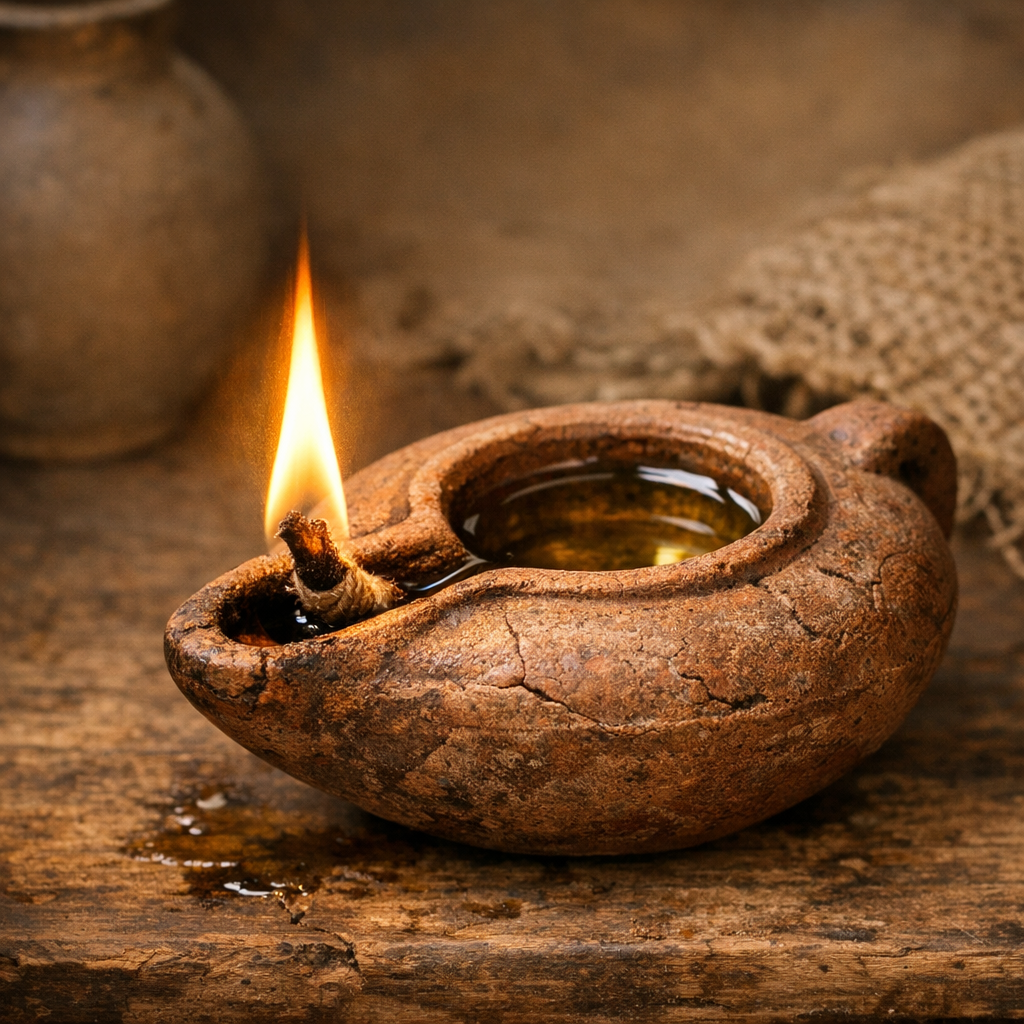
A small oil lamp sitting on a wooden table. The clay is cool and smooth to the touch, worn from years of being carried from room to room. The reservoir is deep — built to hold more than enough. But the flame above it is struggling. It flickers and gasps, throwing uneven shadows across the wall. The light that once filled the room now barely reaches the edges. And the smell — that faint, acrid trace of something burned — tells you exactly what the problem is before you even look closely.
The wick.
Run your finger along it and you'll feel it — the top is hard and crusted, blackened from the last time it burned. It's not drawing oil the way it should. The channel that once pulled fuel upward has become clogged with its own history, its own spent residue. The lamp isn't broken. The oil hasn't run out. But something in between — the thin, humble thread that was meant to be the bridge between the two — has become an obstacle instead of a conduit.
The remedy isn't dramatic. You don't throw out the lamp. You don't start over from scratch. You take a small pair of scissors, trim away the dead portion with a clean, deliberate snip, pour fresh oil until the reservoir is full and the scent of it rises warm and rich into the air, and then you bring a single flame close — and you watch the lamp come back to life.
God spoke to you in the language of a lamp keeper. He's been speaking that language for a long time, through ancient temples and olive groves and oil-stained hands that tended flames through the night. And now He's speaking it over your life, your calling, your season.
These three instructions — cut, get, relight — are not complicated. But they are costly. They require your honest attention. And they begin with the hardest one.
Cut the Wick — Surrender What's Been Burned
"Therefore, since we are surrounded by such a great cloud of witnesses, let us throw off everything that hinders and the sin that so easily entangles, and let us run with perseverance the race marked out for us." — Hebrews 12:1
The scissors feel cold in your hand.
That's the thing nobody tells you about pruning — it isn't always painful in the dramatic, obvious sense. Sometimes it's just cold. Clinical. Uncomfortably precise. God doesn't always come at us with the swell of music and the warmth of emotion when He asks us to let something go. Sometimes He simply places the scissors in our hands and waits, quietly, while we work up the courage to use them.
Here is what makes the cutting hard: the charred portion of a wick was not always charred. It was once clean and white and full of purpose. It was once the very part that held the flame. It has already given something — it has already burned in service, already been consumed in the light it was meant to produce. And there is something in us that wants to honor that. Something that says, "This carried fire once. I can't just cut it away."
But the lamp keeper knows better. The burned portion, left in place, doesn't honor the fire it once held — it chokes the new flame trying to rise from below. What was once the channel becomes the blockage. What was once the servant of the light becomes, through no fault of its own, the enemy of it.
Think about what that means for your life right now.
There are things you are carrying — seasons that ended but you haven't officially closed, roles that were genuine and fruitful but whose time has passed, wounds that hardened into scar tissue that now sits like a cap over the place where God wants fresh fire to emerge. You haven't been stubborn about holding onto them out of laziness or rebellion. You've held on because they meant something. Because they cost something. Because somewhere underneath it all you're afraid that releasing them means the sacrifice they required was wasted.
It wasn't wasted. It burned. It gave light. And now God, the most precise of lamp keepers, is reaching for the scissors — not to punish what you've carried, but to make room for what He still wants to ignite.
The cut, when it comes, is clean. One deliberate motion. And what falls away is not your value or your history or your calling — it is only the spent, blackened portion that was never meant to stay forever.
Reflect: What has God been asking you to release that you've been calling "faithfulness" but may actually be resistance? Where is the charred portion in your life right now — the thing that used to carry fire but has now become the obstacle between you and fresh flame?
Get the Oil — Return to the Source
"Then the disciples came to him and asked, 'Why couldn't we drive it out?' He replied, 'This kind can only come out by prayer and fasting.'" — Matthew 17:19–21
"Is anyone among you sick? Let them call the elders of the church to pray over them and anoint them with oil in the name of the Lord." — James 5:14
"Your love is more delightful than wine… more fragrant than any spice. Your name is like perfume poured out." — Song of Solomon 1:2–3
Feel the weight of the flask in your hand.
Oil is heavy for its size. Dense. Substantial. When you pour it, it doesn't rush and splash like water — it moves slowly, deliberately, coating everything it touches with a richness that water simply cannot replicate. It clings. It saturates. It doesn't evaporate quickly or blow away in the wind. When olive oil was poured over a priest's head in the ancient world, it ran down through his hair, into his beard, soaking into the fabric of his garments — visible, fragrant proof that something had happened, that someone had been set apart, that the presence of God had marked this person for purpose.
That is what you are going back for. Not a quick splash. A soaking.
Scripture uses oil almost everywhere as the symbol of the Holy Spirit — His presence moving over dry and thirsty ground, His anointing saturating what was once hollow and brittle, His filling turning ordinary vessels into sources of warmth and light. And here is the thing about oil that the parable of the ten virgins in Matthew 25 makes searingly clear: you cannot borrow it, you cannot manufacture it, and you absolutely cannot assume that last season's supply will carry you through this one.
The five wise virgins had oil in their lamps and extra in their flasks because they had taken the time to go and get it. They had done the unglamorous, unspectacular work of preparation — of going to the place where oil could be obtained and standing there long enough to fill their containers. The five foolish ones didn't lack desire. They had lamps. They showed up. But when the bridegroom was delayed and the night grew long and cold, they had nothing left to pour.
Getting the oil is not a complicated instruction, but in practice it is profoundly countercultural. It means choosing to be still in a world that rewards constant motion. It means going to prayer not when you feel spiritual, but especially when you don't — when your hands feel empty and your words feel thin and the distance between you and God feels like a physical thing you could press your palm against. It means returning to the Word not for content you can use but for the contact that changes you. It means fasting from the noise long enough to remember what quiet sounds like. It means sitting in the presence of God until you feel the warmth of Him begin to move in places that had gone cold.
This is not about guilt. You know what this feels like — the early morning stillness, the weight of a hand held, the moment in prayer when something in your chest releases and you realize you had been holding your breath for days. You know the difference between going through motions and actually pressing in. The oil doesn't flow in the rush of performance. It flows in the lean of surrender.
Go get it. Take the flask. Stand at the source for as long as it takes to fill.
Reflect: Where have you been trying to operate on residual anointing — running on what God poured into you in a previous season — instead of seeking fresh oil for this one? What specific practice, when you're honest with yourself, is the place where you most reliably encounter the presence of God? When did you last go there not for productivity, but simply to be filled?
Relight the Flame — Trust the Fire to God
"For this reason I remind you to fan into flame the gift of God, which is in you through the laying on of my hands. For the Spirit God gave us does not make us timid, but gives us power, love and self-discipline." — 2 Timothy 1:6–7
"He will not crush a bruised reed or snuff out a smoldering wick, till he leads justice to victory." — Isaiah 42:3 / Matthew 12:20
Hold out your hand and feel the warmth of a lit match — that brief, bright flicker balanced on a thin wooden stem. It seems almost ridiculous, doesn't it? Such a small thing. Such a vulnerable, temporary light. One breath too strong and it's gone.
And yet.
That is what you bring to the wick. That is all you bring. You don't need to manufacture the blaze — you just need to bring the small flame close enough to let the oil do what oil was made to do.
This is the step that requires the most faith, because by the time you reach it, you've already done the vulnerable work. You've made the cut — and maybe it still stings. You've gone for the oil — and maybe you came back from that place feeling more aware of your emptiness than your fullness, the way a clean vessel always feels emptier than a cluttered one. And now you're standing here, holding what feels like a very small flame over a wick that hasn't burned in a long time, and something in you is afraid.
Afraid it won't catch. Afraid the season of dimness has gone on too long. Afraid that the version of you that burned brightly was younger, less complicated, less worn — and that you can't get back to it.
But read Isaiah 42:3 again slowly, with your hands open. He will not crush a bruised reed. He will not snuff out a smoldering wick. That word smoldering — in the Hebrew it carries the image of something faint, something that has been reduced almost to nothing, something that is barely there. And God looks at that nearly-gone flicker and His response is not disappointment. His response is protection. He guards it. He cups His hands around it against the wind. He does not extinguish it — He tends it, until it can burn again in full.
You may feel like you've been down to a smolder. Maybe the calling still feels real but the fire has felt far away. Maybe the dreams are still present but distant, like a light seen through fog rather than held in your hand. Maybe you've been ministering, working, showing up — but feeling hollow behind the eyes, going through the rhythms without the resonance.
A smolder is not death. A smolder is an invitation.
Paul's instruction to Timothy was not to create flame but to fan what was already there — to take action toward something God had already deposited. The gift was already in him. The laying on of hands had already happened. The anointing was real. But it needed attention. It needed someone willing to lean in close, cup the ember with their breath, and fan it deliberately until the glow spread into something larger than itself.
Fan into flame the gift of God that is in you. Don't wait until you feel like a bonfire to act like you believe the fire is coming. You trim in faith. You fill in faith. And then, with the quietest, most determined kind of courage, you bring the flame close — and you trust. Trust the One who called you to burn. Trust that He hasn't changed His mind about you. Trust that the oil He provided will catch, that the wick He prepared will draw it upward, that the light He designed you to carry will fill the room again.
Strike the match. Bring it close. And watch.
Reflect: In what area of your life, your calling, your marriage, your ministry — has God been whispering "this isn't finished, bring the flame back"? What would it look like to stop waiting for the feeling and take one act of faith toward the fire this week?
Closing Prayer
Father, I come to You with the scissors in one hand and the flask in the other, and I'm asking You to steady both.
Show me what needs to be cut — not what I've decided to release on my own terms, but what You, in Your precision and mercy, are asking me to let fall away. Give me the courage to make the cut cleanly, without mourning what was spent in Your service, trusting that You honor what has already burned.
Fill me again. Pour out Your Spirit over the dry and empty places — the reservoirs I've been pretending weren't low, the channels I've been trying to run on memory and habit instead of fresh anointing. Let me feel the weight of it. Let it saturate what has gone brittle. Let it run down into the places I've kept hidden and make them fragrant again.
And then, Lord — relight what You started. I am bringing You what feels like a very small flame. But You are the God who spoke fire from nothing, who descended in tongues of flame at Pentecost, who keeps the smoldering wick from going out. Fan it. Tend it. Let it catch.
I trust You. I trust that what You began in me, You have not abandoned. That the calling You breathed over my life still stands. That the oil is sufficient. That the wick is ready.
Relight the flame. Amen.
Going Deeper
Matthew 5:14–16 — "You are the light of the world… let your light shine before others."
Psalm 18:28 — "You, Lord, keep my lamp burning; my God turns my darkness into light."
Zechariah 4:6 — "Not by might, nor by power, but by my Spirit, says the Lord Almighty."
John 15:4–5 — "Remain in me, as I also remain in you. No branch can bear fruit by itself; it must remain in the vine."
Exodus 27:20–21 — "Command the Israelites to bring you clear oil of pressed olives for the light so that the lamps may be kept burning." The priests tended the flame every single morning and evening — renewal was never a one-time event, but a daily, faithful returning.
Written by
Wes ShinnWes Shinn is a visual storyteller, photojournalist, filmmaker, and minister whose life and calling have been forged in some of the most demanding arenas a creative can inhabit.