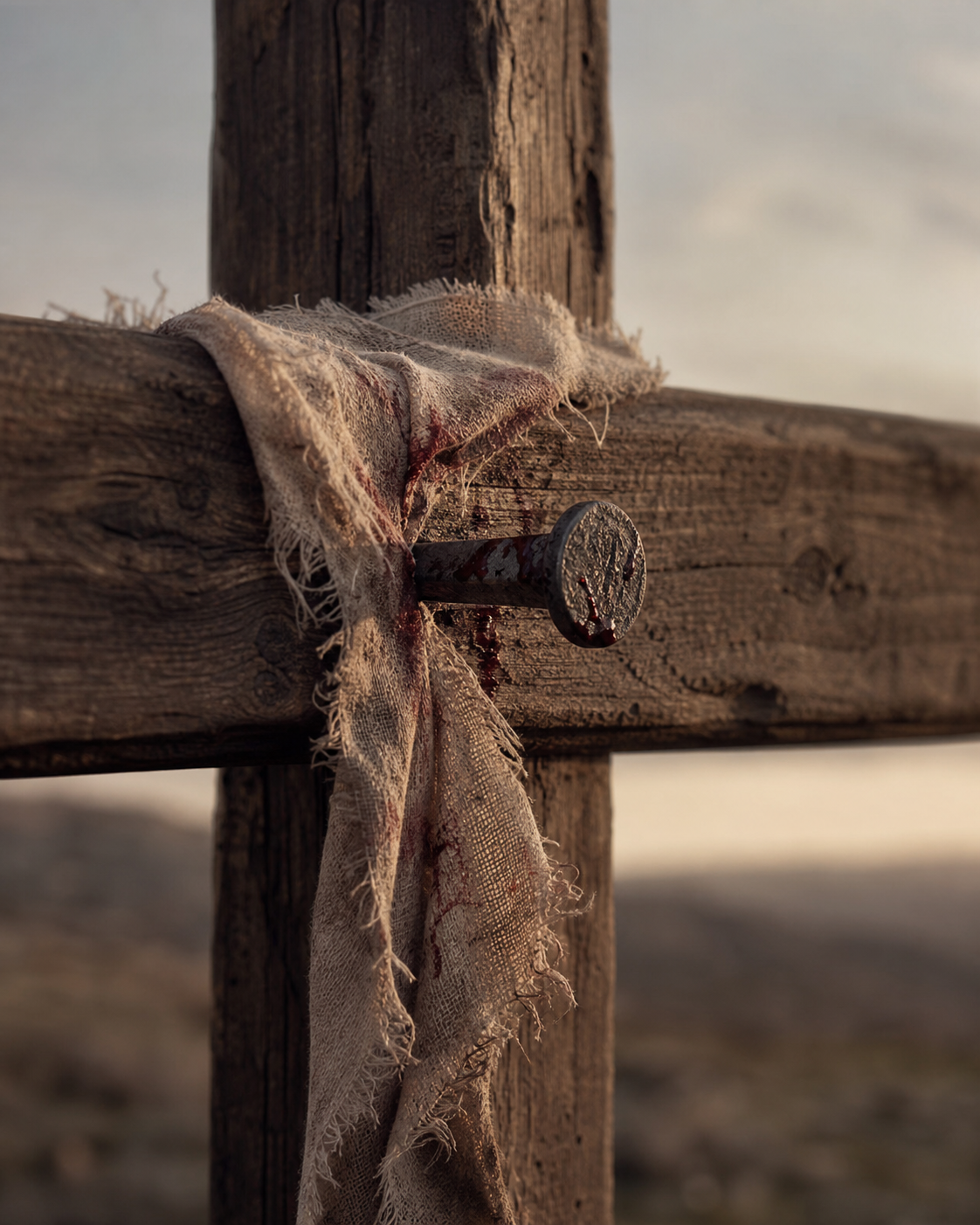
The Cycle Breaker
Luke 22:62
"And he went out and wept bitterly."
A Devotional on Peter, the Wound That Drives Us,
and the God Who Interrupts the Pattern
— BEFORE WE BEGIN: THE THING NOBODY NAMES —
There is a pattern that runs through human lives like a seam through stone.
It does not announce itself. It does not ask permission. It simply runs — beneath the surface of your decisions, beneath the architecture of your relationships, beneath your spiritual life and your ambitions and your failures and your recoveries. It runs so deep and for so long that most people never identify it as a pattern at all. They just think: this is who I am. This is what happens to people like me.
The pattern usually begins with a wound. Something that happened in a place or a family or a season that handed you a verdict about yourself before you were old enough to argue with it. A verdict that said, "You are not enough." You are too much. You are in the wrong place. You carry the wrong name. You are not the kind of person for whom great things are written.
And then — because the human soul was made for more than smallness — you begin to fight the verdict. You overcompensate. You promise more than you can deliver. You volunteer first. You perform the loudest. You make the boldest claim in the room, because the boldest claim is the one farthest from the verdict you are trying to outrun. And for a season, it works. You feel the distance growing between you and that original wound. You feel the name you've built for yourself settling into place.
And then pressure comes. Real pressure. The kind that strips performance down to what lies beneath. And underneath it, in the place where the wound still lives, you collapse. And in collapsing, you return to the old behavior, the old identity, the old life, the old name. The cycle completes itself. And the verdict feels proven.
This is not a modern psychological insight. It is a biblical story. And its main character is a fisherman from Galilee named Simon, who was renamed Peter, and who — before he became the rock the church was built on — lived this cycle so completely and so publicly that it was recorded in four separate Gospels and has been read by billions of people for two thousand years.
Because the point was never just Peter's story. The point was yours.
— PART ONE: THE PLACE THAT SHAPED THE MAN —
To understand Peter's cycle, you have to start where the cycle started: not in the upper room, not in the courtyard, not even on the shore of Galilee. You have to start with the cultural wound that was handed to him before he ever met Jesus. Because cycles are not born in a moment of weakness. They are born in a place. In history. In the accumulating weight of a world that has already decided what you are.
Galilee in the first century was the kind of place that produced an inferiority complex in its people, whether they acknowledged it or not. It was a northern province — occupied by Rome, taxed into subsistence, and looked down upon by the religious establishment in Jerusalem, the way any cosmopolitan center looks down on the rural periphery. The people of Galilee were known for their thick accent, their manual trades, and their distance from the centers of Torah scholarship. They were working people. Fishermen. Farmers. Craftsmen. People whose hands were their primary tool.
The religious and intellectual elite of the day had a term for people like Peter. They called them am ha-aretz. It is a Hebrew phrase that translates literally as "people of the land" — but in the cultural usage of the time, it meant something more cutting than that. It meant: common. Unlearned. Below the threshold of serious consideration. The am ha-aretz were the people who had not studied, had not been selected by a rabbi to follow, had not been deemed worthy of the investment of theological formation. They were the remainder — the people left behind when the gifted ones moved on to something greater.
Peter grew up inside that designation. Not necessarily named by it daily, but shaped by it the way water shapes stone — slowly, continuously, invisibly. Every Pharisee who moved through the market without acknowledging the fishermen. Every Jerusalem scholar whose accent marked him as educated, significant, worth listening to — in contrast to the Galilean drawl that marked Peter as precisely the opposite. Every system, every structure, every unspoken social grammar of his world said the same thing in a hundred different ways:
You are not the kind of person for whom great things are written.
And here is the thing about that kind of wound — the kind that is not delivered in a single blow but accumulated over years of small dismissals: it does not produce passivity in every person. In some people — in people wired the way Peter was wired, people with fire in them and a hunger that ordinary life cannot satisfy — it produces the opposite. It produces a man who overreaches. Who volunteers before anyone else? Who needs to be first, to be loudest, to be the most committed person in the room.
Not because he is arrogant. Because he is afraid. Afraid that if he is not spectacular, the verdict will be confirmed. Afraid that the am ha-aretz label will prove true. Afraid that ordinary is all he will ever be — and he has been ordinary his whole life and it has been suffocating.
Cycles do not begin with character flaws. They begin with wounds that produce survival strategies. And survival strategies, left unhealed, become the very patterns that destroy us.
Bethsaida — the village where Peter was born — carries a particular irony in this story. The name means "house of fishing" or "house of the hunter." It was a fishing village. It was, by name and by nature, a place defined by its trade. You were from the house of fishing. That was the ceiling. That was the inheritance. That was what you were expected to remain.
And then Nathanael — a man from a different part of the region — would later say of nearby Nazareth: "Can anything good come out of Nazareth?" He said it as a throwaway remark, the kind of casual regional dismissal people make when they have absorbed the cultural hierarchy so thoroughly they don't even notice they're reproducing it. And it tells us everything about how the whole area was perceived. Not just one town. The whole region. The whole people. A place from which good things did not come.
Peter knew that verdict intimately. It was the water he swam in. It was the air he breathed. It was the thing he had been fighting his whole life without having a name for the fight.
— PART TWO: THE NAME THAT BROKE THE CEILING —
When Jesus walked along the shore of the Sea of Galilee and called to Simon and Andrew, He was not simply recruiting disciples. He was reaching into the middle of a generational cycle and doing something that no amount of ambition or willpower had ever been able to do: He was speaking from outside the system that had produced the wound.
The Pharisees and scribes operated within the system. A rabbi who selected disciples chose from the best students — the ones who had already proven themselves through years of Torah study. The selection process itself was an affirmation of what the system valued. You were chosen because you had already demonstrated that you were extraordinary within the existing hierarchy.
Jesus chose none of those people. He walked past the academies and the synagogues and the scholarship and went to the shoreline — to the am ha-aretz, to the people of the land, to the fishermen who had already been passed over by every other rabbi — and He said: Follow me.
“And he said to them, “Follow me, and I will make you fishers of men.””— Matthew 4:19
I will make you. Not: you already are. Not: you have proven yourself worthy of this. I will make you. The transformation is My project, not your achievement. The calling precedes the qualification. The invitation comes before the evidence.
And then — in one of the quietest, most seismic moments in the Gospels — Jesus looked at Simon for the first time and said:
“You are Simon the son of John. You shall be called Cephas.”— John 1:42
You are Simon. I see exactly who you are. I see the accent, the trade, the father's name, the village. I see the am ha-aretz designation and the Galilean stigma and the man who has been told his whole life that he is from the wrong place. I see all of it.
You shall be called Peter. Rock.
In the Hebrew tradition, a name was not a label. It was a declaration of nature, of destiny, of divine intention. When God changed Abram's name to Abraham — father of nations — He spoke it before Abraham had a single heir. When He changed Jacob's name to Israel — one who wrestles with God — He spoke it in the middle of a night of wrestling, when Jacob was broken and alone and had nothing left to prove himself with. The pattern is consistent throughout Scripture: God renames people not after the transformation is complete but at the beginning of it. Not as a reward but as a seed. Not as a description of what is but as a declaration of what will be.
For Simon, the fisherman from Bethsaida, the am ha-aretz from the region from which nothing good was supposed to come — this renaming was not just a spiritual transaction. It was the first time in his life that someone with authority had looked directly at him, seen the full weight of where he was from, and said: that is not the final word about you.
Feel the power of that. And feel the danger of it.
Because a wound this deep, and a naming this large, creates an enormous internal pressure. Peter now carried something that the culture around him had never affirmed and his own history had never prepared him for. He had a new name. But he still had the old wound underneath it. And the old wound had not been healed — it had been covered by the calling. And those are not the same thing.
A calling placed over an unhealed wound does not heal the wound. It pressurizes it. The larger the calling, the more the wound strains beneath it — until something forces the fracture open.
This is the architecture of Peter's coming collapse. It was not a failure of love. His love for Jesus was real, fierce, and genuine. It was not a failure of faith — the man walked on water. It was the failure of a man who had taken the new name and run hard on it, building his entire identity on the distance between Peter-the-rock and Simon-the-fisherman — without ever letting Jesus reach all the way down into the place where the wound actually lived.
— PART THREE: THE CYCLE IN MOTION —
Watch the pattern move through Peter's three years with Jesus and you will see it clearly — the reaching, the overextension, the fracture, the return. Over and over, in smaller cycles, before the large one came.
On the water: Peter was the one who stepped out of the boat. Not reckless — love-driven. When he heard that it was Jesus walking on the sea, he could not bear to remain in the boat while Jesus was out there. He asked permission — "Lord, if it is you, command me to come" — and then he did the impossible. He walked on water toward the man who had renamed him.
And then he looked at the wind. He shifted his attention from Jesus to the circumstances threatening him. And he sank.
“O you of little faith, why did you doubt?”— Matthew 14:31
Cycle, in miniature: reach toward Jesus with everything, encounter a threat, return to the default self, require rescue. Jesus caught him. Of course He did. But Peter returned to the boat still carrying both the memory of walking on water and the memory of sinking — and he had not yet been given the tools to know which one was more true about him.
On the mountain: Peter witnessed the Transfiguration — Jesus blazing white, Moses and Elijah present, the voice of God breaking through the cloud. And Peter's immediate response was to build something. Three shelters. One for Jesus, one for Moses, one for Elijah. He wanted to construct a monument to the moment. To contain it. To make it permanent and manageable.
The man who had always been told he was from a place where nothing significant was built — when he finally witnessed something transcendent, his instinct was to build. To produce. To do something that would mark him as part of what he had just experienced. The wound speaking, even on the holy mountain.
At Caesarea Philippi: Jesus asked His disciples who they believed Him to be. And Peter answered — not after deliberation, not after consulting with the others — immediately, completely, with total confidence:
“You are the Christ, the Son of the living God.”— Matthew 16:16
Jesus told him that this was a revelation from heaven. That on this rock — this confession, this Peter — He would build His church. That the gates of hell would not prevail against it. That He would give Peter the keys of the kingdom.
And then, moments later — the same conversation, the same chapter — Jesus began to explain that He must suffer and die. And Peter pulled Him aside and rebuked Him. The man who had just received the keys of the kingdom tried to correct the King.
“Get behind me, Satan! You are a hindrance to me.”— Matthew 16:23
From "you are the rock" to "get behind me, Satan" in less than ten verses. Because Peter's confession was real, but it was not yet rooted deep enough to hold the weight of a suffering Messiah. The moment Jesus' path threatened Peter's idea of what the calling was supposed to look like — the wound activated. A suffering Christ meant a suffering Peter. And Peter had not followed Jesus to return to smallness. He had followed Jesus to finally, permanently escape it.
The cycle again: reach, overextend, fracture, retreat.
By the time they arrived at the Last Supper, Peter had lived this pattern enough times that it was deeply grooved into him. And so when Jesus said: tonight, all of you will fall away — Peter's response was completely predictable. It was the response of a man who had built his entire identity on the distance between his new name and his old wound. He could not afford to fall away. Falling away would mean the wound was right. Falling away would mean Galilee was right. Falling away would mean the am ha-aretz verdict had been accurate all along.
“Even if all are made to stumble because of You, I will never be made to stumble.”— Matthew 26:33
Even if all. He drew the line. He separated himself from the possibility. Because the alternative — accepting that he was capable of this — was more than the wound could survive. The over-promise was not arrogance. It was a man in the grip of a cycle, making the same move he had always made when the verdict threatened to catch up with him: he reached further out, promised more, staked more, separated himself from the limitation by the force of his own declaration.
Jesus looked at him and said: before the rooster crows, you will deny me three times.
And Peter pushed harder. Louder. Even if I must die with You, I will not deny You. And all the disciples said the same.
Twelve men. Twelve promises. Twelve cycles waiting to complete.
— PART FOUR: THE GARDEN — ASLEEP AT THE ROOT —
After the supper they walked to the Garden of Gethsemane. And Jesus — the Son of God, the one who had stilled storms and raised the dead — fell on His face and asked the Father if there was another way. He was in such anguish that Luke tells us His sweat fell like drops of blood.
He asked His three closest disciples — Peter, James, and John — to stay awake. To watch. To hold vigil with Him in the hours before everything. It was not a complicated request. Stay awake. Be present. Pray.
They fell asleep. Three times. Jesus came back from His agonized prayer three times and found them sleeping.
Three times asleep in the garden. Three times denying in the courtyard. The number was already doing something — already rehearsing a pattern that would find its fullest expression before the night was over. The garden was not separate from the denial. It was the first act of it. Peter could not sustain presence in the place of prayer, so he would not be able to sustain presence in the place of pressure.
This is where the wound shows itself most quietly: not in the loud moments of overconfidence, but in the inability to be still. The man who grew up in a culture of productivity, of labor, of proving value through output — this man did not know how to sit in the dark and pray. He knew how to swing a sword. He knew how to step out of a boat. He knew how to make a declaration. But the slow, unseeable, unproductive work of intercession — of simply staying present with Jesus in His suffering — that was the discipline the wound had never allowed him to develop.
Because the wound always needed to be doing something. The wound needed to be building shelters on the mountain, swinging swords in the garden, making declarations at supper tables. Stillness felt too much like the smallness. Too much like the fisherman. Too much like the man who had not yet done enough to deserve the name.
“The spirit indeed is willing, but the flesh is weak.”— Matthew 26:41
When the soldiers came — torches and swords and Judas at the front — Peter woke up swinging. He cut off the ear of the high priest's servant. One last act of spectacular performance. One last attempt to be the man who died rather than denied.
Jesus healed the ear. Put it back. Reached out in the moment of His own arrest and repaired the wound Peter's impulse had caused. And then they led Jesus away. And Peter followed — at a distance.
At a distance. Those three words are the sound of the cycle beginning its final rotation. Not gone. Not yet. But the gap was already there. Between the man and his promise. Between Peter and the rock. Between who he said he was and who he was about to prove himself to be.
— PART FIVE: THE COURTYARD — WHEN THE CYCLE COMPLETED —
Come into this scene. Stay with it.
It is deep night in Jerusalem. Cold enough that the servants and soldiers in the high priest's courtyard have gathered around a charcoal fire — anthrakia in the Greek, the particular word John chooses with the precision of a witness who remembered the smell. Peter slips through the gate and joins the circle. He needs to see what is happening. He is not ready to run. But he is not ready to stand either. He is in the middle place — the worst place — where you are too afraid to be courageous and too loving to be a coward.
He stands near the fire. Warming his hands. Trying to be invisible in a group of people, which is something you can only manage if nobody looks at you.
A servant girl looks at him.
Not a soldier. Not a Pharisee with power to arrest him. A servant girl, doing her job, managing the gate, noticing faces in the firelight. She looks at him and says simply: You also were with Jesus of Galilee.
Of Galilee. She identified him not just as a follower of Jesus but as a Galilean follower of Jesus. She named his origin. She invoked the very marker that the whole culture used to sort people — and she placed him in the category of the overlooked, the regional, the people from the place where good things did not come from.
And Peter — the Rock, the water-walker, the man who swore he would die first — opened his mouth and said:
“I do not know what you mean.”
He moved away from the fire. But you cannot move away from yourself. And so another person came — and then another group — and each time the accusation came with more force. And each time, Peter denied. With an oath. With a curse. Three times.
And then — the detail that breaks everything open — a bystander said: "Certainly you too are one of them, for your accent betrays you."
Your accent betrays you.
The very thing that marked him as am ha-aretz. The Galilean inflection — the vowels, the rhythm, the sounds that a lifetime of Jerusalem education would have smoothed away but that Peter would carry in his mouth forever — that was what gave him away. His origin was audible. You could hear where he was from. You could hear what he had spent his whole life trying to transcend.
And in that moment — the accent exposed, the origin named, the wound laid bare — Peter did not just deny Jesus. He did what the cycle had always moved him toward. He returned to the verdict. He agreed with it. He confirmed it with his own mouth.
I do not know the man.
He didn’t just deny Jesus in that courtyard. He denied the name. He denied the calling. He agreed with everything Galilee had ever said about him. The cycle completed itself in three sentences, at a charcoal fire, while the man who renamed him stood bound inside the same building.
And then the rooster crowed. And Jesus turned and looked at Peter.
“And the Lord turned and looked at Peter.”— Luke 22:61
The text gives us no adjective for the look. No description of what was in His eyes. Because the look did not need to be described. It only needed to be received. And Peter received it — in the chest, in the gut, in the deepest place of him — and he understood that he had just done the thing he swore he would never do.
He went out. Into the night. Into the cold. Into the dark that was now inside him as much as around him.
And he wept bitterly.
Pikros — sharp, cutting, piercing. The weeping that comes from somewhere beneath the ribs and will not be managed. The weeping of a man who has finally, completely, undeniably met himself. And found that the self he met was not the rock. Was not Peter. Was still Simon. Still the fisherman. Still the man from the region from which nothing good was supposed to come.
The wound had been right all along. That was the lie the cycle told him as he wept.
And the lie was so loud, and so convincing, and so perfectly timed that Peter believed it.
— PART SIX: THE FISHING TRIP — WHEN THE CYCLE RESTARTED —
Jesus rose from the dead. The tomb was empty. The angel's message was specific — and the specificity was an act of grace:
“But go, tell his disciples and Peter that he is going before you to Galilee.”— Mark 16:7
And Peter. By name. In the resurrection announcement. As if Jesus, even in the language of the most significant morning in human history, wanted Peter to know: I have not forgotten you. You are still seen. You are still named.
But knowledge and healing are not the same thing. You can know you are still called and feel in your marrow like the calling no longer belongs to you. You can hear that the risen Christ remembered you specifically and still not know how to receive yourself back. The cycle had completed. The verdict felt proven. And no amount of resurrection news can instantly undo the weight of what you did.
So Peter did what people do when the new identity feels too far gone to retrieve. He went back to the old one.
“Simon Peter said to them, “I am going fishing.””— John 21:3
Notice the name the narrator uses at this moment. Not Peter. Simon Peter — both names together, as if the Gospel writer is holding both realities in tension at once. The name Jesus gave him and the name he was born with. The calling and the retreat from it. The rock and the fisherman. The cycle trying to restart, the old self reasserting itself against the new one.
"I am going fishing" is not a casual statement. It is a resignation letter. It is a man who has weighed the evidence of his own life and concluded that the calling was for someone else. That the name Peter was always too large for a man with his particular history. That the safest thing — the most honest thing, the most realistic thing — is to go back to what he was before anyone looked at him and said: you shall be called a rock.
He was going back to Simon. Back to the house of fishing. Back to Bethsaida. Back to the ceiling. Back to the world that had never expected more of him than this.
Six disciples went with him. The leader's retreat becomes the community's retreat. When the person the group looks to says: I'm done, I'm going back — the gravitational pull is immense. Cycles are contagious. Wounds that have not been addressed in the leader find their way into the people who follow.
They fished all night.
Experienced men. The sea they had worked their entire lives. Every technique, every pattern, every good spot and favorable current — they knew all of it.
They caught nothing.
You can return to the old identity. But the old identity cannot hold you anymore. The nets were made for Simon. And you are not Simon anymore, no matter how convincingly the wound tells you otherwise.
The empty nets were not punishment. They were a mercy. They were God refusing to let the old life become comfortable again. They were the Father saying: the husks of the far country will not satisfy you. You were not built for this anymore. The cycle has nowhere left to take you. You have reached the end of what the wound can produce. There is only one direction left.
Toward the shore.
— PART SEVEN: THE SHORE — WHERE CYCLES END —
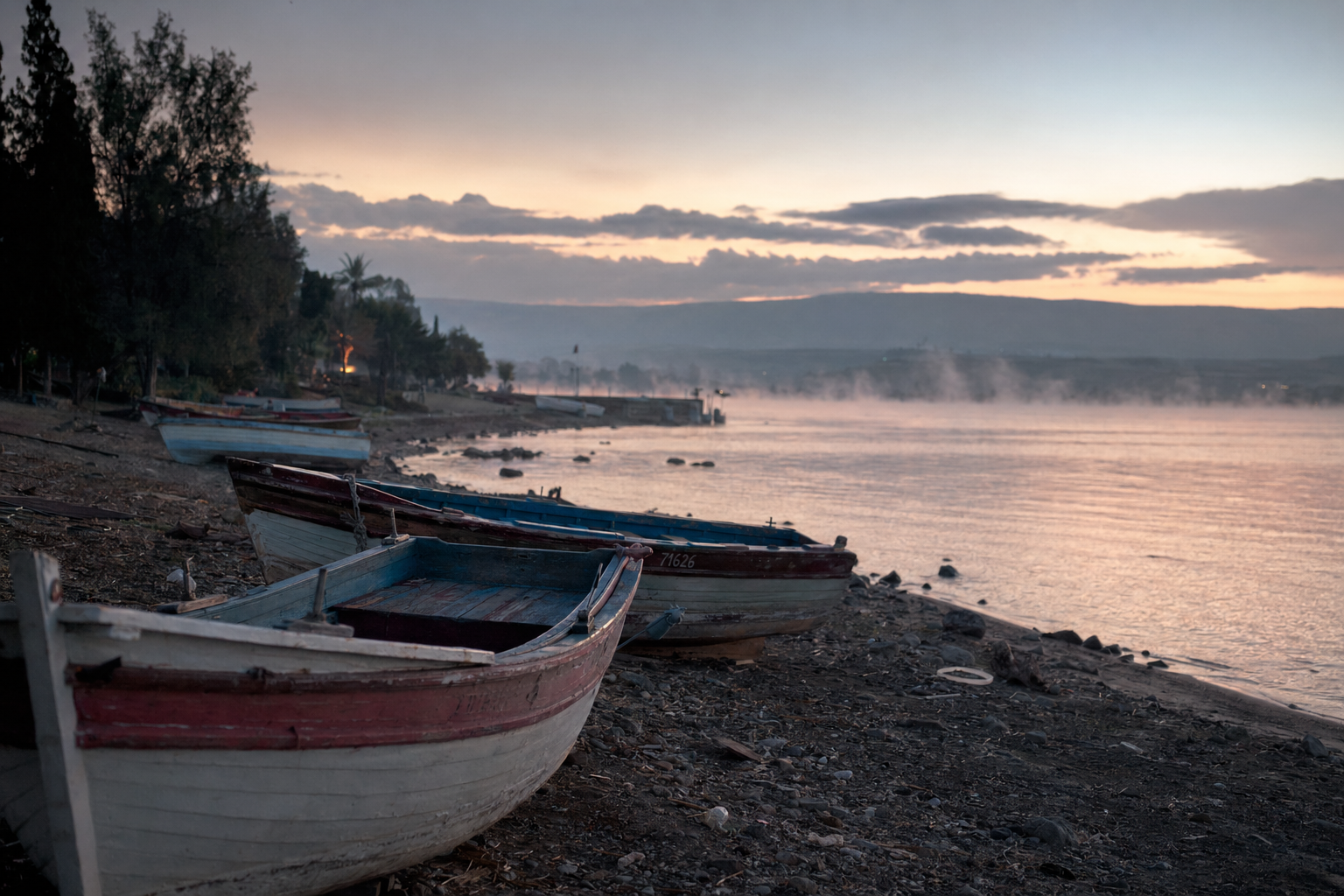
Just as day was breaking — the particular hour when darkness surrenders but has not yet fully released — Jesus stood on the shore.
They did not recognize Him.
Maybe the light was wrong. Maybe exhaustion had dimmed their senses. Or maybe — sit with this — the Jesus who meets you at the end of your cycle looks different than the one you remember from the beginning of it. Not changed. Not diminished. But seen from a different angle. The angle of your empty hands and your aching back and your finished excuses. And sometimes it takes a miracle to recognize the presence that has been standing on the shore of your life the whole time you were trying to make the old patterns work.
He called out. Children — the Greek is paidia, a word of tender address, a word you use for people you love — do you have any fish?
No.
Cast the net on the right side.
They did. And the net filled — one hundred and fifty-three large fish. So full they could not haul it in. And the net, which should have torn under that weight, held. John notes this specifically: the net was not torn. The nets that could not hold them in the old life — the same nets — now held because Jesus was directing the cast.
This is the sign. This is what John understood and recorded: the same nets, the same sea, the same men — but a completely different outcome. Because the cycle was not broken by Peter getting better. It was broken by Jesus showing up. The difference between the fruitless night and the overflowing morning was not Peter's effort or Peter's faith or Peter's performance. It was the presence and direction of Jesus.
“That disciple whom Jesus loved therefore said to Peter, “It is the Lord!””— John 21:7
And Peter — still wearing only the outer garment of a working fisherman, still technically mid-fishing-trip, still mid-retreat, mid-cycle, mid-return-to-the-old-life — tucked up his garment and threw himself into the sea.
A hundred yards of cold water. He did not wait. He did not calculate. He did not first compose himself or resolve the guilt or prepare what he was going to say when he got there. He heard: it is Jesus — and his body was in the water before his mind had formed a complete sentence.
This is the truest thing in Peter's story. Underneath the pattern. Underneath the wound and the over-promising and the denials and the bitter weeping and the fishing trip. Underneath all of it, there was a love that moved faster than shame. A love that could not be fully suppressed even by the most complete cycle of failure Peter had ever lived through.
He swam to Jesus. And Jesus was already there, already kneeling in the sand, already tending a fire.
A charcoal fire.
Anthrakia. The same Greek word. The same word John used to describe the fire in the courtyard where Peter denied Jesus three times. John uses this word only twice in the entire New Testament. Here. And there. The repetition is not accidental. John is a precise writer. He wants you to feel the echo. He wants you to understand that Jesus chose this specific setting — a charcoal fire on a beach in the early morning — because He was going to do something surgically intentional. He was going to go back to the exact location of the wound and rebuild from there.
God does not simply move you past your cycles. He goes back into them with you — all the way to the origin point — and rebuilds from the inside out.
Come and have breakfast.
No lecture. No inventory of failures. No conditional restoration. Breakfast. Bread and fish, prepared by the hands of the risen Christ, offered to the man who had denied Him by the warmth of the same kind of fire where the denial happened.
This is who God is. He is not waiting at the end of the cycle with a clipboard. He is waiting with a fire and food. He is the father who runs while the prodigal is still a long way off. He is the shepherd who does not wait at the fold but goes into the wilderness. He is the woman who lights every lamp in the house and will not stop searching until the lost coin is found.
He is the God who builds breakfast fires for the people whose cycles have just run out of road.
— PART EIGHT: THREE QUESTIONS — THE CYCLE DISMANTLED —
After they had eaten — after the warmth of the fire and the shared meal had settled something in the air between them — Jesus turned to Peter and began to do the most precise and intentional act of restoration in the New Testament.
He asked him a question. Three times.
The number was not incidental. Jesus was not repeating Himself because He didn't hear the answer. He was counting. One for each denial. One for each rotation of the cycle. He was going to walk back through the courtyard, not to reopen the wound, but to replace what happened there with something new. He was performing a spiritual surgery — dismantling the cycle at each of its three joints.
“Simon, son of John, do you love me more than these?”— John 21:15
Simon. Son of John. He called him by his old name. The name from before the calling. The name from Bethsaida. The fisherman's name. The am ha-aretz name.
This was not a demotion. It was a declaration: I am reaching all the way back. Not just to the courtyard. Not just to the Last Supper. All the way back to the beginning of the wound. To the place where the cycle was born. To the cultural verdict and the regional stigma and the years of smallness. I see Simon, son of John. And I am calling even him — that man, from that place, with that history — into what I have always said he would become.
And notice something else: Jesus asked, "Do you love me more than these?" More than these — likely gesturing at the boats, the nets, the sea. More than the fishing life. More than the old identity you just spent the night trying to return to. More than the safety of the cycle. Do you love me more than the thing you retreated to?
Peter answered — and the Greek here carries something the English often flattens. In the first two questions, Jesus uses the word agape. The highest, most self-giving, most unconditional form of love. The love that sacrifices everything. The love Peter had sworn he possessed when he said he would die before denying.
Peter did not respond with agape. He used phileo — the love of deep friendship and affection. The love that is real and genuine but does not make grand claims about its own quality. The love that says: I have nothing to prove. I have no declaration to make. You know what is in me. I give you what I have.
This is one of the most profound moments of spiritual maturity in Peter's entire story. The man who had over-promised his whole life — who had built his identity on the distance between his calling and his wound — is now refusing to over-promise even in the moment of restoration. He is not saying: I love you with the love of a martyr. He is saying: You know everything. You know me better than I know me. What I have in me, whatever it is and whatever it is worth — I give it to you.
On the third question, Jesus descends to Peter's word. He uses phileo. He meets Peter in the more humble place Peter has claimed. And Peter — grieved now, because he understands what the third question means, because the number three is reverberating through him — says it one final time:
“Lord, you know everything; you know that I love you.”— John 21:17
Lord, you know everything. This is the sound of a man who has finally stopped trusting his own self-assessment. The man who swore "I will never deny you" has arrived at the end of self-reliance. He does not say: here is my love, evaluated and certified by me. He says: You look. You assess. You know what is true about me better than I do. I refer the question back to the One who actually knows.
And every time Peter answered — every time the simple, humble, un-overpromised yes came back — Jesus issued a commission. Feed my lambs. Tend my sheep. Feed my sheep.
Three denials replaced with three restorations. Three rotations of the cycle dismantled one by one, at a charcoal fire, with the same warmth and the same smell that had been present at the collapse. The cycle was not erased. It was redeemed. Jesus walked back into the exact architecture of the wound — the number three, the fire, the question of identity, the verdict about who Peter was — and He rebuilt it from the inside.
Redemption is not erasure. Erasure pretends the past did not happen. Redemption takes the actual past — the specific failure, the particular fire, the exact number — and transforms it into the foundation of a new future.
And notice what the commission was. Not a smaller assignment. Not a probationary period. Not: we'll see how you do. Feed my sheep. The same authority, the same responsibility, the same scope — entrusted to the man who had just completed the most spectacular cycle of failure in the Gospels. Jesus was not saying: in spite of what happened, I'll give you another chance. He was saying: because of who you are and what I am doing in you, I am sending you. The wound is no longer the enemy of the calling. Brought to the shore and placed under My authority, the wound becomes part of the message.
— PART NINE: WHAT BROKE THE CYCLE PERMANENTLY —
The cycle did not break because Peter got stronger. It did not break because he tried harder or wept more sincerely or made a better promise. Cycles cannot be broken by the same energy that produced them. A man who over-promises because of a wound cannot out-promise his way to healing. A man who retreats to the old identity under pressure cannot will himself into a new one. The very mechanism of the cycle — the wound driving the performance driving the failure driving the return — cannot be dismantled from inside the cycle.
It requires an interruption from outside.
What broke Peter's cycle was the resurrection of Jesus and the specific, intentional way that Jesus used His resurrection to meet Peter at the bottom of the cycle rather than waiting for him at the top. Jesus did not say: when you are restored, come find me. He said: tell Peter I am going ahead of him to Galilee. He did not wait for Peter to work his way back. He went to where Peter had retreated and stood on the shore and built a fire and waited.
And then, fifty days later, the Holy Spirit fell.
And the thing that had driven every cycle — the wound, the striving, the need to prove, the terror of returning to Simon — was addressed at its root. Because the Holy Spirit is not an external authority requiring performance. The Holy Spirit is the Spirit of adoption — the Spirit that reaches into the deepest place of our formation, the place where the wound first told us who we were, and cries out from that place:
“For you did not receive the spirit of slavery to fall back into fear, but you have received the Spirit of adoption as sons, by whom we cry, “Abba! Father!””— Romans 8:15
The spirit of slavery — the spirit that says: perform, prove, produce, outrun the verdict — that is the spirit that had driven Peter's cycles from the beginning. The am ha-aretz wound had functioned as a spirit of slavery. It had bound him to the cycle. Every rotation of the pattern was another loop of the chain.
The Spirit of adoption does not motivate through fear of returning to smallness. It motivates from the security of belonging. It does not say: you must be the rock or you will be the fisherman again. It says: you are already a son. You already belong. The Father already ran toward you. The breakfast was already prepared. You have nothing to prove and no verdict left to outrun.
And from that place — from the place of secure sonship rather than striving performance — Peter stood up on the Day of Pentecost and did something that the cycle could never have produced.
“But Peter, standing with the eleven, lifted up his voice and addressed them.”— Acts 2:14
The voice that said "I do not know the man" in a whisper beside a courtyard fire — that voice, filled with the Spirit of the living God, lifted up and addressed thousands of people in the city that had crucified Jesus six weeks earlier. The accent that betrayed him — that Galilean inflection, that marker of the am ha-aretz — now carried the words of the kingdom to people from every nation under heaven. The very wound that had driven the cycle became, in the hands of the Spirit, the instrument of the breakthrough.
Three thousand people were saved that morning.
On the first sermon preached by the man who had run the full cycle of over-promise and failure and return — and been met at the bottom by a God who builds fires and cooks breakfast and asks the same question three times until the answer comes back clean.
“And I tell you, you are Peter, and on this rock I will build my church, and the gates of hell shall not prevail against it.”— Matthew 16:18
The gates of hell did not prevail. Not over the church. Not over Peter. Not over the wound. Not over the cycle. Jesus said it before the cycle completed — and it was still true after. The declaration was not conditional on Peter's performance. It was rooted in the character of the One who spoke it.
— A WORD TO YOU — RIGHT NOW —
I want to speak to you directly. Not around you. Not at the general reader somewhere beyond you. To you.
You know your cycle. You may not have called it that. But you know the pattern. The wound that was handed to you early — the verdict from a place, a parent, a church, a failure, a season — and the way you have been running from it ever since. The over-promising that looks like faith but is really fear. The spectacular effort that looks like devotion but is really the sound of a person desperately trying to outpace the thing they are most afraid is true about them.
And you know the courtyard. You know the specific fire you stood beside. You know the question that was asked and the words that came out of your mouth before you could stop them. You know the rooster. You know what followed it.
Maybe the cycle has run more than once. Maybe you've been restored before — really restored, genuinely — and then found yourself, months or years later, back at the same fire with the same question being asked. And that second or third loop of the cycle feels worse than the first, because by now you know better. By now you have experience. By now you have testimony. And still the pattern found you.
Hear this: the repetition of the cycle is not evidence that the restoration wasn't real. It is evidence that cycles this deep require more than a single encounter to fully dismantle. The beach scene with Jesus addressed the courtyard. But the full breaking of the cycle — the permanent interruption of it at its root — came at Pentecost, when the Spirit of adoption replaced the spirit of slavery at the foundation of Peter's identity. It was a process. It happened in stages. And at every stage, Jesus met him where he was.
He will meet you where you are.
You do not have to climb out of the cycle before Jesus shows up. He shows up at the bottom of it. He shows up in the fishing boat. He shows up in the empty nets. He shows up on the shore in the dark with a fire already built.
Your accent will not disqualify you. The place you are from will not disqualify you. The number of times the cycle has run will not disqualify you. The wound that started it will not disqualify you. Because the One who renamed you did it knowing the full history. He named you Peter knowing the courtyard was coming. He built the church on that rock knowing what the rock would do on the worst night of his life.
He is standing on the shore of your life right now. The fire is already burning. The breakfast is already prepared. And He is going to ask you a question — maybe three times, one for each place the cycle touched — and when you answer, He is not going to give you a smaller commission. He is going to give you the full one.
Stop fishing. Swim to the shore.
“For you did not receive the spirit of slavery to fall back into fear, but you have received the Spirit of adoption as sons, by whom we cry, “Abba! Father!””— Romans 8:15
You are not the verdict. You are not the wound. You are not the cycle.
You are a son. You are a daughter. You are named by the One who stands outside the system that produced the wound and speaks from the end of the story into the middle of your worst night.
And what He speaks cannot be un-spoken by a rooster, or a servant girl, or an accent, or a fishing trip, or the accumulated weight of every cycle you have ever run.
He speaks and it stands.
A Prayer for the End of the Cycle
Father —
I know my cycle. I know where it started. I know the wound, and the verdict that came with it, and the way I have been running from that verdict in one form or another for most of my life. I know the over-promising. I know the swinging of swords in gardens when I should have been praying. I know the courtyard. I know the fire. I know exactly what I said, and to whom, and how many times the rooster crowed.
I confess that I went back to the nets. That when the new identity felt too broken to carry, I folded it up and set it aside and went back to what was familiar. I confess the fishing trip — not just this one, but every one. Every time the cycle ran its full rotation and deposited me back at the beginning, back at Simon, back at the house of fishing, back at the ceiling I thought You had removed.
But I hear You on the shore. I hear You calling: children, do you have any fish? And my answer is no. My answer has been no for a long time. And I am done pretending otherwise.
I am throwing myself into the water. Not because I have resolved the guilt or composed the right words or earned the right to approach. But because the love in me that is actually Yours — the love You placed there before the cycle ever started, the love that survived the courtyard and the bitter weeping and the fishing trip — that love moves faster than my shame. And it is moving now.
Ask me the question. As many times as You need to. I will answer it from the humble place, the honest place — not with the love of a martyr who swears he will never fail, but with the love of a child who has run out of alternatives and knows that You know everything anyway. You know what is in me. What is in me, I give You.
Break the cycle at its root. Not just the most recent rotation — the root. The wound that started it. The verdict I absorbed before I was old enough to argue with it. The spirit of slavery that told me I had to perform or be forgotten, had to prove or be overlooked, had to be spectacular or be Simon again.
Replace it with the Spirit of adoption. Let the cry of Abba rise from the place where the wound used to live. Let the security of sonship do what no amount of over-promising ever could — give me a foundation that the next courtyard cannot shake.
Feed Your sheep through me. Use the scar. Use the accent. Use the cycle itself as part of the message — because a voice that has been through the courtyard and come back carries something that an untested voice cannot carry. Let the very place I fell become the place from which I speak most truly.
I am not going back to the nets.
In the name of Jesus — who stood on the shore, who built the fire, who asked the question three times, who gave back the commission in full —
Amen.
The Adopted Son
Rooted in Romans 8:15
Written by
Wes ShinnWes Shinn is a visual storyteller, photojournalist, filmmaker, and minister whose life and calling have been forged in some of the most demanding arenas a creative can inhabit.