FINISHED.
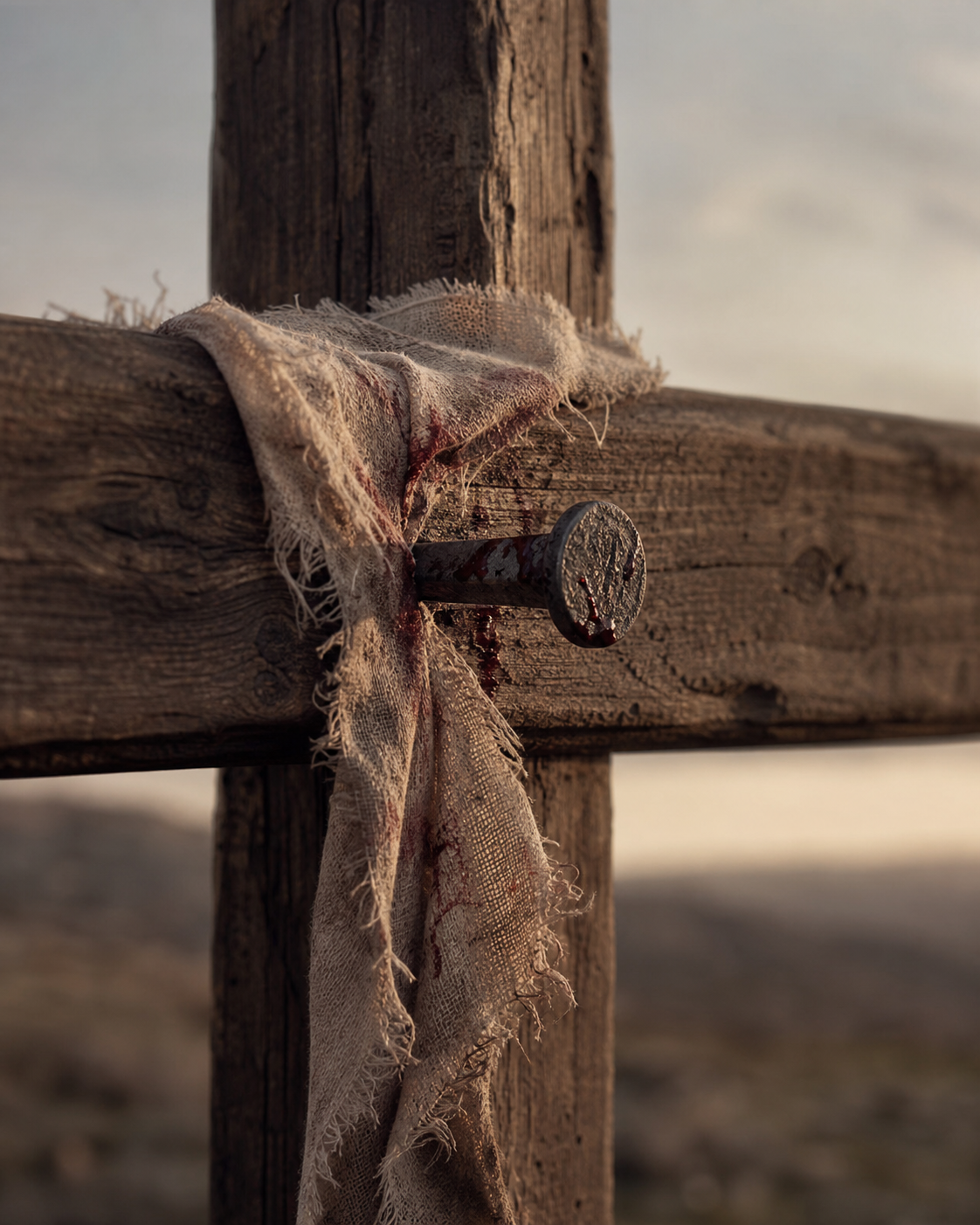
Isaiah 53:5
"He was pierced for our transgressions; he was crushed for our iniquities; the punishment that brought us peace was on him, and by his wounds we are healed."
What the Cross Actually Cost
A Devotional by The Adopted Son
We say it casually. We print it on T-shirts. We hang it on walls. We wear it around our necks in gold.
The cross.
But somewhere between the Sunday school flannel boards and the stadium worship services, we have lost something. We have sanitized the most violent, sacred, cosmos-altering event in human history into a symbol we barely pause to consider.
This is an invitation to pause. To actually look. To see what was happening on that hill outside Jerusalem — not through stained glass, but through splinters and iron and agony and glory.
Because if you understand what actually happened on the cross, you will never be the same.
The cross was not a tragedy. It was a transaction — and you were the purchase.
THE ROAD BEFORE THE HILL: What Was Already in Motion
Before a single nail was driven, before the hammer fell, something had already been set in motion that stretched back thousands of years. The cross was not improvised. It was prophesied, prepared, and precise.
The prophet Isaiah, writing over 700 years before Christ walked the earth, recorded words that read less like prophecy and more like a crime scene report:
"He was pierced for our transgressions, he was crushed for our iniquities; the punishment that brought us peace was on him, and by his wounds we are healed." — Isaiah 53:5
The Hebrew word for "crushed" here is דָּכָא (daka) — it means to be pulverized, ground into powder, utterly demolished. Isaiah was not writing poetry. He was writing a preview.
King David, a thousand years before Jesus, wrote Psalm 22 — and if you read it slowly, it is one of the most terrifying and breathtaking chapters in the entire Bible:
"My God, my God, why have you forsaken me? ... I am a worm and not a man, scorned by everyone, despised by the people. All who see me mock me; they hurl insults, shaking their heads ... they divide my clothes among them and cast lots for my garment." — Psalm 22:1, 6-7, 18
David wrote those words while alive. He never experienced crucifixion. Crucifixion hadn't even been invented yet. And yet — every detail he recorded maps with surgical precision onto what would happen at Golgotha ten centuries later.
When God writes history in advance, He doesn't approximate. He is exact.
The Passover lamb — slaughtered in Egypt, its blood painted on doorposts so the angel of death would pass over — was always pointing to this moment. The lamb had to be without blemish (Exodus 12:5). The lamb's bones could not be broken (Exodus 12:46). When the soldiers came to break the legs of the crucified men to hasten their deaths, they found Jesus already gone. John records it plainly:
"But when they came to Jesus and found that he was already dead, they did not break his legs ... These things happened so that the scripture would be fulfilled: 'Not one of his bones will be broken.'" — John 19:33, 36
The lamb. The blood. The doorpost. The cross. One continuous, unbroken line of divine design.
THE GARDEN AND THE ARREST: The Weight Before the Wood
It begins in a garden. It is not coincidental that the first catastrophic failure of humanity also happened in a garden — Eden. And it is not coincidental that the reversal of that failure began in one too.
Gethsemane. The name means "oil press." It is a place where olives are crushed to release what is inside them.
Jesus went there knowing what was coming. He had known since before the foundations of the world. But knowing something is coming and experiencing its approach are two different things. Luke records something that most comfortable readings of this story skip past:
"And being in anguish, he prayed more earnestly, and his sweat was like drops of blood falling to the ground." — Luke 22:44
This is not metaphor. Medical literature documents a condition called hematidrosis — a physiological response to extreme psychological stress so severe that capillaries beneath the skin burst, releasing blood that mingles with sweat and seeps through the pores. Jesus was under a weight so crushing that His body was already beginning to bleed before anyone touched Him.
What was He carrying? The answer is not just the anticipation of pain. Jesus was staring into something far worse: the moment when the Father would turn His face away. The moment when He — who had never known a single second apart from perfect communion with the Father — would take upon Himself the full sum of every sin ever committed by every human being who would ever live, and feel the weight of divine wrath pressed down upon Him like an oil press on an olive.
He wasn't just afraid of the nails. He was staring into the abyss of our sin — and He chose to fall in.
When Judas arrived with the mob — soldiers, chief priests, elders, lanterns, torches, weapons — Jesus did not run. He stepped forward. "Who is it you want?" He asked. "Jesus of Nazareth," they replied. And John records that when Jesus said "I am he," they drew back and fell to the ground (John 18:6).
The Greek there is simply "ἐγώ εἰμι" — "I AM." The same words God used from the burning bush. His own name, spoken in a garden in the dark, and the mob collapsed. He had to let them take Him. He did not lose a fight. He surrendered a victory.
THE SCOURGING: Before the Cross, the Lash
Roman flogging was not like a modern whipping. It was an instrument of near-death, calibrated to bring a man to the edge of dying without pushing him over — because the real punishment was still ahead.
The flagellum was a short wooden handle with multiple leather straps attached. Embedded into those straps were pieces of bone, metal balls, and jagged sheep bone — designed to tear through skin, muscle, and fat. Jewish law limited flogging to 39 lashes. Roman law had no such limit.
Historians and physicians who have studied Roman flogging describe what would have happened to Jesus: by the time it was done, the back would have been reduced to ribbons. Muscle would have been exposed. In some cases, ribs were visible. The victim would have lost significant blood. Some died from the flogging alone.
Isaiah had already described it: "Just as there were many who were appalled at him — his appearance was so disfigured beyond that of any human being and his form marred beyond human likeness" (Isaiah 52:14). The word "marred" in Hebrew means ruined, distorted, unrecognizable.
They dressed Him in a purple robe and pressed a crown of thorns into His skull — a mockery of kingship that was also a fulfillment of Genesis 3:18, where God cursed the ground after the fall: "It will produce thorns and thistles for you." The very symbol of the curse was now pressed into the brow of the One who came to reverse it.
They struck Him. They spat on Him. They mocked Him as a fake king. And He bore it. Not because He was powerless. Because we were the ones who were.
The thorns on His head were our curse, made physical. He wore our condemnation like a crown.
THE ROAD TO GOLGOTHA: A Man Who Could Barely Walk
They made Him carry His own cross.
Or they tried to. The crossbeam alone — what Roman soldiers called the patibulum — weighed between 75 and 125 pounds. Jesus had been awake all night. He had sweat blood in a garden. He had been flogged to the edge of death. He had been beaten, mocked, and spat upon.
And He fell.
The Gospels tell us Simon of Cyrene was pulled from the crowd and compelled to carry the cross. What the Gospels don't editorialize — but what history makes clear — is that this was not a rescue. A man condemned to crucifixion carrying his own cross was part of the ritual of public humiliation. The fact that Jesus could not carry it tells us the physical state He was already in.
The road from the Praetorium to Golgotha was approximately a third of a mile through crowded, narrow streets. Jerusalem was packed with Passover pilgrims. They watched. Some wept. Jesus turned to the women mourning for Him and said something remarkable:
"'Daughters of Jerusalem, do not weep for me; weep for yourselves and for your children.'" — Luke 23:28
Even in this moment — bleeding, stumbling, dying — He was thinking about them. He was a shepherd even on His way to slaughter.
THE NAILS: What Iron Through Flesh Actually Means
They offered Him wine mixed with myrrh — a mild analgesic, an act of mercy common to crucifixions. Matthew records that Jesus refused it (Matthew 27:34). He would face this fully conscious. He would not numb it.
They stretched His arms out and drove nails through His wrists.
Not His palms. Medieval art got this wrong. Nails through the palms tear through soft tissue under body weight and the hands slide free. Roman crucifixion nails — large, iron, tapered spikes roughly five to seven inches long — were driven through the wrist, between the radius and ulna, where the skeletal structure could hold a man's weight.
As the nail passed through, it would have severed or compressed the median nerve — one of the primary nerves of the hand. The sensation that results is not merely pain. Physicians describe it as one of the most intense pain experiences the human body can produce: an electric, burning, crushing agony that radiated up the arms with every movement.
Then the feet. A single nail, driven through the ankles or the metatarsals, fixing the feet to the upright post.
And then they raised Him up.
Every breath He drew on that cross was a choice. He could have stopped. He did not stop.
Here is something that is rarely spoken plainly: crucifixion is death by suffocation. When a man hangs by his arms, the position of the body makes it nearly impossible to exhale. The chest locks. To breathe, a crucified man must push up on his nailed feet, lift himself, and inhale — then slowly sink back down. Then do it again. Every breath was paid for with the full weight of His body pressing down on nails.
This is why breaking the legs was a mercy kill. Without legs to push up on, a man suffocated in minutes. The Gospels tell us Jesus was on the cross for approximately six hours. For six hours, He chose to keep breathing.
He chose each breath. He paid for each breath. And He used those breaths — those blood-bought, agony-purchased breaths — to speak.
THE SEVEN WORDS: What He Said From the Cross
Jesus spoke seven times from the cross. Not seven outbursts. Seven deliberate, intentional words — each one a window into what was actually happening in the spiritual realm while the physical horror played out on the surface.
"Father, forgive them, for they do not know what they are doing." — Luke 23:34
This is the first word from the cross, and it should arrest us completely. The nails are freshly driven. The soldiers are gambling for His clothing at His feet. The crowd is jeering. And His first utterance is not a curse. It is an intercession.
He is praying for His executioners. He is fulfilling Isaiah 53:12 in real time: "he bore the sin of many, and made intercession for the transgressors." The ink was still wet on that scroll. He was living it out while He died.
The word "forgive" in Greek is ἄφες (aphes) — release, let go, send away. He was asking the Father to release them from the debt their hands were incurring in this moment. This is the character of God. Not a God who waits for us to clean up and come to Him. A God who, while we are still driving the nails, is asking the Father to pardon us.
He prayed for the men holding the hammer while the hammer was still falling.
"Today you will be with me in paradise." — Luke 23:43
Two criminals flanked Him — one on either side. One mocked Him. The other rebuked the first, and then, hanging on his own cross, dying for crimes he admitted he committed, turned and said simply: "Jesus, remember me when you come into your kingdom" (Luke 23:42).
He did not say a sinner's prayer. He did not get baptized. He could not do anything. He was nailed to a cross. All he had was a last breath and a desperate, honest plea — and Jesus received it as enough.
"Today." Not eventually. Not after purgatory. Not after you get it together. Today, in paradise, with Me.
This is the first soul saved after the cross was raised. And he had nothing to offer but his need.
"Woman, here is your son ... Here is your mother." — John 19:26-27
Mary stood at the foot of the cross. Simeon had told her thirty-three years earlier that "a sword will pierce your own soul too" (Luke 2:35). She was watching the fulfillment of that prophecy in real time.
And Jesus — despite everything — looked down and made sure she would be cared for. He entrusted her to John, the beloved disciple. Even in His dying, He was a son. Even from the cross, He honored His mother.
The love of Jesus does not take a day off, even on the day it costs Him everything.
"My God, my God, why have you forsaken me?" — Matthew 27:46
This is the moment theology trembles.
Jesus quoted the opening of Psalm 22 directly. He was not misquoting or confused. He was announcing, to anyone with ears to hear, that what was written in that Psalm was being fulfilled in that moment.
But He was also experiencing what He was quoting. The Father's face turned away. The fellowship that had existed from before creation — Father, Son, Spirit in unbroken communion — was disrupted. Why? Because in that moment, Jesus bore in His body the totality of human sin, and God cannot look upon sin.
The One who had never been without the Father was made sin for us. 2 Corinthians 5:21 is precise: "God made him who had no sin to be sin for us, so that in him we might become the righteousness of God."
He became sin. Not sinful. Sin itself. The substance, the weight, the full repository of human transgression — past, present, future — was placed upon Him, and the wrath of God that sin justly deserves was poured out on Him in full.
He was forsaken so that you would never have to be.
"I am thirsty." — John 19:28
John tells us this was said "so that Scripture would be fulfilled." The Psalm again — Psalm 22:15: "my mouth is dried up like a potsherd; and thou hast brought me into the dust of death." And Psalm 69:21: "They put gall in my food and gave me vinegar for my thirst."
A sponge soaked in vinegar was lifted to His lips. It is almost too simple. The One who turned water to wine at Cana, who said "whoever drinks the water I give them will never thirst" (John 4:14) — He thirsted. He entered fully into our human frailty so that our frailty could be fully redeemed.
"It is finished." — John 19:30
The Greek word is τετέλεσται (tetelestai). It is a single word in the original language — a word that appears on ancient papyri receipts discovered by archaeologists, stamped across accounts that had been paid in full.
"Paid in full."
This was not a defeated man gasping his last. This was a declaration. A legal pronouncement. The debt of sin — the full weight of every human transgression from Adam to the last person who will ever live — was not partially paid, not put on a payment plan, not waiting on something else. It was finished. Done. Complete. Nothing to add.
Tetelestai. Paid in full. Your debt has been cancelled. The receipt is signed in blood.
"Father, into your hands I commit my spirit." — Luke 23:46
This is another quotation from Psalm 31:5 — a psalm of trust. In the Jewish tradition, this was a bedtime prayer. Parents taught their children to recite it at night before sleep. "Into your hands I commit my spirit" — it was the last prayer a child said before closing their eyes.
Jesus died like a child going to sleep. Not in defeat. In trust.
The seventh word. The final breath. Not taken from Him — given by Him. John 10:18 says clearly: "No one takes it from me, but I lay it down of my own accord."
He did not die because He ran out of strength. He died because He decided He was done.
THE BLOOD: Why It Matters That It Was Shed
We sing about the blood of Jesus constantly. But do we know what we are singing about?
The entire sacrificial system of the Old Testament was built on one terrifying truth: the wages of sin is death, and without the shedding of blood, there is no remission of sin (Hebrews 9:22, Leviticus 17:11). Blood represented life. To pour out blood was to offer a life in exchange.
The problem was that animal blood was never sufficient. Hebrews 10:4 says plainly: "it is impossible for the blood of bulls and goats to take away sins." Every lamb, every goat, every dove laid on the altar was a symbol pointing forward — a deposit, an IOU, a placeholder.
They were all pointing to one blood. One life. The life of the only Person in history who was simultaneously fully God and fully human — and therefore the only One whose life could satisfy the debt owed by all humanity, and the only One whose divine nature meant that sacrifice was of infinite worth.
When the Roman soldier drove a spear into the side of Jesus after His death, John records something medically fascinating: "blood and water came out" (John 19:34). Physicians recognize this as a sign of pericardial effusion — fluid had collected around the heart, likely from the physical trauma. It confirms that Jesus did not merely appear to die. He was clinically dead. His heart had given out.
The blood of Jesus accomplished what thousands of years of animal sacrifice could not:
"But now he has appeared once for all at the culmination of the ages to do away with sin by the sacrifice of himself." — Hebrews 9:26
It satisfied the wrath of God. It purchased our redemption. It established a new covenant. It opened the way into the Most Holy Place. It speaks a better word than the blood of Abel (Hebrews 12:24) — not crying out for vengeance, but crying out: mercy.
The blood of Abel cried for justice. The blood of Jesus cried for mercy. And mercy won.
THE WATCHERS: What the People Around the Cross Were Doing — and What It Means
Look at who was there. The people who surrounded the cross are not incidental background characters. They are a mirror.
The religious leaders stood below Him and sneered: "He saved others; let him save himself if he is God's Messiah, the Chosen One" (Luke 23:35). They intended it as mockery. But they were accidentally speaking the most profound theological truth of the day: He could not save Himself and save us at the same time. He chose us.
The soldiers gambled for His clothing (Psalm 22:18 — fulfilled). They offered him sour wine (Psalm 69:21 — fulfilled). They drove the nails (Zechariah 12:10 — "they will look on me, the one they have pierced" — fulfilled). Unwitting participants in the most choreographed divine event in history.
The crowd passing by "hurled insults at him, shaking their heads" (Matthew 27:39) — fulfilling Psalm 22:7 exactly. People who had never read Isaiah or David were, in their contempt, embodying prophecy.
The women — Mary His mother, Mary Magdalene, Salome, the other Mary — stood and watched. They did not run. In a culture where public association with a condemned criminal was dangerous, they stood there. They watched. They loved Him to the end, and they would be the first to the tomb. The last at the cross, the first at the resurrection.
The women who refused to leave the cross were the first to see the empty tomb. Faithfulness to the cross always leads to the resurrection.
And somewhere in that crowd — probably watching from a distance, probably not fully understanding — were the disciples. Peter had already denied Him three times. Judas had already taken his own life. Thomas would later demand proof. Philip had asked to "just show us the Father" the night before.
These are our people. These are the ones Jesus was dying for.
Not the polished, not the prepared, not the theological elite. The afraid. The doubting. The denying. The impulsive. The ordinary.
THE CURTAIN: The Moment Heaven Opened
At the moment of Jesus' death, Matthew records something that would have been incomprehensible to any Jew watching:
"And when Jesus had cried out again in a loud voice, he gave up his spirit. At that moment the curtain of the temple was torn in two from top to bottom." — Matthew 27:50-51
The curtain. To understand this, you need to know what it separated.
The Temple in Jerusalem was divided into courts, moving from the outer court of the Gentiles inward to the Most Holy Place — the Holy of Holies. The curtain separated the outer Holy Place from the inner sanctuary where the presence of God dwelled. It was approximately 60 feet tall, 30 feet wide, and four inches thick. Historians say it was so thick and heavy that horses attached to each side could not tear it apart.
Only one person could enter the Holy of Holies: the High Priest, and only once a year, on Yom Kippur — the Day of Atonement. He entered with blood. He entered with bells on his robe so that those outside could hear he was still moving. He entered with a rope tied to his ankle so that, if God struck him dead, they could pull his body out without entering themselves.
The barrier between God and humanity was not symbolic. It was devastating. Real. Enforced by death.
When Jesus died, the curtain tore. From top to bottom — not bottom to top. God tore it. From heaven's side, He ripped the barrier open. The way into His presence, which had been closed since Eden, was not just cracked open. It was abolished.
God tore the curtain from top to bottom. You didn't have to fight your way in — He tore the wall down from the inside.
"Therefore, brothers and sisters, since we have confidence to enter the Most Holy Place by the blood of Jesus, by a new and living way opened for us through the curtain, that is, his body ... let us draw near to God with a sincere heart and with the full assurance that faith brings." — Hebrews 10:19-20, 22
The curtain is gone. You are no longer standing outside the presence of God. You have been given full access — not because you earned it, not because you are worthy, but because the price of entry was paid in blood and the barrier was torn by grace.
THE EARTHQUAKE, THE DARKNESS, THE DEAD: Creation Responding to Its Creator
The cross did not happen in isolation. Matthew records that from the sixth to the ninth hour — noon to 3 PM — darkness fell over all the land (Matthew 27:45). This was not a solar eclipse; Passover is always a full moon, when eclipses are impossible. This was creation itself going dark in response to what was happening.
The Roman historian Phlegon, referenced by early church fathers, recorded an unusual darkness and earthquake around this period. The darkness was noticed beyond Jerusalem.
And then the earthquake:
"The earth shook, the rocks split and the tombs broke open. The bodies of many holy people who had died were raised to life. They came out of the tombs after Jesus' resurrection and went into the holy city and appeared to many people." — Matthew 27:51-53
The resurrection power that would fully manifest on Sunday morning leaked through at the moment of His death. Even the graves could not stay shut in the presence of His dying. Death could not hold its captives at Golgotha — and in three days, it would not hold Him either.
The Roman centurion who had overseen the execution — a hardened military man, a witness to countless deaths — looked at all of this and said: "Surely this was the Son of God" (Matthew 27:54).
A pagan Roman soldier became the first Gentile voice in the Gospels to confess Jesus as the Son of God. The cross did not just save Jewish believers. It was always — always — for the whole world.
The man who supervised His execution became a witness to His identity. The cross makes confessors of the most unlikely souls.
WHAT IT MEANS FOR YOU: The Personal Weight of the Cross
We have walked through the history, the prophecy, the physiology, and the theology. Now we must get personal. Because the cross was not a historical event to be studied from a comfortable distance. It was a transaction made on your behalf.
Think about this: Paul writes in Galatians 3:13 that "Christ redeemed us from the curse of the law by becoming a curse for us, for it is written: 'Cursed is everyone who is hung on a pole.'" The Law demanded death for sin. Jesus stepped between us and that demand. He absorbed the curse.
Every broken thing in your life — the shame you carry, the sin that keeps resurfacing, the sense that you are too far gone, too familiar with failure, too known in your worst moments — all of it was placed on Him. Not theoretically. Not as a category. Your specific sin. Your specific shame. Your specific name was on the weight He carried into that Garden and up that hill.
"He himself bore our sins in his body on the cross, so that we might die to sins and live for righteousness; by his wounds you have been healed." — 1 Peter 2:24
"By his wounds." The Greek word for "wounds" is μώλωψ (molopsi) — it specifically refers to the raised, bruised welt left by a whip. Peter was not speaking abstractly. He was pointing to specific marks on a specific body — and saying that those marks have healing power over specific places in you.
His wounds are not ancient history. They are still speaking. And what they say is: you are healed.
The cross tells you who you are. You are not a mistake that God is tolerating. You are not a project God is barely managing. You are the reason the Son of God entered human flesh, walked through the worst that humanity could do to a man, and stayed on that cross with the power to step off it at any moment.
You are worth the cross. Not because of anything in you — but because of everything in Him, and the unfathomable love He has fixed on you from before the foundation of the world.
"For God so loved the world that he gave his one and only Son, that whoever believes in him shall not perish but have eternal life." — John 3:16
"Gave." The word in Greek is ἔδωκεν (edoken) — it is the language of gift. A gift given freely. Not reluctantly. Not with conditions buried in fine print. Not as an exchange. A gift.
The cross is God's gift to you.
God did not send a memo. He sent His Son. And His Son did not send a representative. He went Himself.
THE RESURRECTION LENS: The Cross Without Sunday Is Incomplete
We must not leave the story on Friday.
Paul writes in 1 Corinthians 15:17: "If Christ has not been raised, your faith is futile; you are still in your sins." The resurrection is not the coda to the cross — it is the validation of it. The proof that the payment was accepted. The Father's receipt.
On the third day, Jesus rose. Not metaphorically. Physically. The tomb was empty. The grave clothes were folded. The stone was rolled away — not to let Jesus out (He was already gone) but to let witnesses in.
Because the cross does not end with death. It ends with a rolled stone and an empty room and a man who appeared to over 500 people (1 Corinthians 15:6) and told His friends: "Peace be with you" (John 20:19).
The One who was pierced is alive. The One who was forsaken was found. The One who said "it is finished" had only finished the dying. The living is eternal.
And because He lives, Hebrews 7:25 tells us something that should change how you start every single day: "He is able to save completely those who come to God through him, because he always lives to intercede for them."
He is not a memory. He is not a symbol. He is alive — and right now, He is speaking your name to the Father.
THE POWER OF THE CROSS: What It Actually Does in Your Life Today
Here is what we cannot afford to miss: the cross is not only something that happened. It is something that works. Right now. In you. There is power in the cross — not metaphorical power, not inspirational power, but the actual, present-tense power of God released into human lives. Paul said it plainly:
"For the message of the cross is foolishness to those who are perishing, but to us who are being saved it is the power of God." — 1 Corinthians 1:18
The Greek word for "power" there is δύναμις (dynamis) — the same root we get "dynamite" from. The cross is not a relic. It is a detonation. And that explosive power touches four specific places in a person's life: healing, deliverance, restoration, and redemption. Let's walk through what each one actually looks like when it's lived out, not just believed.
HEALING — For the Body, the Mind, and the Wound No One Sees
"By his wounds you have been healed." — 1 Peter 2:24
This is not a promise reserved for the afterlife. Healing through the cross is present tense, and it operates on three levels.
Physical healing: the same authority that raised Jesus from death still moves in bodies today. James 5:14-15 instructs the church to pray over the sick, anointing with oil, "and the prayer offered in faith will make the sick person well." This doesn't mean every prayer ends the way we want — but it means we pray expecting God to move, not as a formality.
Emotional and psychological healing: the cross addresses trauma, anxiety, depression, and grief — not by pretending they don't exist, but by placing them inside the wounds of a Savior who experienced abandonment, betrayal, physical agony, and the silence of God. He does not heal from a distance. He heals from inside the wound with you.
Practically, this means: when you bring your therapy, your medication, your hard conversations, your grief counseling to the foot of the cross, you are not doing something separate from your faith. You are doing the very thing the cross makes possible — bringing the broken places into the presence of the One who was broken for you.
The cross doesn't ask you to pretend you're not wounded. It meets you in the wound and starts there.
DELIVERANCE — Breaking What Has Had a Grip on You
"Since the children have flesh and blood, he too shared in their humanity so that by his death he might break the power of him who holds the power of death — that is, the devil — and free those who all their lives were held in slavery by their fear of death." — Hebrews 2:14-15
Colossians 2:15 says that on the cross, Jesus "disarmed the powers and authorities" and "made a public spectacle of them, triumphing over them by the cross." The addiction, the generational pattern, the cycle of shame, the stronghold of fear — these were not defeated by your willpower. They were defeated at Calvary, and your job is to walk in what was already won.
Practically, this means: deliverance is not white-knuckling your way out of bondage. It is naming the thing honestly — to God, to a trusted counselor, to community — and standing on what Christ already accomplished rather than what you're still trying to accomplish on your own. Confession (1 John 1:9), accountability (James 5:16), and renewing your mind (Romans 12:2) are not extra steps tacked onto the cross. They are how the freedom purchased there gets walked out day by day.
You don't fight for freedom. You fight from freedom. The chain was already broken — your job is to stop picking it back up.
RESTORATION — What Was Broken Being Made Whole Again
"'I will repay you for the years the locusts have eaten...' Then you will know that I am in Israel, that I am the Lord your God, and that there is no other." — Joel 2:25-27
Restoration is God's specialty. The cross does not just forgive what was lost — it goes back and rebuilds what was taken. Peter denied Jesus three times, and three times by a charcoal fire Jesus restored him with the question "Do you love me?" (John 21:15-17) — the exact number of his denials, mirrored back as restoration.
Practically, this means: whatever season feels like it ate years from you — a broken marriage, a lost career, wasted time, a relationship you can't get back — bring it to God specifically. Restoration in Scripture is rarely generic. It is detailed, it is personal, and it often comes through the very places you assumed were permanently lost. Pray specifically. Name what the locusts ate. Ask Him to repay it.
God doesn't just forgive the years you lost. He has a track record of repaying them.
REDEMPTION — Being Bought Back and Given a New Story
"In him we have redemption through his blood, the forgiveness of sins, in accordance with the riches of God's grace." — Ephesians 1:7
Redemption is a marketplace word. It means a price was paid to buy something — or someone — out of slavery or debt. You were not just forgiven; you were purchased. Bought back. The old ownership — sin, shame, the enemy's claim on your identity — no longer holds title to your life.
This is the heartbeat of adoption theology, and it is why this ministry carries the name it does. Redemption is not just rescue from something. It is being brought into something — a family, an inheritance, a new name. Galatians 4:4-5 says Christ came "to redeem those under the law, that we might receive adoption to sonship." Redemption and adoption are not two separate gifts. They are one movement: bought back so you could be brought in.
Practically, this means: your past does not get the final word on your identity. Whatever defined you before — what was done to you, what you did, what was said about you — the cross has already overwritten the title. You are not what happened to you. You are who He bought you to be.
You were not just saved from something. You were bought into something — a family, a name, an inheritance that can never be taken from you.
HOW TO ACTUALLY WALK THIS OUT
Theology that never reaches your Tuesday afternoon is just information. Here is how the power of the cross becomes practice, not just belief:
Bring the specific thing. Not "I have anxiety" in general — name the moment, the trigger, the memory. Specificity invites specific healing.
Stand on what's finished, not what you're still earning. Stop approaching God like you're applying for grace. You already have it. Tetelestai. Walk like someone already approved, not someone still auditioning.
Let community carry what you can't carry alone. Deliverance and healing rarely happen in isolation. The early church "devoted themselves" to one another (Acts 2:42) for a reason — wounds heal in the light, not in hiding.
Expect restoration, not just survival. Don't settle for merely getting through a hard season. Ask God, specifically, to rebuild what was lost — and watch for it.
Live like you were bought, because you were. Let your decisions, your relationships, your work, your rest — all of it — reflect the fact that you belong to Someone who paid everything for you.
A FINAL WORD: Don't Just Know It. Let It Break You Open.
Information about the cross can remain at the level of information. History can remain history. Theology can remain theology.
But it was never meant to.
The cross was meant to break you open the way an olive is broken in a press — so that what is inside can come out. So that the life of God can flow through you the way oil flows from crushed olives. So that you become, as Paul writes, "a letter from Christ ... written not with ink but with the Spirit of the living God, not on tablets of stone but on tablets of human hearts" (2 Corinthians 3:3).
Look at the cross. Really look at it.
See the nails — and know that your sin put them there, and His love kept Him there.
See the blood — and know that it is not just red. It is the price of your freedom, the ink of your covenant, the medicine for your wound.
Hear the words — and know that every one of them was spoken for you. Even the cry of desolation was on your behalf: He was forsaken so you would never be.
See the torn curtain — and know that there is no longer a wall between you and God. Walk in. You are welcome in the Most Holy Place. Not because you are holy, but because He made you so.
The cross is not a theological concept. It is the place where God chose you before you chose Him, paid for you before you were worth paying for, and loved you before you knew what love was.
"This is how we know what love is: Jesus Christ laid down his life for us." — 1 John 3:16
Finished. Paid in full. Forever.
SCRIPTURE REFERENCES
All Scripture quotations are from the New International Version (NIV) unless otherwise noted.
Old Testament Prophecy and Fulfillment
Genesis 3:18 — The curse of thorns, fulfilled in the crown of thorns
Exodus 12:5, 46 — The Passover lamb without blemish; no bones broken
Leviticus 17:11 — The life of the creature is in the blood
Psalm 22:1, 6-7, 15, 18 — The full crucifixion psalm; forsaken cry, mockery, thirst, casting lots
Psalm 31:5 — "Into your hands I commit my spirit"
Psalm 69:21 — Vinegar given as drink
Isaiah 52:14 — His appearance disfigured beyond human likeness
Isaiah 53:5, 12 — Pierced for transgressions; intercession for transgressors
Zechariah 12:10 — "They will look on me, the one they have pierced"
New Testament — The Passion Accounts
Matthew 26:36-46 — Gethsemane; sweat and anguish
Matthew 27:27-54 — Trial, flogging, crucifixion, death, earthquake, curtain
Mark 15:21-39 — The passion narrative
Luke 22:44 — Hematidrosis; sweat like drops of blood
Luke 23:26-49 — Road to Golgotha; seven words (selected)
John 18:6 — "I am he" and the crowd falling
John 19:17-37 — The crucifixion; blood and water; bones not broken
New Testament — Theological Texts
Romans 5:8 — God demonstrates His love while we were still sinners
1 Corinthians 15:3-6, 17 — Death, burial, resurrection; faith futile without resurrection
2 Corinthians 3:3 — Letters written on hearts
2 Corinthians 5:21 — He was made sin for us
Galatians 3:13 — Redeemed from the curse of the law
Hebrews 7:25 — He lives to intercede
Hebrews 9:22, 26 — Without blood no remission; appeared to do away with sin
Hebrews 10:4, 19-22 — Blood of bulls insufficient; confidence to enter
Hebrews 12:24 — Blood that speaks a better word than Abel
1 Peter 2:24 — He bore our sins; by His wounds we are healed
1 John 3:16 — This is how we know what love is
New Testament — The Power of the Cross Applied
1 Corinthians 1:18 — The message of the cross is the power (dynamis) of God
James 5:14-16 — Prayer for healing; confession and accountability
Hebrews 2:14-15 — Christ breaks the power of death and frees those held by fear
Colossians 2:15 — He disarmed the powers and triumphed over them by the cross
1 John 1:9 — If we confess our sins, He is faithful and just to forgive
Romans 12:2 — Be transformed by the renewing of your mind
Joel 2:25-27 — God repays the years the locusts have eaten
John 21:15-17 — Peter's threefold restoration
Ephesians 1:7 — Redemption through His blood
Galatians 4:4-5 — Redeemed to receive adoption to sonship
Acts 2:42 — The early church devoted to one another in community
ADDITIONAL RESOURCES
The following authors and works have deeply shaped Christian reflection on the cross and are commended for further study:
Classic and Foundational Works
Stott, John R. W. — The Cross of Christ (InterVarsity Press, 1986). The definitive modern theological treatment of the atonement in all its dimensions.
Lewis, C. S. — Mere Christianity (1952), particularly Book II: "What Christians Believe." Lewis articulates substitutionary atonement with characteristic clarity for the lay reader.
Luther, Martin — On the Freedom of a Christian (1520). Luther's foundational articulation of justification by faith and what Christ's exchange on the cross achieves.
Spurgeon, Charles H. — The Power of the Cross of Christ (compiled sermons). Spurgeon preached on the cross with unparalleled pastoral depth and rhetorical force across his lifetime at the Metropolitan Tabernacle.
Anselm of Canterbury — Cur Deus Homo ("Why God Became Man"), 1098. The philosophical and theological argument for why incarnation and substitution were necessary — still foundational to Western atonement theology.
Historical and Medical Reference
Edwards, William D., Gabel, Wesley J., and Hosmer, Floyd E. — "On the Physical Death of Jesus Christ," Journal of the American Medical Association (JAMA), 255:11 (March 21, 1986), pp. 1455-1463. The landmark medical analysis of crucifixion and the physical death of Jesus, cited widely in both theological and medical literature.
Josephus, Flavius — The Jewish War, Book VII. First-century Jewish historian's accounts of Roman crucifixion practices in Judea, providing critical historical context.
Cicero, Marcus Tullius — Against Verres (70 BC). Roman statesman's description of crucifixion as "the most cruel and disgusting penalty" — valuable for understanding the Roman cultural weight of the death Jesus underwent.
Contemporary Works
Piper, John — Fifty Reasons Why Jesus Came to Die (Crossway, 2006). A concise and Scripture-rich survey of the purposes of the cross.
Chan, Francis — Crazy Love (David C. Cook, 2008). Chapter treatments of what the love of God manifest in the cross demands in response from those who receive it.
Keller, Timothy — Jesus the King (Dutton, 2011, published as The King's Cross in some editions). A passage-by-passage walk through the Gospel of Mark that culminates in a theologically rich treatment of the passion and cross.
Ortberg, John — Who Is This Man? (Zondervan, 2012). Explores how the cross redefined power, beauty, worth, and human dignity — particularly accessible for those new to deep theological engagement.
Nouwen, Henri J. M. — The Return of the Prodigal Son (Doubleday, 1992). Not strictly about the cross, but Nouwen's meditation on the nature of the Father's love illuminates why God would go to the lengths He did.
On Prophecy and Fulfillment
McDowell, Josh — The New Evidence That Demands a Verdict (Thomas Nelson, 1999). Extensive treatment of Messianic prophecy and its statistical improbability of coincidental fulfillment.
Brown, Michael L. — Answering Jewish Objections to Jesus, Vol. 3: Messianic Prophecy Objections (Baker Books, 2003). Rigorous exegetical engagement with the Old Testament prophetic texts pointing to Christ's suffering.
"For you did not receive the spirit of slavery to fall back into fear, but you have received the Spirit of adoption as sons, by whom we cry, 'Abba! Father!'"
Romans 8:15 (ESV)
Written by
Wes ShinnWes Shinn is a visual storyteller, photojournalist, filmmaker, and minister whose life and calling have been forged in some of the most demanding arenas a creative can inhabit.