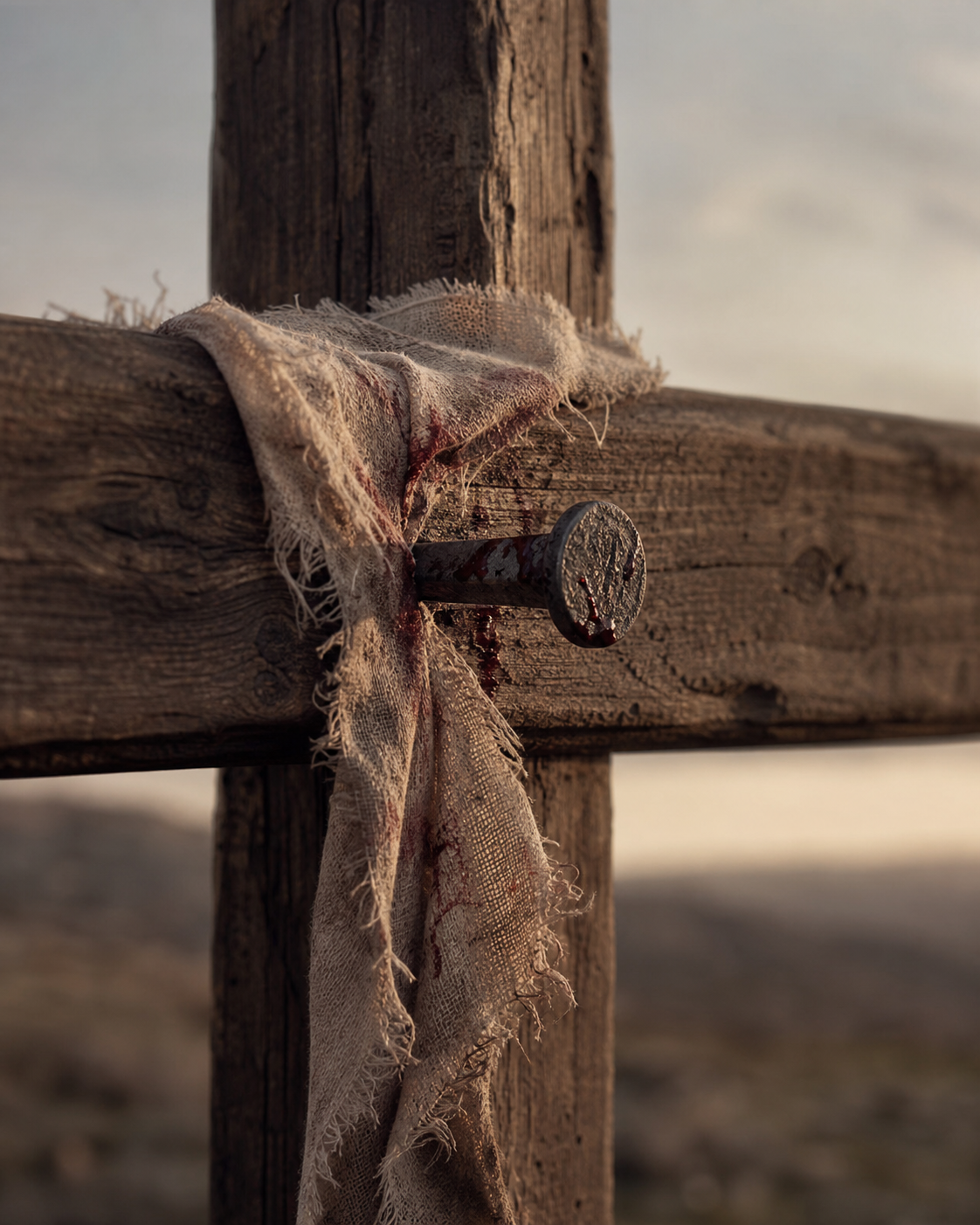
The Last Supper - Part 2

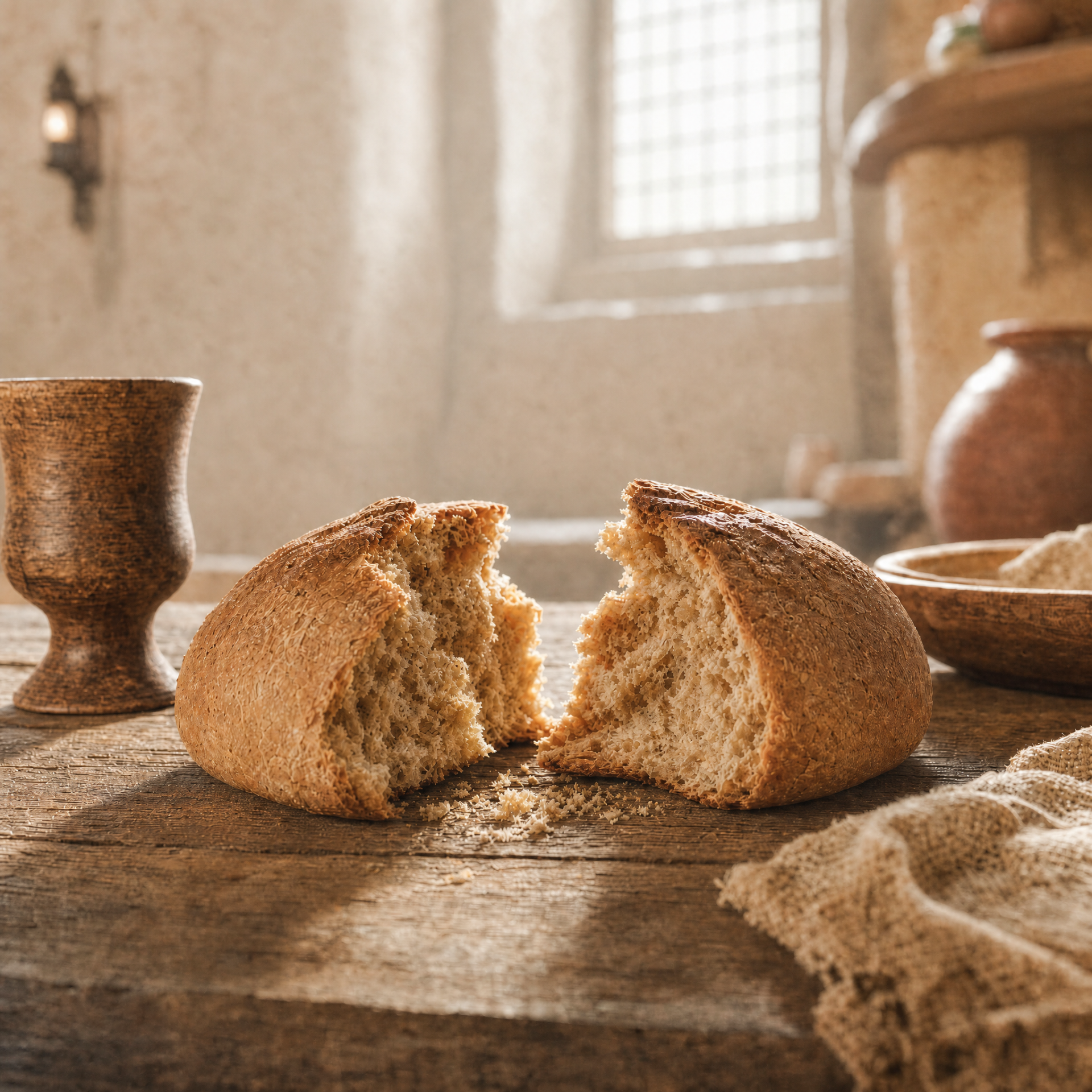
LUKE 22:19
"And he took bread, and when he had given thanks, he broke it and gave it to them, saying, 'This is my body, which is given for you. Do this in remembrance of me.'"
THE LAST SUPPER · PART TWO OF TWO
Breaking Bread
What the Bread at the Last Supper Was Always Meant to Say
FROM THE CUP TO THE TABLE
In the last devotional, we sat with the cup. We tasted the weight of what it meant — blood poured out, covenant sealed, wrath absorbed, redemption purchased. We followed the wine backward through the Hebrew prophets and forward through the halls of eternity, and by the end we were not merely reading history. We were standing in it.
But Jesus did not stop with the cup.
He reached for something else.
He picked up bread.
And what He did with that bread — what He said over it, what He was declaring in the breaking of it — carries a different texture than the cup, and an equally devastating grace. The cup spoke of what He would suffer. The bread speaks of who He would feed. The cup is about the cross. The bread is about the table. And in the bread, we find that the covenant Jesus sealed in blood is not just a legal transaction recorded in heaven. It is a meal. It is a body. It is a life broken open and distributed freely — not just to the worthy, not just to the clean, not just to the ones who have their theology assembled correctly — but to anyone who will receive it.
Pull your chair in a little closer. The cup has been passed. The bread is about to be broken.
And it is broken for you.
I. DAILY BREAD: WHAT BREAD MEANT BEFORE JESUS TOUCHED IT
To understand what Jesus was saying when He broke the bread, you have to understand what bread already meant. Bread was not a neutral food in the ancient world. It was not a dinner roll placed beside a plate as an afterthought. In the Hebrew imagination — and in the Greco-Roman world that surrounded it — bread was life itself. It was the thing that stood between a family and starvation. It was the daily visible sign that God had not forgotten you.
This is why the disciples, when Jesus taught them to pray, were instructed to say: "Give us this day our daily bread" (Matthew 6:11). Not weekly. Not annually. Daily. The prayer is not a shopping request. It is a declaration of dependence — the admission that every morning, you wake up needing something you cannot produce for yourself, and that you have a Father who provides it. Bread was the simplest and most elemental way of saying: I am alive because Someone is sustaining me.
Go back further. When God brought Israel out of Egypt and into the wilderness, the first crisis was hunger. And God's response was manna — bread from heaven, appearing on the ground each morning like frost, sweet as honey, sufficient for one day's portion, and completely impossible to hoard or manufacture. Try to store more than you need, and it rotted. Try to gather it on the Sabbath, and there was nothing there. Every single morning for forty years, Israel woke up and went out to find bread they had not earned and could not replicate. The lesson was not nutrition. The lesson was theology: I am the one who feeds you. You don't survive by your own cleverness. You survive by my faithfulness.
"He humbled you and let you hunger and fed you with manna, which you did not know, nor did your fathers know, that he might make you know that man does not live by bread alone, but man lives by every word that comes from the mouth of the Lord."
DEUTERONOMY 8:3 (ESV)
Jesus quoted this verse when He was hungry in the wilderness and the enemy offered Him bread (Matthew 4:4). He refused to produce bread by His own power because He was living out the theology He had written into Israel's story. He was not surviving by His own hand. He was being sustained by the Father — and He was modeling for us what that posture looks like.
Bread also saturated the tabernacle and the Temple. The Bread of the Presence — twelve loaves, representing the twelve tribes, set on a golden table in the Holy Place — was replaced fresh every Sabbath (Leviticus 24:5–9). Week after week, year after year, century after century, bread sat in the presence of God. The symbol was not subtle: the people of God were sustained in the very presence of God. Their life was bound up with His proximity. Remove the bread, and you remove the sign of covenant nearness.
Bread was also the language of ordinary grace between people. To share bread was to share life. To break bread at a common table was to say: what I have, I open. You are not a stranger here. You belong at this table. This is why the ritual of hospitality in the ancient Near East — from Abraham welcoming angels (Genesis 18) to Boaz feeding Ruth (Ruth 2:14) — was always centered on bread and a shared meal. The table was not social nicety. The table was covenant.
Bread was never just food. It was always a declaration: I see you. You matter. You belong here.
II. THE SHADOW OF THE BREAD: OLD TESTAMENT PROPHECY POINTS TO THE TABLE
If the cup Jesus lifted at the Last Supper was surrounded by centuries of prophetic shadow, the bread He broke was no different. The Old Testament does not merely suggest a Messiah who would die. It suggests a Messiah who would feed — who would be Himself the provision, the nourishment, the sustaining presence the bread had always represented.
The Manna and the Greater Bread. In John 6, the chapter most directly tied to the Lord's Supper in the Gospel of John, Jesus makes an explicit connection. The crowd has just been fed with five loaves and two fish — a miraculous multiplication that echoed the wilderness manna. And when they press Jesus to do it again, He reorients the entire conversation: "I am the bread of life; whoever comes to me shall not hunger, and whoever believes in me shall never thirst" (John 6:35). He is not offering a bread-delivery program. He is declaring Himself the fulfillment of everything the manna had pointed to. The wilderness bread sustained bodies for a day. He sustains souls into eternity.
"Your fathers ate the manna in the wilderness, and they died. This is the bread that comes down from heaven, so that one may eat of it and not die."
JOHN 6:49–50 (ESV)
Isaiah 55 and the Banquet Invitation. Seven hundred years before the Last Supper, Isaiah 55 opens with one of the most stunning invitations in all of Scripture: "Come, everyone who thirsts, come to the waters; and he who has no money, come, buy and eat! Come, buy wine and milk without money and without price." The specific pairing — bread (food), wine — mirrors exactly what Jesus will take up in the upper room. And the terms of the invitation are radical: without money, without price. The qualification is not wealth or merit. It is hunger. It is thirst. It is the willingness to come.
Ezekiel and the Valley of Dry Bones. Ezekiel 37 gives us the great vision of dry bones reanimated by the breath of God. But the larger prophetic movement in Ezekiel anticipates a restored people — gathered, fed, and shepherded: "I will feed them with good pasture" (Ezekiel 34:14). God as shepherd feeding His scattered sheep is the context into which the bread of the Last Supper falls. The new covenant is not merely forgiveness. It is a return to the Father's table for those who had wandered into famine.
Psalm 22 and the Broken Body. Psalm 22 is the passion Psalm — the one Jesus quoted from the cross ("My God, my God, why have you forsaken me?"). But it ends in a feast: "The afflicted shall eat and be satisfied... All the ends of the earth shall remember and turn to the Lord" (Psalm 22:26–27). The suffering of the one leads to the feeding of the many. The broken body of the Servant becomes the bread of the nations. This is the arc Jesus was embodying when He took the loaf and broke it.
The broken body wasn't an interruption of the feast. It was the bread that made the feast possible.
HISTORICAL NOTE: Unleavened bread — matzah — was used at the Passover Seder, as it had been since Exodus 12. Leaven (yeast) represented corruption and sin; its removal was a ritual of purification before the feast. When Jesus broke unleavened bread and called it His body, He was not choosing a random element. He was saying: this is uncorrupted, uncontaminated life — a body without the leaven of sin — broken and given to you. Paul would later draw this line explicitly: "Christ, our Passover lamb, has been sacrificed. Let us therefore celebrate the festival, not with the old leaven, the leaven of malice and evil, but with the unleavened bread of sincerity and truth" (1 Corinthians 5:7–8).
III. BROKEN FOR YOU: THE THEOLOGY OF THE BREAKING
"This is my body, which is given for you" — Luke's account. "Which is broken for you" — Paul's account in 1 Corinthians 11:24. The two words that change everything are not body. They are for you.
Bread doesn't nourish you whole. It nourishes you broken. You cannot receive an unbroken loaf. You cannot take a solid round of flatbread into yourself — it must be pulled apart, distributed, shared, and finally consumed. The breaking is not incidental to the gift. The breaking is how the gift is given. And Jesus, holding that Passover loaf in the lamplight of the upper room, was saying something that reached far beyond the meal: I am going to be broken. And that breaking is not an accident. It is not a tragedy that spins out of control. It is the giving. It is the for you.
The Greek word used in 1 Corinthians 11:24 — klaō, "to break" — is used throughout the New Testament specifically in the context of meals shared with intention. Luke uses it at Emmaus, when the risen Jesus "took the bread and blessed and broke it and gave it to them" (Luke 24:30), and the disciples recognized Him in the breaking. It is used in Acts 2:42 to describe the earliest church: "devoted to the apostles' teaching and the fellowship, to the breaking of bread and the prayers." The breaking of bread became the identifying mark of the resurrection community. Not a lecture hall. Not a legal assembly. A table with broken bread at the center.
But here is the weight of the theology: when Paul writes to the Corinthians that "Christ, our Passover lamb, has been sacrificed" (1 Corinthians 5:7) and then explains the Lord's Supper in chapter 11, he is drawing a direct line between the Passover lamb — whose blood covered the doorpost so death would pass over — and the broken bread — which represented the body of the one who would go to the cross. The bread is not a secondary symbol. It is the complementary half of the covenant. The cup says: my blood purchased your forgiveness. The bread says: my body bears your burden. Together, they constitute the full declaration of substitution: He took what we deserved so we could receive what He earned.
"He himself bore our sins in his body on the tree, that we might die to sin and live to righteousness."
1 PETER 2:24 (ESV)
"Broken for you." Not broken by accident. Not broken despite God's best efforts. Broken intentionally, purposefully, on your behalf. The cross was not the interruption of a plan. It was the execution of one. And the bread Jesus broke that night in the upper room was His way of saying, before a single nail was driven: I know what is coming. I choose it. And I choose it for you.
He didn't stumble into the breaking. He walked into it — with your name on His lips.
IV. THE TABLE THAT SCANDALIZED EVERYONE
Before we examine the bread Jesus broke with His twelve in the upper room, we need to remember the kind of table Jesus had been building His entire ministry. Because the Last Supper did not happen in a vacuum. It was the final act of a ministry that had been defined — and condemned — precisely by who Jesus ate with.
The religious establishment had a word for it: table fellowship. And it was not a neutral practice. In first-century Jewish culture, the table was a controlled environment. You ate with your own kind — socially, religiously, ritually. Pharisees ate with Pharisees. The ceremonially clean ate with the ceremonially clean. The table was a boundary, and where you sat defined who you were.
Jesus shattered this.
He ate with tax collectors — Matthew, Zacchaeus — men who had sold their loyalty to Rome and made their living extracting money from their own people. He ate with sinners — a word that in this context meant not merely people who made moral mistakes, but people who were categorically outside the covenant in the eyes of the religious gatekeepers. He allowed a woman of the streets to wash His feet with her tears at a Pharisee's table (Luke 7:37–39). He received a Samaritan woman — a person doubly disqualified, by gender and by ethnicity, and carrying a personal moral history that would have made even His own disciples uncomfortable — and treated her as a theologian worth engaging (John 4).
And every time He did this, the Pharisees took note. Luke 15:2 records their complaint with devastating precision: "This man receives sinners and eats with them." They meant it as an accusation. Jesus was living it as a mission statement.
They called it a scandal. He called it a kingdom.
The parable that follows — the father running to meet the prodigal son, throwing a robe over his filthy shoulders and calling for a feast — is Jesus' direct answer to that accusation. The Father doesn't feed you because you've cleaned up. The Father runs to you before you've finished your speech and calls for the bread and the fatted calf. The feast is the grace. The table is the welcome. And the older brother, standing outside and refusing to enter, is the Pharisee — the one who has kept every rule and still doesn't understand what the party is for.
Jesus was the kind of person who broke bread across every boundary His culture had erected. He was not making social statements for the sake of progressivism. He was modeling the kingdom of God, in which the table has always been wider than our fears, and the Father has always been more generous than our theology.
V. ARE WE CALLED TO BREAK BREAD WITH EVERYONE?
This is the question that needs to be asked plainly, because the answer has significant consequences for how we live.
Are we — followers of Jesus, people who have received the broken bread and the poured-out cup — called to break bread with gay people? With lesbians? With agnostics, atheists, Buddhists, Muslims, people whose theology is diametrically opposed to ours? With people who have made choices we consider sinful? With people who have hurt us, betrayed us, or are actively hostile to what we believe?
The answer, when we look honestly at the ministry of Jesus, is yes.
Not because there are no distinctions. Not because all paths lead to the same place. Not because truth doesn't matter. But because the table was never designed as a reward for theological correctness or moral performance. It was designed as a place where broken people could encounter the one who breaks Himself open to feed them.
Jesus ate with people who did not understand who He was. He ate with people who would eventually walk away (John 6:66). He ate with Judas, who had already sold Him. He did not wait for people to have correct doctrine before He sat down with them. He sat down with them, broke bread with them, and let the presence of God at the table do what only the presence of God can do.
To be clear: this is not a statement about compromising what we believe. It is a statement about where we believe transformation happens. It does not happen in the lecture. It does not happen in the protest. It often happens at a table, where someone unexpected breaks bread with someone they disagree with, and the Spirit moves in the ordinary grace of shared food and human proximity.
The early church was so distinct in this practice that it drew both admiration and suspicion from the surrounding Roman world. They ate together across the most rigid social boundaries of the ancient world — slave and free, Jew and Gentile, Roman citizen and conquered provincial — and the Roman world watched, bewildered, saying: "See how they love one another." Not because they agreed on everything. Because they sat at the same table.
"There is neither Jew nor Greek, there is neither slave nor free, there is no male and female, for you are all one in Christ Jesus."
GALATIANS 3:28 (ESV)
Breaking bread with someone is not an endorsement. It is an invitation. It is not saying their choices are correct. It is saying: you are a human being made in the image of God, and I am willing to sit with you. Jesus did not eat with sinners because He approved of their sin. He ate with them because He loved them more than He was afraid of being associated with them.
The orphan spirit builds walls around the table. The spirit of sonship widens it. A son who knows the Father's extravagance with the bread is not afraid to share it. He knows there is enough. He knows that giving the bread away does not diminish it. He knows that the Father's table was never meant to be a private dining room.
You don't have to agree with someone's life to share a meal with them. Jesus never did.
VI. WHAT GOD SAW IN THE DISCIPLES THAT WE EASILY MISS
Stand back from the twelve for a moment. Not from their failures — we covered those in Part One — but from what Jesus saw when He looked at them. Because what He saw was not what any rabbi, employer, or institution in their world would have seen.
He saw Peter, and He saw a foundation. The same man who spoke before he thought, who swung a sword in panic and wept in shame — Jesus looked at that raw, volatile, unfinished person and called him Rock. Not as a compliment for what he currently was. As a prophecy of what he was being formed into. Peter didn't become a rock by trying harder. He became one by dying to himself and being rebuilt by the same Spirit that raised Jesus from the dead. Jesus named the person Peter was becoming before Peter had any idea the becoming had started.
He saw James and John — the thunder-brothers who argued for the best seats, whose ambition was embarrassingly visible — and He saw men who could love with ferocity. That same intensity that made them want the seats of honor would, decades later, make James willing to die for what he had seen (Acts 12:2) and John willing to walk into exile rather than deny it (Revelation 1:9). Jesus didn't call them out of their intensity. He redirected it. The fire in them was always real. It just needed the right fuel.
He saw Matthew, the tax collector — a man whose own community had written him off as ceremonially dead — and He saw the one who would write the most Jewish of the four Gospels, the one most concerned with showing the Jewish people that their Messiah had finally come. The man the synagogue had discarded became the pen through which the church would receive Matthew 5–7. The Sermon on the Mount was recorded by a sinner. Let that sit.
He saw Thomas, the one who would demand physical evidence before believing the resurrection, and He saw the man who would travel furthest with the gospel — tradition holds that Thomas carried the message to India, planting one of the oldest Christian communities in history. The doubter became the distant missionary. The questions didn't disqualify him. They sent him further.
He saw Simon the Zealot — a man committed to the violent overthrow of everything Rome represented — and He saw someone capable of a revolution that would actually change the world. Not with a sword. With a story. The energy of the revolutionary had always been there. Jesus just redirected it toward a kingdom that no empire could contain.
What did God see in the disciples that we so easily miss?
He saw past the immediate presentation into the eternal potential. He saw not what they were performing, but what they were carrying. He saw not the failure of last Tuesday, but the harvest of the next twenty years. He saw people who were not yet what they would become, and He treated them as if they already were.
He didn't see finished versions. He saw futures. And He sat down with them anyway.
This is the radical pedagogy of Jesus. The rabbinical system said: prove you can become like me, and then I will walk with you. Jesus said: walk with me, and I will become the proof of what you can be. The bread He broke with twelve ordinary, fractured, arguing, beloved men was His declaration that the table was not for the formed. It was for the forming. He did not wait until they were safe. He broke bread with them in the middle of their becoming.
And He does the same with you. He does not see only the version of you sitting in the pew, wrestling with the same doubt you've carried for three years, still losing the same fight you've been losing for a decade. He sees the one being formed. He sees the rock in the volatile man. He sees the evangelist in the skeptic. He sees the father in the prodigal. And He breaks bread with the version of you that currently exists — not the polished version you're ashamed you haven't become yet — and says: this is for you. Right now. As you are. Because the breaking of this bread is how you get there.
VII. THE BODY OF CHRIST: BROKEN AND DISTRIBUTED
There is one more layer to the bread that must not be passed over.
Paul writes in 1 Corinthians 10:17: "Because there is one bread, we who are many are one body, for we all partake of the one bread." This is an extraordinary statement. The bread is not merely a symbol of Christ's physical body on the cross. It is also — simultaneously — a symbol of the community formed by the breaking. When we eat the one bread together, we are declaring that we are one body. The table creates the community it celebrates.
Which means that the breaking of bread is not just vertical — between you and Jesus. It is horizontal — between you and every other person at the table. To receive the bread from Christ's hand is to be drawn into a body that includes everyone else who has received it. You cannot eat the bread of sonship and then treat your brother as an orphan. You cannot receive the grace of the table and then refuse it to the person sitting beside you. The bread is both the celebration of inclusion and the call to practice it.
This is what made the Corinthian church's communion practice so devastating, in Paul's eyes. They had turned the Lord's Supper into a class dinner — the wealthy eating their fill, the poor going hungry, the divisions of the surrounding culture imported wholesale into the table of Christ (1 Corinthians 11:20–22). Paul's response is searing: "When you come together, it is not the Lord's supper that you eat." If the divisions are there, the bread is not doing what the bread was meant to do. The table of Jesus is not a private feast for the comfortable. It is a common table for the whole body.
"Because there is one bread, we who are many are one body, for we all partake of the one bread."
1 CORINTHIANS 10:17 (ESV)
When Jesus broke bread with twelve imperfect men in the upper room, He was not merely feeding them a meal or instituting a ceremony. He was creating a pattern for a community — a body that would be defined by broken-bread living. A community where the fractures in people are not disqualifications from the table but are themselves brought to the table to be fed. Where the broken sit with the broken, and together receive the body of the one who was broken for all of them.
The bread doesn't just remember His body. It creates ours.
VIII. WHAT HE IS HANDING YOU WHEN HE HANDS YOU THE BREAD
When the bread comes to you — whether it is a torn piece of handmade loaf, a small square of unleavened cracker, a wafer placed on an extended palm by trembling hands — you are receiving everything this devotional has reached toward.
You are receiving the manna your ancestors ate in the wilderness, now fulfilled in the one who is Himself the bread from heaven. You are receiving the invitation of Isaiah 55 — come, without money, without price, because the hunger is qualification enough. You are receiving the body of the Suffering Servant who, as Isaiah 53:5 prophesied, was pierced for our transgressions and crushed for our iniquities — and by whose wounds we are healed.
You are receiving the declaration that you are not an outsider at this table. The bread was broken for you before you ever showed up. The decision to give it was made in eternity past, at a cross outside Jerusalem, in an upper room at Passover, and it arrives in your open hands today unchanged, unconditioned, unearned.
You are also receiving a commission. Because the body that receives the broken bread is called to become itself a breaking — a life broken open in service, in generosity, in the radical table-fellowship that characterized its Lord. To eat the bread of Jesus is to be sent as the bread of Jesus — into neighborhoods, into relationships, across the lines our culture insists are uncrossable, with a table wide enough to seat the people everyone else is turning away.
And you are receiving, perhaps most simply and most deeply, the answer to the whisper that has followed you for as long as you can remember. The whisper that says the table is for someone else. That there is a version of you that would be welcome — a more obedient, more consistent, more spiritually impressive version — but that the current version needs to wait outside.
The bread answers that whisper with a breaking.
The bread says: I was broken precisely for the version of you that is standing here right now. Not the version you hope to become. This version. The arguing, the doubting, the afraid, the still-unfinished, the carrying-too-much, the quietly-ashamed version of you. That is the version the bread was broken for. That is the version He saw at that table in the upper room, and saw again in the long corridor of time that stretched from that night to this moment, and said: yes. That one. Broken for them.
You did not receive the spirit of slavery to fall back into fear. You received the Spirit of adoption — the Spirit that allows you to look at the bread in your hand and know, in the deepest register of who you are, that you are not a guest on probation at someone else's table.
You are a child of the house.
And the Father Himself broke the bread.
He didn't break the bread for the person you're trying to become. He broke it for the person He already calls His own.
"You did not receive the spirit of slavery to fall back into fear, but you have received the Spirit of adoption as sons, by whom we cry, 'Abba! Father!'"
ROMANS 8:15 (ESV)
A PRAYER AT THE BREAKING
Father,I receive the bread not as a stranger who wandered inbut as a child who was called.I do not earn this table. I belong to it.Because He was broken, I can be whole.Because He was given, I can be fed.Let this bread do what no sermon can —let it land in the body,let it remind me that You are not a God of vague spiritual impressionsbut a God who became flesh and broke it open in our hands.And let me carry that breaking outward —to the table I set, the seat I offer,the stranger I invite in.Make me bread for someone hungry.As He was bread for me.Amen.
REFLECT & RESPOND
1.. When you receive the bread, are you more aware of what it cost or what it gives? Ask the Holy Spirit to hold both in you simultaneously — the cross behind and the feast ahead.
2.. Is there someone at the edges of your life — someone whose beliefs, choices, or history make sharing a table feel uncomfortable — whom Jesus might be asking you to sit with? What would it look like to break bread with them this week?
3.. What is the whisper that tells you the table isn't for you? Bring that whisper to the bread. Let the breaking answer it.
← Return to · Part One: The Cup He Chose
The Adopted Son · theadoptedson.com
SCRIPTURE REFERENCES
Old Testament: Genesis 18 • Leviticus 24:5–9 • Deuteronomy 8:3 • Ruth 2:14 • Psalm 22 • Isaiah 53 • Isaiah 55:1 • Ezekiel 34:14 • Ezekiel 37
New Testament: Matthew 4:4 • Matthew 6:11 • Luke 7:37–39 • Luke 15:2 • Luke 22:19 • Luke 24:30 • John 4 • John 6:35, 49–50, 66 • Acts 2:42 • Acts 12:2 • Romans 8:15 • 1 Corinthians 5:7–8 • 1 Corinthians 10:17 • 1 Corinthians 11:20–24 • Galatians 3:28 • 1 Peter 2:24 • Revelation 1:9
All Scripture quotations, unless otherwise noted, are from the English Standard Version (ESV), © 2001 by Crossway, a publishing ministry of Good News Publishers.
HISTORICAL & THEOLOGICAL SOURCES
Bock, Darrell L. Jesus According to Scripture: Restoring the Portrait from the Gospels. Grand Rapids: Baker Academic, 2002. [For the Last Supper as prophetic enactment and the disciples’ formation.]
France, R. T. The Gospel of Mark. New International Greek Testament Commentary. Grand Rapids: Eerdmans, 2002. [For the institution narrative and breaking of bread in Mark 14.]
Jeremias, Joachim. The Eucharistic Words of Jesus. Trans. Norman Perrin. London: SCM Press, 1966. [The foundational scholarly work on the Passover context, unleavened bread, and the breaking rite.]
Keener, Craig S. The Gospel of John: A Commentary. 2 vols. Peabody: Hendrickson, 2003. [For John 6 and the bread of life discourse as fulfillment of the manna typology.]
Motyer, J. Alec. The Prophecy of Isaiah: An Introduction and Commentary. Downers Grove: IVP Academic, 1993. [For Isaiah 53 (the broken servant), Isaiah 55 (the banquet invitation), and the Suffering Servant as bread for the nations.]
Scott, James M. Adoption as Sons of God: An Exegetical Investigation into the Background of HUIOTHESIA in the Pauline Corpus. Tübingen: Mohr Siebeck, 1992. [For the sonship and table-fellowship framework underlying Romans 8:15 and the Lord’s Supper as adoption meal.]
Thiselton, Anthony C. The First Epistle to the Corinthians. New International Greek Testament Commentary. Grand Rapids: Eerdmans, 2000. [For 1 Corinthians 10:17 (one bread, one body), 11:20–24 (the abuse of the table), and 5:7–8 (unleavened bread and the Passover lamb).]
Wright, N. T. Jesus and the Victory of God. Christian Origins and the Question of God, vol. 2. Minneapolis: Fortress Press, 1996. [For the table fellowship of Jesus as kingdom proclamation, the scandal of eating with sinners, and the breaking of bread as prophetic enactment.]
HISTORICAL & CULTURAL BACKGROUND
Edersheim, Alfred. The Life and Times of Jesus the Messiah. 2 vols. London: Longmans, Green, 1883. Rep. Peabody: Hendrickson, 1993. [For the Passover Seder structure, unleavened bread practice, and the social context of first-century table fellowship.]
Haggadah shel Pesach (The Passover Haggadah). Various traditional editions. [Primary liturgical source for the Seder order, including the breaking and distribution of the afikomen.]
Mishnah Pesachim 10. [Rabbinic tractate governing the Passover Seder, including the role of bread, the afikomen, and the liturgical order of breaking.]
Neyrey, Jerome H. “Ceremonies in Luke–Acts: The Case of Meals and Table Fellowship.” In The Social World of Luke–Acts. Ed. Jerome H. Neyrey. Peabody: Hendrickson, 1991. Pp. 361–387. [For the social and honor codes governing table fellowship in first-century Jewish and Greco-Roman culture.]
Smith, Dennis E. From Symposium to Eucharist: The Banquet in the Early Christian World. Minneapolis: Fortress Press, 2003. [For the development of early Christian table fellowship from Jewish Passover practice through the Greco-Roman symposium tradition.]
Stein, Robert H. “Last Supper.” In Dictionary of Jesus and the Gospels. Ed. Joel B. Green and Scot McKnight. Downers Grove: IVP, 1992. Pp. 444–450. [Overview of the institution narrative across all four Gospel accounts, including the bread-breaking gesture.]
Written by
Wes ShinnWes Shinn is a visual storyteller, photojournalist, filmmaker, and minister whose life and calling have been forged in some of the most demanding arenas a creative can inhabit.