LUKEWARM.


Revelation 3:17
"You say, ‘I am rich; I have acquired wealth and do not need a thing.’ But you do not realize that you are wretched, pitiful, poor, blind and naked."
THE ADOPTED SON
LUKEWARM.
Why the Enemy Doesn’t Need You Cold — He Just Needs You Comfortable
A Devotional by The Adopted Son
We use the word casually now. “Don’t be a lukewarm Christian.” It shows up on sermon graphics, in small group discussion guides, printed under a coffee cup on a T-shirt. It has become a soft rebuke — the kind that makes us nod, feel a little convicted, and move on with our morning.
But the word was never soft. It was a technical description of something that made people gag.
Jesus didn’t invent “lukewarm” as a metaphor pulled from thin air. He was writing to a specific church, in a specific city, with a specific water problem — and every person who first heard this letter read aloud would have felt their stomach turn before they understood a word of the theology.
This is an invitation to taste what they tasted. To feel what “lukewarm” actually meant before we sanded it down into a mild warning.
Because the truth underneath the warning is this: the enemy does not need to make you cold. He only needs to keep you comfortable — and comfortable is so much easier to sell.
This devotional will not stay in one city. Scripture never leaves lukewarmness as an isolated problem belonging only to Laodicea. It shows up again and again, wearing different clothes: a sleeping fortress, an abandoned love, a hoarded meal, a burned-out lamp, a heart that hardened so slowly nobody noticed the exact day it happened. Each one is the same disease examined from a different angle. By the end, the point is not “here is one warning to feel bad about.” The point is: this pattern is everywhere in Scripture because it is everywhere in us, and God keeps naming it because He keeps wanting us back.
Read what follows in order. Each section picks up a thread the one before it dropped, and the full picture only finishes assembling at the door where this devotional ends.
THE LAST OF SEVEN: Setting the Scene Before We Get to the Water
Before the water, a question worth answering first: what is Laodicea, and why does the Bible have anything to say about it at all?
Laodicea shows up in the opening chapters of Revelation, the last book of the Bible — and Revelation itself begins in an unexpected place for what most people assume is a book of end-times symbolism. It begins with a specific man on a specific island. John, exiled to the rocky, isolated island of Patmos “because of the word of God and the testimony of Jesus” (Revelation 1:9), receives a vision of the risen Christ. And the very first thing that risen Christ tells him to do is write a letter — not a vague prophecy for the ages, but seven short, specific letters, addressed to seven actual congregations meeting in seven actual cities across the Roman province of Asia, modern-day western Turkey (Revelation 1:11).
These were not symbolic addresses invented for the vision. Ephesus, Smyrna, Pergamum, Thyatira, Sardis, Philadelphia, Laodicea — real cities, connected by a real Roman road, in the order a courier would have carried the letter from one town to the next. Before Revelation ever gets to the seals, the trumpets, or the beasts it’s famous for, it opens as something much more grounded: a stack of personal mail to seven real churches, each letter tailored to what was actually happening in that specific place.
Laodicea is the last stop on that route — a wealthy hub in the Lycus River valley, about a hundred miles east of Ephesus, known across the region for banking, textiles, and medicine, as the next section will unpack in detail.
Key Insight — Every one of the seven letters follows the same pattern: Christ identifies Himself using an image from the vision in chapter 1, commends what is right in the church, rebukes what is wrong, and closes with a promise “to the one who overcomes.” Six of the seven churches receive at least some commendation mixed in with their correction. Laodicea is the only one of the seven that receives none. Not a single compliment. That absence is itself the loudest thing about this letter, before a single word of the rebuke has even been read.
Of all seven churches, Laodicea is the only one Jesus has nothing good to say about.
So when we turn now to what He actually does say to them, every detail is going to matter — starting with the detail every original reader in that city would have felt in their own stomach before they understood a single word of the theology: the water.
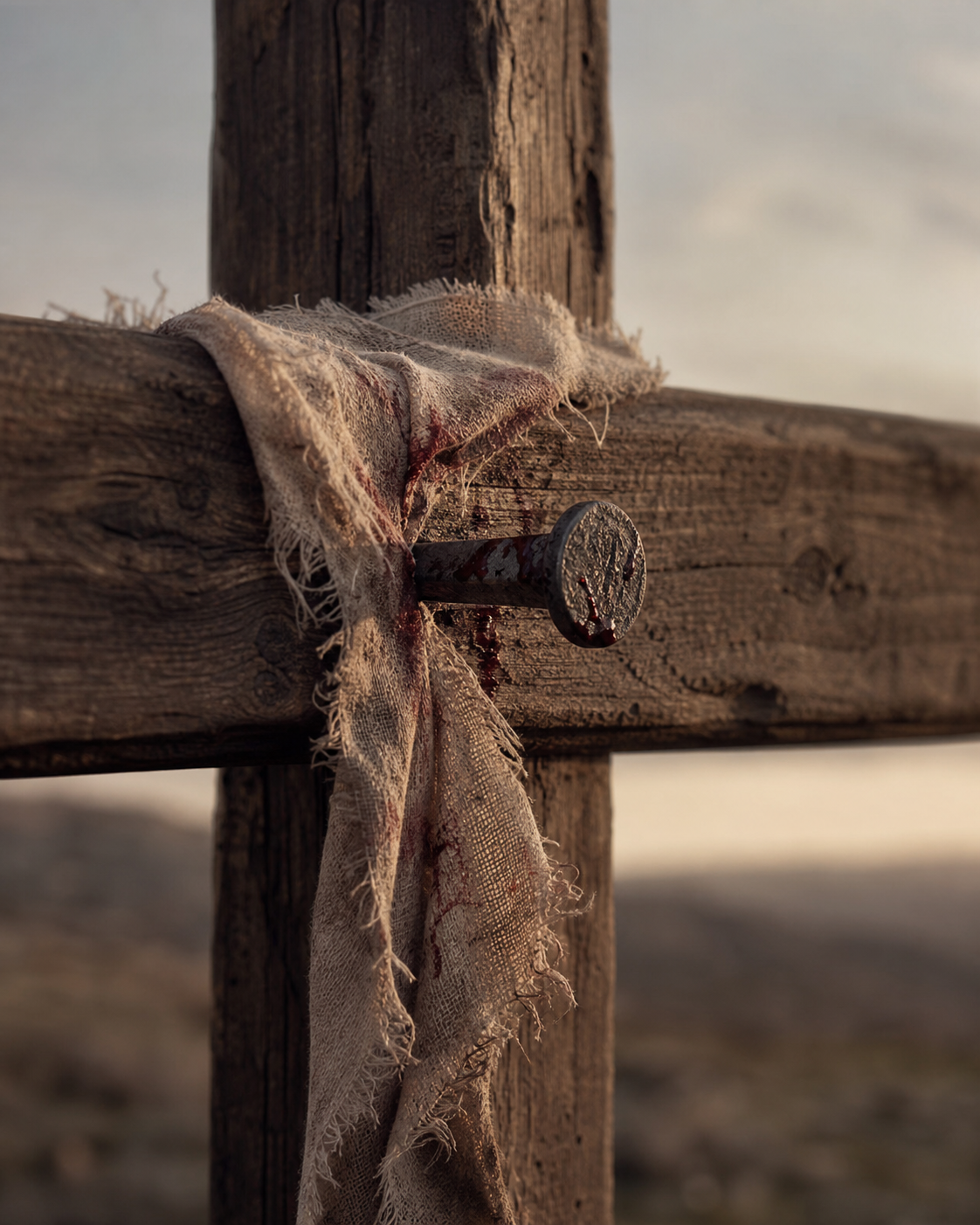
The cross was not a tragedy. It was a transaction. And lukewarmness is not a mood. It is a slow forgetting of what that transaction cost.
THE PIPES OF LAODICEA: What the Water Actually Tasted Like
Laodicea did not have its own water source. This is the detail almost every reading of Revelation 3 skips, and it is the detail the whole passage hangs on.
Six miles north of Laodicea sat Hierapolis, famous for hot mineral springs — the kind people traveled to for healing, still steaming when they reached the surface. Six miles the other direction sat Colossae, fed by cold, clean mountain water, sweet enough to drink straight from the source.
Laodicea sat between them with neither. Its water arrived by aqueduct, piped in from miles away, and by the time it reached the city it had done something worse than simply cool down or warm up. Archaeologists who have traced the remains of Laodicea’s stone pipeline have found them thick with mineral deposits — calcified limescale built up layer on layer, the kind that narrows a pipe’s throat over decades. The water that finally reached Laodicean cups was tepid, mineral-heavy, and by most historical reconstructions, genuinely nauseating to drink.
Paul, writing decades earlier from a Roman prison, had instructed the church at Colossae to trade letters with the believers just up the road: “After this letter has been read to you, see that it is also read in the church of the Laodiceans, and that you in turn read the letter from Laodicea” (Colossians 4:16). The two cities were already in each other’s mail — trading encouragement, trading correction, six miles apart from the cold springs that fed one and the hot springs that fed the other. By the time John writes Revelation, the church that once exchanged letters with Colossae had also somewhere exchanged away whatever had made it worth writing to.
Hierapolis had hot water that healed. Colossae had cold water that refreshed. Laodicea had neither — just a lukewarm, chalky, room-temperature disappointment that people drank because it was what they had, not because it was good.
Neither able to heal like the hot springs, nor able to refresh like the cold ones.
Key Insight — Jesus is not describing a temperature on a scale of spiritual intensity. He is describing a church that had become exactly like its water supply: neither able to heal like the hot springs nor able to refresh like the cold ones. Useless for the very things water is for.
I AM ABOUT TO SPIT YOU OUT: The Violence Inside the Politeness
“I know your deeds, that you are neither cold nor hot. I wish you were either one or the other! So, because you are lukewarm — neither hot nor cold — I am about to spit you out of my mouth.” — Revelation 3:15–16 (NIV)
The Greek word translated “lukewarm” is χλιαρός (chliaros) — literally tepid, room-temperature. But the phrase that follows is where the real force sits: μέλλω σε ἐμέσαι — “I am about to vomit you.” Not spit, in the sense of a dismissive expectoration. Vomit. The involuntary, full-body rejection of something the stomach cannot process.
Plain Language — This is not Jesus mildly displeased. This is Jesus describing a physiological reflex — the body’s automatic revolt against something it was never designed to hold down. That is what lukewarm faith produces in the presence of a holy God.
Read that again slowly. The risen Christ — the one whose eyes are like blazing fire, whose voice is like rushing waters, who holds the keys of death and Hades (Revelation 1:14–18) — is telling a church that their spiritual condition makes Him want to gag.
He would rather you were cold.
That line alone should stop us. We assume cold is the worse condition, the farther-from-God condition. But cold, at least, is honest. Cold knows it needs something. Cold has not lost the ability to recognize its own thirst.
Lukewarm has stopped noticing.
BOUGHT AT A PRICE: Why the Revulsion Runs So Deep
That reaction — the risen Christ’s stomach turning at lukewarmness — only makes sense once you know what it cost Him to bring this church into being in the first place.
“You are not your own; you were bought at a price. Therefore honor God with your body.” — 1 Corinthians 6:19–20 (NIV)
The Greek word behind “bought” is ἡγοράσθητε (ēgorasthēte), from ἀγοράζω (agorazō) — a marketplace word, the same verb used for purchasing goods, livestock, and in the ancient world, slaves. Paul is not reaching for a metaphor. He is describing an actual transaction, with an actual price, in an actual marketplace of sin and death — and Peter names exactly what that price was: “you were redeemed... with the precious blood of Christ, a lamb without blemish or defect” (1 Peter 1:18–19).
That price was not paid comfortably. Peter’s readers would have known — the way the first readers of Laodicea’s letter would have known — what a Roman scourging did to a human back, what six hours of suffocating on a cross actually cost a body to endure. They offered Jesus wine mixed with myrrh before they nailed Him up, a mild anesthetic, an act of mercy common to crucifixions. Matthew records that He refused it (Matthew 27:34). He would feel every bit of what He was paying, fully conscious, all the way to the end.
He refused to be numbed to the size of what He was paying. We anesthetize ourselves to the size of what He gave.
When it was finished, He said so, in a single word: τετέλεσται (tetelestai) — “It is finished” (John 19:30). Archaeologists have found the same word stamped across ancient receipts, marking a debt paid in full. Not partially paid. Not put on a payment plan. Finished. Nothing left to add.
Key Insight — This is what actually stands behind the violence of the Laodicean rebuke. Jesus was not asking that church to try harder or contribute more toward their own worth. The debt had already been retired in full, in blood, before the letter was ever dictated. Their sin was not underpayment. It was indifference — letting a life that had already been bought at the highest possible price run tepid, as though the purchase had never happened, as though nothing of consequence had actually been spent to obtain them.
Lukewarm is not a small sin against a distant God. It is indifference toward a purchase that cost the purchaser everything He had.
This is what actually stands behind Laodicea’s accidental honesty when they say, “I am rich, I have need of nothing.” They are surrounded by a wealth they never had to earn or buy — and they have forgotten there was ever a price attached to it at all.
RICH, AND DID NOT KNOW IT: The Danger of Feeling Fine
“You say, ‘I am rich; I have acquired wealth and do not need a thing.’ But you do not realize that you are wretched, pitiful, poor, blind and naked.” — Revelation 3:17 (NIV)
Every clause in that rebuke was aimed at something Laodicea was actually, historically proud of.
Laodicea was a banking city — wealthy enough that when an earthquake leveled it in AD 60, the citizens refused imperial aid to rebuild and paid for the reconstruction themselves. The Roman historian Tacitus records this fact plainly, almost in passing, the way you’d note a city’s credit rating: Laodicea didn’t need Rome’s money. Laodicea was also known across the empire for a specific black wool, sheared from local sheep, woven into garments that were a status symbol from Italy to Syria. And Laodicea housed a renowned medical school, famous for a particular eye salve — Phrygian powder, ground and mixed into a paste believed to treat eye conditions, exported throughout the region.
Rich. Well-clothed. Sharp-sighted. That was Laodicea’s self-image, and it was not fantasy — it was civic reputation, verifiable, real.
And Jesus took each one and turned it inside out. Rich — but wretched and poor. Well-clothed in the city’s famous black wool — but naked. Renowned for eye salve — but blind.
The most dangerous spiritual condition is not the one that feels distant from God. It is the one that feels fine.
A Pastoral Note — This is not a rebuke for people who know they are struggling. This is a rebuke for people who have every external marker of spiritual health and none of the internal reality. If you already feel conviction because you know you are cold or far off, this passage is not primarily aimed at you — cold people can still hear their own thirst. It is aimed at the version of us that has stopped checking.
THE NAME YOU KEEP LIVING BY: Jacob and the Front That Finally Broke
Here is a question worth sitting with before we move on: why does a lukewarm heart maintain a front at all? Why “I am rich, I have need of nothing” instead of simply the truth?
The orphan spirit doesn’t announce itself as rebellion. It announces itself as fine — and it does that because somewhere underneath the performance is a belief that acceptance has to be earned by appearing to have it together. Admitting the truth feels like risking everything: the marriage that looks stable from the outside, the finances that look secure, the walk with God that looks devoted. So the front goes up. Not usually as a conscious lie — more often as a slow, exhausting habit of managing what other people see, until managing it becomes easier than actually living it.
Scripture already told this story once, in far more detail, centuries before Laodicea ever existed.
Jacob was born grasping his twin brother’s heel (Genesis 25:26) — and his Hebrew name, Ya’aqov, carries that image inside it, a wordplay on “heel” that idiomatically means something closer to “he deceives” or “the supplanter.” He spent decades living all the way up to that name. He talked a starving Esau out of his birthright for a bowl of stew (Genesis 25:29–34). He put on animal skins and lied to his own blind father to steal a blessing that wasn’t his (Genesis 27). He fled his brother’s rage, and was promptly deceived in return by his uncle Laban, who gave him the wrong wife on his own wedding night — the schemer, out-schemed. Jacob built a family, a fortune, and a reputation almost entirely through cunning and managed appearances. By every external measure he was a success. He was also, for most of his adult life, running from the truth of exactly who he was.
He kept the name. He just never said out loud what it meant.
Everything changed at a river crossing called the Jabbok, the night before Jacob finally had to face the brother he’d wronged. A man wrestled with him until daybreak, and Jacob would not let go without a blessing. Then the man asked him something that should stop you the way the letter to Laodicea should stop you: “What is your name?” (Genesis 32:27).
God didn’t ask his name because He didn’t know it. He asked because Jacob needed to hear himself say it.
Every time Scripture has anyone say the name “Jacob” out loud, it carries the same weight: deceiver, heel-grabber, supplanter. So when Jacob answers the question, he isn’t giving information. He is confessing. Out loud, to God’s face, after decades of managing everyone else’s perception of him, he finally has to say the one sentence he’d spent his whole life avoiding: this is who I actually am.
Key Insight — The front was never primarily about deceiving other people. Like Jacob, like Laodicea, it was about managing a self-perception so effectively that a person no longer has to feel the truth underneath it. The exhausting part was never the wrestling match. It was the twenty years of pretending that came before it.
Only after that confession does the transformation come: “Your name will no longer be Jacob, but Israel, because you have struggled with God and with humans and have overcome” (Genesis 32:28). Not a new name handed out to reward good behavior. A new name given the moment the old, honest one was finally spoken.
And Jacob did not walk away from that river the same. The same encounter that renamed him also touched his hip and left him with a limp he carried for the rest of his life (Genesis 32:25, 31). The very strength he had always relied on — the quickness, the self-sufficiency, the ability to out-maneuver anyone in his way — was marked, permanently, so that he could not go back to managing his way through the next hard thing. He walked out to meet Esau the next morning limping. Exposed. Unable to run. Just honest, and dependent, for the first time in his life.
He did not receive a new name and then go back to the tent to protect it. He limped straight into the one relationship he had spent two decades avoiding.
This is what a lukewarm front postpones. Laodicea never had a Jabbok moment. They kept saying “I am rich” year after year, and nobody made them wrestle it out loud — Jesus is doing from a distance, in a letter, exactly what the man at the river did to Jacob up close: asking a question they already knew the honest answer to, and waiting to hear them say it.
THE BLESSING YOU CAN’T STEAL: Why Concealment Always Costs You the Full Inheritance
There is one more piece of Jacob’s story worth pulling out on its own, because it answers a question the rest of this devotional has only implied so far: what does living under a lie actually cost you, in terms of what God has for you?
Jacob had a blessing spoken over him decades before the Jabbok. His father Isaac, deceived into thinking he was blessing Esau, spoke real, weighty, prophetic words over Jacob’s head: “May nations serve you and peoples bow down to you... may those who curse you be cursed and those who bless you be blessed” (Genesis 27:29). Every word of it was true. Every word of it was also stolen.
And look at what that stolen blessing actually produced. Not peace. Not inheritance enjoyed in the open. Fear. Twenty years of exile from his family. A father he would not see alive again for decades. A wife he never intended to marry, handed to him by the very kind of deception he had used on his own father. The blessing was legally his and relationally worthless — words he possessed but could never fully live inside of, because he had taken them instead of receiving them.
“Whoever conceals their sins does not prosper, but the one who confesses and renounces them finds mercy.” — Proverbs 28:13 (NIV)
The Hebrew word behind “confesses” here is built on the root ydh (yadah) — the same root that gives us the name Judah, and the same root behind the Hebrew word for praise. To confess and to praise are, at the linguistic root, the same act: telling the truth about something out loud, to God’s face. Concealment and worship cannot occupy the same sentence in Hebrew, because they are opposites built from the same word family.
David knew this from the inside, long before he ever wrote a psalm about it:
“When I kept silent, my bones wasted away through my groaning all day long... Then I acknowledged my sin to you and did not cover up my iniquity... and you forgave the guilt of my sin.” — Psalm 32:3, 5 (NIV)
Notice what he says happened while he stayed silent: not peace, not relief, not a successfully maintained front. His bones wasted away. Concealment did not protect him from consequence. It just added exhaustion to the sin he was already carrying, and delayed the only thing that could actually resolve it.
Key Insight — God’s blessings are not templates that can be forged by managing the appearance of righteousness. They are relational, spoken face to face — the way Jacob finally received his at the river, the way David finally received forgiveness the moment he stopped covering his sin. A lie doesn’t just delay the blessing. It structurally cannot carry it, the way a closed fist cannot receive what is being handed to it.
You can inherit a blessing by deception. You can only receive one by honesty.
This is exactly what Jesus is offering Laodicea underneath the rebuke: “I counsel you to buy from me gold refined in the fire, so you can become rich” (Revelation 3:18). Real gold, offered freely, to a church already convinced it was holding gold of its own. But you cannot receive what He is offering while your fist is still closed around the counterfeit. Jacob’s stolen blessing and Laodicea’s manufactured wealth are the same transaction, run in two different directions — one grabbed by force, one guarded by denial — and both of them left their owners with something that looked like blessing and functioned like exile.
THE CITY THAT FELL ASLEEP TWICE: Sardis and the Reputation of the Living Dead
Laodicea’s front was financial — a manufactured sense of self-sufficiency. Jacob’s front was an entire fabricated identity, built and maintained for decades. Scripture shows the same pattern again, one register up — not a person’s front this time, but an entire congregation’s. Two chapters earlier in the same book, in the letter to Sardis, Jesus diagnoses the identical disease at the level of a church’s collective reputation, and He says something that should stop us just as hard: “I know your deeds; you have a reputation of being alive, but you are dead” (Revelation 3:1).
Sardis had a story it told about itself, and the story was built into the city’s very geography. The old citadel of Sardis sat on a steep, nearly vertical acropolis — sheer rock cliffs on three sides, a natural fortress that made the city feel untouchable. For generations, Sardis carried a reputation for impregnability the way Laodicea carried a reputation for wealth.
And twice in its history, that reputation collapsed in a single night. In 546 BC, Cyrus the Great’s Persian forces besieged the city and found it exactly as unconquerable as everyone believed — until a soldier named Hyeroeades noticed a Sardian guard accidentally drop his helmet down the cliff face, climb down to retrieve it, and climb back up an unguarded crevice nobody thought needed watching. Hyeroeades followed the same path that night with a detachment of troops. The city fell before dawn. Nearly three hundred years later, in 214 BC, Antiochus III’s forces took Sardis the exact same way — the same overlooked crevice, the same assumption that a cliff face didn’t need a guard because it looked impossible to climb.
Twice, the same fortress. Twice, the same blind spot. Twice, a garrison that trusted its reputation instead of watching its walls.
Key Insight — Sardis didn’t fall to a superior army either time. It fell to nobody watching a door that seemed too small to matter. That is precisely what Jesus is diagnosing in the church: a congregation with a name for being alive, coasting on a reputation instead of a pulse.
A fortress no one is watching is already halfway conquered.
The Greek word Jesus uses in His command to Sardis is γρηγορέω (grēgoreo) — “wake up,” “stay alert,” “keep watch.” It is the same word family Jesus uses in Gethsemane when He finds the disciples asleep: “Could you not keep watch with me one hour?” (Matthew 26:40). Sardis wasn’t told to repent of some scandalous sin. It was told to wake up — because whatever life remained in the church was, in Jesus’s own words, “about to die” (Revelation 3:2). Not already dead. Not yet fully gone. Sardis is a picture of a church on the exact hinge point Laodicea had already tipped past — and the letter reads like Jesus grabbing a shoulder before it’s too late, not after.
THE LOVE YOU LEFT AT THE DOOR: Ephesus and the Orthodoxy That Forgot to Feel
If Sardis shows us a reputation with no pulse, Ephesus shows us something even more unsettling: a church that was, by every doctrinal measure, doing everything right.
“I know your deeds, your hard work and your perseverance... You have persevered and have endured hardships for my name, and have not grown weary. Yet I hold this against you: You have forsaken the love you had at first.” — Revelation 2:2–4 (NIV)
Read the commendation slowly before you get to the rebuke. This church worked hard. This church endured hardship without growing weary. This church tested false teachers and correctly identified them as frauds (2:2). Paul himself had spent three years in Ephesus, longer than almost anywhere else in his ministry (Acts 20:31), pouring doctrinal foundation into this congregation. By the time John writes to them decades later, Ephesus is theologically sharp, doctrinally vigilant, tirelessly active.
And Jesus says: you left something at the door on your way to becoming that.
The Greek for “forsaken” is ἀφῆκας (aphēkas), from the same root used elsewhere for divorce, for letting go, for abandoning something you once held. This is not a church that never had love. It is a church that had it — “the love you had at first” — and set it down somewhere along the way, so gradually that vigilance and hard work grew to fill the space where affection used to be.
You can be exactly right about God and have quietly stopped being in love with Him.
Plain Language — Orthodoxy and intimacy are not the same thing, and one can survive a long time after the other has quietly died. Ephesus is proof that a church can pass every doctrinal test and still receive one of the sharpest warnings in the entire book: “Repent and do the things you did at first. If you do not repent, I will come to you and remove your lampstand from its place” (Revelation 2:5). Not “I will grade you down.” Remove your lampstand. Being right was never going to be enough to keep the light on.
THE MUSCLE THAT NEVER GETS USED: Why Lukewarm Hearts Believe Lies So Easily
Ephesus shows what a lukewarm heart quietly loses — the love it had at first. But there is a second, more dangerous cost hiding underneath the first one: a heart that has cooled off also stops noticing when it is being lied to.
“But solid food is for the mature, who by constant use have trained themselves to distinguish good from evil.” — Hebrews 5:14 (NIV)
The Greek word behind “trained” is γεγυμνασμένα (gegymnasmena) — the same root that gives us “gymnasium.” It doesn’t describe a status you receive at conversion. It describes a muscle built by repeated, unglamorous exercise, the way an athlete’s body is built one ordinary workout at a time. Discernment, in this verse, is not a spiritual gift some believers happen to have. It is a callus formed by constant use.
A discernment muscle that never gets exercised does not stay neutral. It atrophies.
Key Insight — This is the first and most practical reason lukewarm believers are easier to deceive: not because they are less intelligent or less sincere, but because the specific skill of recognizing God’s voice from an imitation only sharpens through use, and lukewarmness is defined by the absence of that use. A cold, dormant limb has no strength to resist anything. It doesn’t need to be overpowered. It just needs to be left alone.
Paul names a second mechanism, and it is uncomfortably direct:
“For the time will come when people will not put up with sound doctrine. Instead, to suit their own desires, they will gather around them a great number of teachers to say what their itching ears want to hear.” — 2 Timothy 4:3 (NIV)
“Itching” translates a Greek word that means being tickled — a sensation that wants to be scratched, not soothed. A lukewarm heart already prefers comfort over confrontation; that preference is what made it lukewarm in the first place. So it is already primed to accept whatever teaching, whatever excuse, whatever manipulation preserves the equilibrium — and to resist whatever threatens it, regardless of which one happens to be true.
The lie doesn’t have to be clever. It only has to agree with what you already want to believe.
A Pastoral Note — Remember Laodicea’s own words back in chapter 3: “I am rich; I have acquired wealth and do not need a thing.” Nobody manipulated them into that sentence. They said it about themselves, out loud, and believed it. Self-deception does most of the enemy’s work before he ever shows up — an outside voice doesn’t have to plant a lie in soil like that. It only has to agree with the story a lukewarm heart is already telling itself.
There is a third piece worth naming, even briefly: isolation. Lukewarm faith tends to quietly disengage from the kind of real, accountable community where a lie gets spoken out loud and named for what it is before it takes root — which is part of why Hebrews prescribes daily encouragement, not annual encouragement, as the antidote to a hardening heart. And underneath all three of these — the unused muscle, the itching ear, the isolated soil — sits the same thing Sardis already taught us: nothing feels urgent, so nothing gets watched. Vigilance is not a personality trait. It is a response to felt danger. Remove the danger and the watchfulness goes with it.
None of these four dynamics require the enemy to lie particularly well. They only require a heart that has stopped practicing, stopped asking hard questions, and stopped staying hungry — which is exactly the strategic reality worth naming plainly.
WHY THE ENEMY DOESN’T NEED YOU COLD
Three cities. Three different blind spots — a thirst nobody felt, a wall nobody watched, a love nobody noticed leaving. Line them up next to each other and a strategic reality comes into focus, and it is worth sitting in plainly: the enemy does not need to make you an atheist. He does not need to make you angry at God, or bitter, or openly rebellious. Those states are loud. They are visible. They tend to produce exactly the kind of crisis that drives a person back to God, desperate and honest, the way the prodigal son came to his senses in a pigpen (Luke 15:17).
Cold is loud enough to notice. Lukewarm is quiet enough to ignore.
Notice what the enemy actually needed in each city. He didn’t need Laodicea to renounce Christ — he needed them comfortable enough to stop noticing their own thirst. He didn’t need Sardis’s walls stormed by force — he needed one unwatched crevice and a garrison that trusted its own reputation. He didn’t need Ephesus to abandon sound doctrine — he needed them busy enough, correct enough, disciplined enough that nobody noticed love had quietly left the building. Three different cities, three different symptoms, and in every case the same low-cost strategy: don’t attack, just let drift do the work.
Peter warns that the enemy prowls like a lion (1 Peter 5:8) — but a lion does not need to chase what has already stopped moving. Paul warns that the enemy disguises himself as an angel of light (2 Corinthians 11:14) — and there is no disguise more effective than convincing a believer that “fine” is the same thing as “alive.” A comfortable, half-warm faith requires no deception, no attack, no spiritual battle at all. It simply requires time, and drift, and the absence of anyone asking hard questions.
“So then, watch carefully how you live — not as unwise people but as wise, making the most of the time, because the days are evil.” — Ephesians 5:15–16 (NIV)
The days are evil. Not because the enemy is working overtime against lukewarm believers — but because he doesn’t have to work at all. Drift does his job for him.
The orphan spirit doesn’t announce itself as rebellion. It announces itself as fine. It settles for the aqueduct water because the aqueduct water is what’s available, and asking whether something better exists feels like too much effort, or too much risk, or simply unnecessary — because nothing feels urgently wrong.
But a son who knows his Father does not settle for tepid water within reach of the hot springs and the cold springs both.
THE MANNA YOU CANNOT STORE: Exodus and the Discipline of Today
If drift is the enemy’s entire strategy, the only real defense is whatever the opposite of drift looks like on an ordinary Tuesday. Scripture had already answered that question long before Laodicea’s pipes ever calcified — God had built a lesson about spiritual urgency into the daily rhythm of an entire nation.
In the wilderness, God fed Israel with manna — a fine, flake-like substance that appeared with the morning dew and had to be gathered before the sun grew hot enough to melt it away (Exodus 16:14, 21). The instruction was strict and strange: gather only what you need for today. Some tried to hoard it anyway, storing extra overnight against tomorrow’s uncertainty — and by morning it “was full of maggots and began to smell” (Exodus 16:20).
Yesterday’s manna is today’s rot.
Key Insight — This was never primarily a test about food supply. It was a test about dependence. God could have dropped forty years of manna in a single afternoon and let Israel ration it themselves. Instead, He made provision something they had to return for, every single morning, for forty years — because a people who could stockpile grace would eventually stop showing up for it.
This is precisely the muscle Laodicea, Sardis, and Ephesus had all let atrophy. None of them needed a dramatic collapse of faith. They needed one thing: to stop showing up hungry every morning, and to start living, quietly and reasonably, off yesterday’s portion. A testimony from three years ago. A worship experience from a retreat that changed everything, once. A season of closeness that has since become a story you tell instead of a hunger you still feel. None of that is false. All of it can still rot, sitting untouched in the jar, if it’s the only thing you’re eating.
THE OIL YOU CANNOT BORROW AT MIDNIGHT: The Ten Virgins and the Limits of Last-Minute Faith
The manna trained a nation to depend on God one day at a time — gathered fresh, never stored. Centuries later, Jesus told a parable that takes that same daily discipline and pushes it out to its final, most uncomfortable edge: the day all the waiting finally ends.
Ten virgins wait with lamps for a bridegroom whose arrival is delayed past midnight. Five had brought extra oil. Five had not.
“The foolish ones said to the wise, ‘Give us some of your oil; our lamps are going out.’ ‘No,’ they replied, ‘there may not be enough for both us and you.’” — Matthew 25:8–9 (NIV)
By the time the foolish virgins returned from buying oil, the door was shut. “Later the others also came... ‘Sir! Sir!’ they said. ‘Open the door for us!’ But he replied, ‘Truly I tell you, I don’t know you’” (Matthew 25:11–12).
That refusal at the door is not a story about scarcity or selfishness among friends. It is a story about a category of thing that simply cannot be transferred at the last minute — a relationship, a depth, an accumulated nearness that has to be built in the ordinary hours nobody’s watching, because it cannot be borrowed in the urgent hour everybody’s watching.
Some things cannot be borrowed at midnight.
A Pastoral Note — Notice the wise virgins were not being cruel. They could not share what they had, because what they had was not a substance that transfers — it was oil accumulated one ordinary, unremarkable day at a time, before the wait ever got long. This is what lukewarmness quietly steals: not your salvation in a single dramatic moment, but the years of ordinary oil-buying that would have meant something different was in the lamp when the hour got late.
TODAY, IF YOU HEAR HIS VOICE: The Wilderness Generation and the Deceitfulness of Sin
The virgins in Jesus’s parable didn’t know when the bridegroom would come — that unpredictability was the whole test. But one generation in Israel’s history knew delay far more intimately than a single midnight: forty full years of it. Their story answers a harder question than “were you ready.” It answers: what does a delay that long slowly do to a heart that stops gathering?
The writer of Hebrews reaches back into that same wilderness generation — the ones who ate the manna, who saw the sea split, who watched fire and cloud lead them for forty years — and asks the church a question none of them wanted to hear: how did people who saw that much still end up hardened?
“Today, if you hear his voice, do not harden your hearts as you did in the rebellion... See to it, brothers and sisters, that none of you has a sinful, unbelieving heart that turns away from the living God. But encourage one another daily, as long as it is called ‘Today,’ so that none of you may be hardened by sin’s deceitfulness.” — Hebrews 3:7–8, 12–13 (NIV)
Deceitfulness of sin. Not the violence of sin, not the obvious rebellion of sin — the deceit of it. Hard hearts don’t announce the moment they became hard. Nobody wakes up one morning having decided, definitively, to stop loving God. It happens the way limescale builds in a pipe: mineral by mineral, day by day, until the water that was once drinkable is something the body wants to reject and nobody remembers exactly when it changed.
Hard hearts don’t announce the moment they became hard.
This is why the writer’s prescription is not an annual retreat or a single decisive altar call. It’s daily — “encourage one another daily, as long as it is called Today” — because the deception that produces lukewarmness is not a single wrong decision. It’s an accumulation of small, undramatic days where nobody checked the temperature.
BREAKFAST ON THE BEACH: What Jesus Did With Peter’s Retreat to Comfort
Scripture doesn’t only diagnose the drift. In one scene, it shows exactly how Jesus responds to a disciple who has already drifted as far as a person can go.
Start with the fire. The night Jesus was arrested, Peter followed at a distance into the high priest’s courtyard, where the guards had built a fire against the cold. Peter stood among them, warming himself — and standing there, in that light, he denied knowing Jesus three times, the last time as the rooster crowed (Luke 22:54–62; John 18:15–18, 25–27). John names the fire specifically: a charcoal fire, ἀνθρακιά (anthrakia) in the Greek.
That word appears exactly one other time in the entire New Testament.
Weeks later, after the crucifixion, after the resurrection — after Peter had already seen the risen Christ standing in a locked room with his own eyes (John 20:19–20) — he still said four words that should stop you the way everything else in this devotional has stopped you: “I’m going fishing” (John 21:3). Not defiance. Not despair, exactly. Something quieter and more familiar: a retreat to the one identity he still knew how to perform competently, after failing completely at the one that actually mattered. Six other disciples went with him. They fished all night and caught nothing.
This is the same instinct behind every front already named in this devotional — Jacob’s decades of managed appearances, Sardis’s coasting reputation, Laodicea’s self-sufficient wealth. When something threatens to expose the truth, the easiest move is retreat to whatever competency still feels safe.
At dawn, a figure on the shore told them where to cast the net. It filled instantly. John said, “It is the Lord” — and Peter, not waiting for the boat, jumped straight into the water to reach Him first (John 21:7). Same impulsive man. Same devotion, still there underneath the retreat.
And here is the detail that ties the whole scene back to where Peter’s failure began: “When they landed, they saw a fire of burning coals there with fish on it, and some bread” (John 21:9). The Greek word for that fire is ἀνθρακιά — the exact same rare word John used only once before, for the fire Peter warmed himself at while denying Christ (John 18:18).
The fire where Peter fell and the fire where Peter was restored are, in the Greek text, the same word — because Jesus built this scene on purpose.
Jesus had already started that fire and already had food cooking before Peter even reached the shore. He did not wait for an adequate confession or a satisfying explanation. “Come and have breakfast” is all He says (John 21:12) — an ordinary, domestic act, extended to a man who three times said, “I don’t know Him.”
Then came the recommissioning: three questions, “Do you love me?” (John 21:15–17), mirroring the three denials — not to make Peter relive the failure publicly, but to let him answer the truth three times where he had denied it three times. Each answer was met not with correction, but with a job: “Feed my sheep.”
Key Insight — There is no guilt language anywhere in this encounter. Jesus does not say “how could you.” He does not list the denials. He asks the disciple who once ran from His name to sit down and eat, and then hands him a purpose again, in the same breath.
This is what actually interrupts lukewarmness — not primarily the threat of being spit out, though Laodicea heard that threat and needed to. It’s the offer that follows it: “I stand at the door and knock... I will come in and eat with him, and he with me” (Revelation 3:20). That is not a new promise invented for a struggling church in Asia Minor. It is the same meal Jesus had already eaten with a disciple who failed Him completely. The door in Revelation 3 and the fire on the beach in John 21 are the same gesture — Christ closing the distance Himself, asking only to be let back into ordinary company.
THE DOOR HE’S STILL KNOCKING ON
And here, after Laodicea’s rebuke, after Sardis’s cliffs, after Ephesus’s abandoned love, after manna that rotted and oil that couldn’t be borrowed and hearts that hardened one ordinary day at a time, after Peter’s own retreat to the water — here is the mercy inside all of it, because none of these letters end where they begin.
“Here I am! I stand at the door and knock. If anyone hears my voice and opens the door, I will come in and eat with that person, and they with me.” — Revelation 3:20 (NIV)
This verse gets quoted constantly as an evangelistic appeal to the unconverted. Read it in context and it lands somewhere far more unsettling and far more tender: Jesus is standing outside the door of a church that already bears His name, already meets in His name, already believes itself rich and in need of nothing — and He is knocking to get back in.
He has not given up on Laodicea. He told Sardis to wake up, not to accept that it was already dead. He told Ephesus to remember and repeat what they’d done at first, not to grieve something permanently lost. The letter that begins with vomit ends with an invitation to dinner.
He would rather spit you out than let you stay comfortable forever. That is not cruelty. That is love that refuses to let you die slowly in a room-temperature faith and call it peace.
Urgency, then, is not fear of a wrathful God waiting to reject you. Urgency is the recognition that comfort is not neutral — that every day spent unbothered by lukewarmness is a day further from the hot springs and the cold springs both, a day of manna quietly rotting in the jar, a day the oil supply goes unreplenished, a day the heart calcifies just slightly more than it did the day before. None of that happens all at once. All of it happens today, if you let it — or is interrupted today, if you answer the door.
This is not the first time Jesus has stood at a barrier that only He could remove. At the moment He died, the curtain in the Jerusalem temple — the sixty-foot wall of fabric separating the Holy of Holies from everyone but a single priest, once a year — tore in two, from top to bottom, torn from heaven’s side, not man’s (Matthew 27:51). God ripped down, by force, the one barrier no human being could ever have torn down on their own. That access was purchased once, fully, at the price already accounted for earlier — and it does not need to be purchased again.
But the door in Revelation 3 is different, and the difference matters. Jesus does not tear this one down. He knocks. The curtain He forced open at Calvary bought you unrestricted access to the Father. The door of your own heart is a door only you can open from the inside. The price for entry has already been paid in full. The only remaining question is whether you will use the access that was already purchased for you, or leave it standing there — knocked on, unopened, one more room-temperature day.
THE INVITATION: What to Do With This
→ Name your temperature honestly. Not what your attendance record says, not what your Instagram says — what your actual hunger for God says right now. Cold can be repented of quickly. Lukewarm has to be noticed first.
→ Ask what “gold refined in the fire” means for you specifically. Jesus doesn’t just diagnose Laodicea — He prescribes: gold refined by fire, white garments, salve for the eyes (Revelation 3:18). What in your life needs the fire? What are you still trying to cover your own nakedness with instead of receiving what He offers?
→ Find your unguarded crevice. Every fortress has one — the small, overlooked place nobody thinks needs watching. For Sardis it was a cliff face. For you it might be a habit, a relationship, a scheduling pattern that quietly erodes what should be guarded. Wake up and go look at it before someone else finds it first.
→ Say your own name honestly. Jacob had to speak the truth about who he’d been — deceiver, heel-grabber — before he could receive who he was becoming. What front have you been maintaining that needs its own Jabbok moment? Say the true sentence out loud, to God, before you say anything else.
→ Stop settling for a blessing you can only hold in secret. If something in your life was gotten or is being kept through concealment, ask whether it has ever actually functioned as a blessing — or just as something you manage and protect. Bring it into the open where it can actually be received.
→ Notice where you’ve gone “fishing.” When something exposes a failure or a distance from God, the easiest move is retreat into whatever competency still feels safe. Name the thing you retreat to, and let Him meet you there instead of waiting until you feel ready to come back on your own.
→ Go back and get what you left at the door. Ephesus wasn’t told to become more doctrinally correct — they already were. They were told to remember, repent, and repeat what they did at first. What did devotion to God look like for you before it became routine? Go do that again, on purpose, this week.
→ Gather today’s portion instead of living off yesterday’s. A testimony, a retreat, a season of closeness — none of it is false, but none of it was ever meant to be stored. Ask God for today’s bread today, and mean it as more than a line in a prayer.
→ Buy your oil before the wait gets long. The nearness you’ll need in the hard, delayed, midnight hour is not available on credit. It has to be building now, in the unremarkable ordinary days when nobody’s watching and nothing feels urgent.
→ Encourage someone today, not eventually. Hebrews doesn’t tell you to guard your own heart in isolation — it tells the church to encourage one another daily, because hardening is easier to catch in someone else’s voice than your own. Call the person you’ve been meaning to check on. Today, while it’s still called today.
→ Answer the knock now. Not once things calm down. Not after this season. The door is not being knocked on in your future — it is being knocked on now, in whatever room-temperature moment you are currently living in.
GUIDED REFLECTION
Take these slowly. Write your answers if you can — this is meant to be looked at honestly, not just read past.
→ If Jesus wrote a letter to your specific spiritual life the way He wrote to Laodicea, Sardis, and Ephesus, what would the opening commendation say — and what would the “yet I hold this against you” say?
→ Where in your life have you mistaken a good reputation for actual life? Where are people (or you) still describing you as “alive” out of habit, past tense, without checking?
→ Where have you been managing an image — “I have it together,” “my marriage is fine,” “I’m doing okay” — rather than telling the truth? What would it cost to say the honest sentence out loud, the way Jacob had to say his own name?
→ What “first love” practices — the things you did early on without needing to be told — have quietly become things you used to do?
→ What is the emotional or spiritual equivalent of hoarded manna in your life right now — an old encounter, an old testimony, an old season — that you have been living off of instead of returning for today’s portion?
→ Where are you currently underinvested in a way that would leave you without oil if the wait got longer than you expected?
→ What would it look like, practically, to answer the door today rather than eventually?
→ Where have you retreated to something familiar and safe instead of facing a failure or a distance from God more directly? What would it look like to let Him meet you there, the way He met Peter at the water, instead of waiting until you feel ready?
Father,
I don’t want to be water You have to force yourself to swallow. I don’t want a faith that has cooled into something merely tolerable — to You or to me.
Show me where I have called myself rich while I was actually poor. Show me where I have trusted my own sight while I was actually blind. Show me the crevice in the wall I stopped watching, the love I set down without noticing, the manna I’ve been living off of instead of gathering fresh.
If there’s a front I’ve been managing instead of a truth I’ve been living, give me the courage Jacob had at the river — to stop wrestling silently and just say the name out loud. I would rather limp out of this honest than walk in looking whole.
And if I’ve gone fishing — if I’ve retreated to something familiar instead of facing You — meet me there the way You met Peter. Not with shame. With a fire already going, and a place already set.
I don’t want the comfort of feeling fine if feeling fine means I’ve stopped noticing You at the door.
You already said it is finished over the debt I keep quietly acting like is still owed. You already paid in full for a life I sometimes hand back to You half-used. Don’t let me treat a purchase that cost You everything like it cost You nothing.
I hear the knock. I’m opening it now — not because I’m afraid of being spit out, but because I don’t want to spend one more day settling for lukewarm when the hot spring and the cold spring were both always meant for me.
Come in. Eat with me. Wake what’s asleep in me. Make me useful again.
Amen.
SCRIPTURE REFERENCE INDEX
All quotations NIV unless otherwise noted.
The Seven Churches
Revelation 1:9–11 — John exiled on Patmos; the risen Christ’s instruction to write to seven churches
Revelation 1:14–18 — The risen Christ’s appearance to John; blazing eyes, keys of death and Hades
Revelation 2:1–7 — The letter to Ephesus: commended for endurance and discernment, rebuked for forsaking their first love
Revelation 3:1–6 — The letter to Sardis: a reputation for life covering an underlying deadness; the call to wake up
Revelation 3:14–22 — The letter to Laodicea in full: lukewarmness, false riches, the refining fire, the knock at the door
Colossians 4:16 — Paul’s instruction that the Colossian and Laodicean churches exchange letters
What the Cross Already Paid
1 Corinthians 6:19–20 — Bought at a price; honoring God with the body
1 Peter 1:18–19 — Redeemed with the precious blood of Christ, a lamb without blemish
Matthew 27:34 — Jesus refuses the wine mixed with myrrh before the cross
Matthew 27:51 — The temple curtain torn in two, from top to bottom
John 19:30 — “It is finished” (tetelestai) — paid in full
Old Testament — Wilderness and Warning
Exodus 16:14–21 — The manna: gathered daily, spoiling when hoarded overnight
Psalm 95:7–8 — “Today, if you hear his voice, do not harden your hearts”
Genesis — Jacob and the Name That Changed
Genesis 25:26 — Jacob born grasping his brother’s heel; the meaning behind his name
Genesis 25:29–34 — Jacob trades a bowl of stew for Esau’s birthright
Genesis 27 — Jacob deceives his blind father to steal the blessing meant for Esau
Genesis 32:22–32 — Jacob wrestles at the Jabbok; his name changed to Israel; the lasting limp
Genesis 27:29 — Isaac’s stolen blessing spoken over Jacob
Proverbs 28:13 — Concealing sin blocks prosperity; confession finds mercy
Psalm 32:3, 5 — David’s silence wastes him; confession brings forgiveness
New Testament — Parables and Perseverance
Matthew 25:1–13 — The parable of the ten virgins; the oil that could not be borrowed at midnight
Matthew 26:40 — Jesus in Gethsemane, asking the disciples to keep watch
Luke 15:17 — The prodigal son “comes to his senses” in the pigpen
Hebrews 3:7–15 — The wilderness generation as warning; the deceitfulness of sin; encouraging one another daily
New Testament — Peter’s Denial and Restoration
Luke 22:54–62 — Peter’s threefold denial at the charcoal fire
John 18:15–18, 25–27 — John’s account of the denial, naming the charcoal fire specifically
John 21:1–19 — “I’m going fishing”; the beach, the second charcoal fire, and the threefold restoration
New Testament — The Nature of the Enemy
Hebrews 5:14 — Discernment as a trained skill, sharpened by constant use
1 Peter 5:8 — The enemy prowls like a roaring lion, seeking whom he may devour
2 Corinthians 11:14 — Satan disguises himself as an angel of light
2 Timothy 4:3–4 — Itching ears; gathering teachers who say what people already want to hear
Ephesians 5:15–16 — Living wisely, making the most of the time, because the days are evil
ADDITIONAL RESOURCES
The following works have shaped Christian reflection on spiritual complacency, urgency, and the seven churches of Revelation, and are commended for further study:
Classic and Foundational Works
Edwards, Jonathan — Religious Affections (1746). The classic theological treatment of the difference between mere religious profession and genuine, felt spiritual affection for God.
Tozer, A. W. — The Pursuit of God (1948). A short, direct call to hunger for the presence of God rather than settling for correct ideas about Him.
Stott, John R. W. — The Cross of Christ (InterVarsity Press, 1986). The definitive modern theological treatment of the price paid at the cross and what it purchased.
Historical and Archaeological Reference
Ramsay, William M. — The Letters to the Seven Churches of Asia (1904). An early landmark study connecting each of the seven letters in Revelation to the specific archaeology and civic history of its city.
Hemer, Colin J. — The Letters to the Seven Churches of Asia in Their Local Setting (Eerdmans, 1986). The definitive modern scholarly treatment of how Laodicea’s water system, Sardis’s acropolis, and each city’s local context shape the meaning of Christ’s letters.
Contemporary Works
Chan, Francis — Letters to the Church (David C Cook, 2018). A direct, pastoral challenge to complacency and comfort in the modern American church.
Piper, John — Don’t Waste Your Life (Crossway, 2003). A sustained argument against a safe, comfortable Christianity in favor of urgent, wholehearted devotion.
“For you did not receive the spirit of slavery to fall back into fear, but you have received the Spirit of adoption as sons, by whom we cry, ‘Abba! Father!’”
Romans 8:15 (ESV)
Written by
Wes ShinnWes Shinn is a visual storyteller, photojournalist, filmmaker, and minister whose life and calling have been forged in some of the most demanding arenas a creative can inhabit.