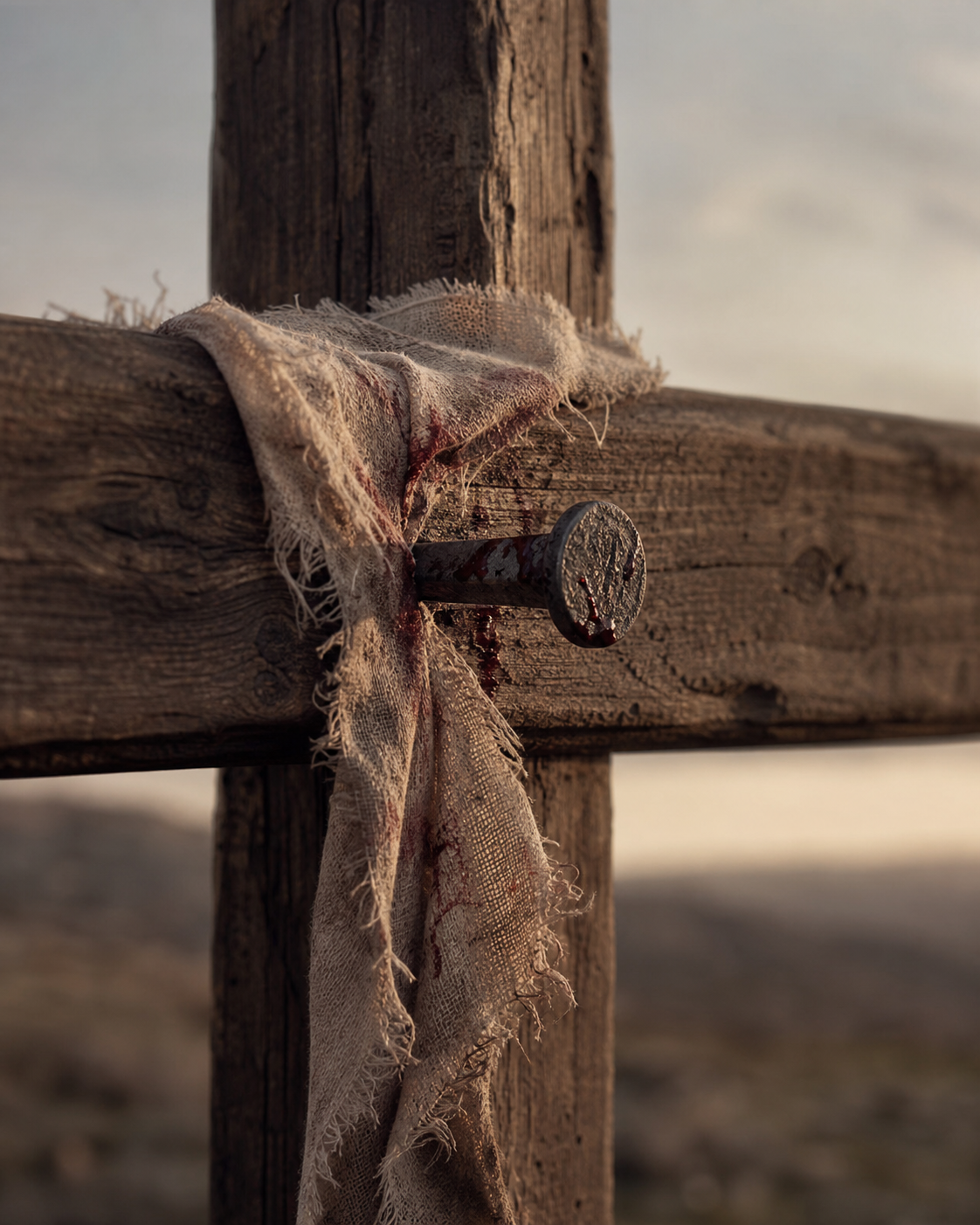
The Wind You Cannot See


Matthew 14:28-29
"Peter answered him, 'Lord, if it is you, command me to come to you on the water.' He said, 'Come.' So Peter got out of the boat and walked on the water and came to Jesus."
THE ADOPTED SON MINISTRY
The Wind You Cannot See
A Devotional on Wounds, Distraction, and Walking with the Holy Spirit
“For you did not receive the spirit of slavery to fall back into fear, but you have received the Spirit of adoption as sons, by whom we cry, 'Abba! Father!'” — Romans 8:15 (ESV)
A Letter to the Reader
You picked this up because somewhere in your life, the wind is blowing. Maybe it's a memory that keeps finding its way into your marriage. Maybe it's the fatigue of ministering to people while nobody ministers to you. Maybe it's a phone in your hand at eleven at night, scrolling a life that isn't yours, wondering why yours doesn't measure up. Maybe you were walking on water — really walking, really doing the thing God called you to do — and somewhere along the way you looked down.
This devotional is not a technique for calming storms. It is not a program for managing your triggers so you can perform better. It is an invitation to notice something most of us have never stopped to ask: when was the last time you actually saw the wind that scares you?
You haven't. Nobody has. Wind is invisible. What you see is what it stirs up — the chop on the water, the strain on your face, the story you tell yourself in the middle of it. This devotional is about learning to tell the difference between the wind and the water, between an old wound doing its work in the present and an actual, present danger. It is about what happens when unhealed pain starts operating your ministry, your marriage, your scrolling thumb, and your sense of who you are — and what happens instead when the Holy Spirit is the one operating you.
The Bible is full of people who sank the way you sink. Peter, on the very water Jesus told him to walk on. Elijah, one chapter after fire fell from heaven. Moses, after forty years of faithful service, cracking at a rock. None of them were disqualified. Every one of them was met.
You are not disqualified either. You are a son. You are a daughter. And your Father already knows exactly which wind you've been staring at.
“You were not made to drown in what you cannot see. You were made to walk toward the One you can.”
— The Adopted Son Ministry
PART
The Water Was Never the Problem
Chapter 1: The Wind You've Never Seen
Peter got out of the boat.
Let that sit for a second before you rush past it. Eleven other men stayed seated, gripping wood, watching a storm do what storms do. One man swung his leg over the side and put his foot on top of the sea.
“Peter answered him, 'Lord, if it is you, command me to come to you on the water.' He said, 'Come.' So Peter got out of the boat and walked on the water and came to Jesus.” — Matthew 14:28-29 (ESV)
He walked on water. Not for a second. Not by accident. He was doing it — present tense, in real time, with the sea holding his weight because the Word had told it to.
Then Scripture says something almost easy to miss:
“But when he saw the wind, he was afraid, and beginning to sink he cried out, 'Lord, save me.'” — Matthew 14:30 (ESV)
Plain Language — The ESV simply says “he saw the wind,” but the underlying Greek word is ischyron — strong, forceful, violent. Older translations render it “boisterous.” Either way, the word describes how hard the wind was blowing. It does not describe the wind becoming visible. The wind was always invisible. What changed was Peter's focus, not the wind's nature.
Here's the question that changes everything: when was the last time you actually saw wind? You've seen what wind does — leaves torn from branches, water whipped into chop, hair blown sideways. But the wind itself has never once been visible to a human eye. Peter didn't get pulled under by the wind. He got pulled under by what the wind stirred up, and by the story he started telling himself about what he saw.
This is the whole devotional in one image. Wounds work exactly like wind. You cannot see the original moment anymore. That memory is over, finished, in the past. What you're reacting to today is what the wound stirs up in your present — the churn, the chop, the noise it kicks up in a conversation, a relationship, a ministry decision that has nothing to do with the moment the wound was formed. And just like Peter, the instant your eyes leave the Person and land on the disturbance, you start to sink in something that, seconds earlier, wasn't sinking you at all.
“You've never seen the wind. You've only ever seen what it disturbs.”
Chapter 2: The Anatomy of a Wound
A wound is not the event. The event ended. A wound is what the event left behind — an interpretation, a vow, a posture the soul quietly adopted to keep from being hurt like that again.
If you were shamed, the wound may have taught you to perform. If you were abandoned, the wound may have taught you to leave first. If you were controlled, the wound may have taught you that trust itself is naive. None of these were sins in the moment they were formed. They were survival strategies: a wounded place built in the dark, without your full permission, long before the Holy Spirit had a chance to interpret the pain for you.
This is why a wound can hijack a mature, Spirit-filled believer in seconds. It isn't reasoning with you. It's reacting for you, faster than reason can arrive — the same way your hand pulls back from a flame before your mind finishes the sentence “that's hot.” And wounds don't stay confined to the moment they were born. They generalize. They start treating your spouse's raised voice like your father's, your pastor's correction like your abuser's control, your friend's silence like your mother's absence.
Key Insight — The wound does not know the danger has passed. It only knows what it felt once, and it will keep interpreting your present through that one memory until it is brought into the light.
David understood this better than most. After a lifetime of being hunted, betrayed, and grieved, he didn't pretend the wounds weren't there. He asked God to go looking for them:
“Search me, O God, and know my heart! Try me and know my thoughts! And see if there be any grievous way in me, and lead me in the way everlasting!” — Psalm 139:23-24 (ESV)
That is not a man managing his wound quietly on his own. That is a man handing it over for surgery.
“An unhealed wound doesn't just remember the past — it recruits your future to relive it.”
PART
When the Wound Speaks
Chapter 3: The Doors a Wound Opens
A wound doesn't stay in the past. Pain that isn't brought to the cross doesn't quietly retire — it relocates. It moves into your marriage and starts finishing your spouse's sentences with old accusations. It moves into ministry and starts preaching self-protection instead of surrender. It moves into church and turns every leadership decision into a referendum on whether you'll finally be safe this time.
Scripture doesn't just warn us about this — it shows us the specific doors, and the specific people who walked through them.
Gideon: The Man Who Needed Proof
Gideon stood in front of an actual angel of the Lord and still could not believe he was the one being called. He asked for a sign. Then he asked for the sign again, reversed, just to be sure (Judges 6:36-40). Gideon's doubt wasn't casual skepticism — it grew out of a nation so beaten down by Midianite oppression that safety itself had become unbelievable. A wound doesn't just make you doubt God's power. It makes you doubt God's intentions toward you specifically.
Elijah: The Man Who Ran Out
One chapter after calling down fire from heaven, Elijah collapses under a juniper tree and asks God to let him die (1 Kings 19:4). Doing the work of God is not a vaccine against the exhaustion of an unhealed heart. Sometimes it's the very thing that exposes it.
Saul: The King Who Grabbed for Safety
Told to destroy everything at Amalek, Saul kept the best of the plunder and the king alive, then blamed his own people when confronted by Samuel (1 Samuel 15:9-21). Self-preservation always sounds reasonable the moment it's happening. It only sounds like rebellion in hindsight.
Saul Again: The King Who Couldn't Watch Someone Else Win
After the women sang songs about David's victories, Scripture says simply, “And Saul eyed David from that day on” (1 Samuel 18:9, ESV). One sentence. One glance that never let go. That is what comparison does — it doesn't erupt, it lingers, quietly reshaping how you see someone God actually sent to help you.
The Elder Brother: Faithful and Furious
He never left the house. He never wasted a cent. And he still could not celebrate his brother's return: “but he was angry and refused to go in” (Luke 15:28, ESV). You don't have to leave home to be far from the Father's heart. You can be standing right outside the party, arms crossed, wounded by your own faithfulness.
Plain Language — None of these doors announce themselves. They arrive disguised as wisdom, as boundaries, as “just being honest,” as loyalty to what's fair. That is the wind. It doesn't announce itself. It just makes the water look like it's about to swallow you whole.
“Every door a wound opens was disguised as wisdom on the way in.”
Chapter 4: The Wind That Social Media Manufactures
If you want to see modern wind in real time, open an app.
Social media is not neutral. It is engineered — built by design teams whose incentive is your attention, not your peace — around a curated life cycle: the good angle, the good lighting, the good day, the highlight, the applause. It is built to show you what people want seen, never what they actually need you to see.
Jesus warned about this exact posture two thousand years before a single phone existed:
“Beware of practicing your righteousness before other people in order to be seen by them... But when you give to the needy, do not let your left hand know what your right hand is doing.” — Matthew 6:1, 3 (ESV)
The temptation to curate a righteous, impressive, admirable image of your life is not new. Social media didn't invent it. It just built a stage, handed everyone a microphone, and made the applause instant and quantifiable.
Key Insight — A wound that has learned to survive by being noticed will start mistaking attention for love, engagement for worth, and a following for a covenant. “For if anyone thinks he is something, when he is nothing, he deceives himself” (Galatians 6:3, ESV). The applause of an algorithm was never going to be able to say “well done” the way the Father can.
“The enemy doesn't need you to sin loudly. He just needs you scrolling long enough to forget whose voice you were following.”
That's a wound factory in the other direction too. When you're already carrying an unhealed place, and you scroll into someone else's edited highlight reel, the wound reads it as evidence. See — they have what you don't. See — you're behind. See — you're not enough. That's not convincing. That's comparison, and comparison is one of the enemy's oldest, cheapest tools.
Cain didn't kill his brother because God rejected him outright — he killed him because he could not stand watching Abel's offering accepted while his own wasn't (Genesis 4:3-8). God warned him first: “sin is crouching at the door. Its desire is contrary to you, but you must rule over it” (Genesis 4:7, ESV). The door was open before the blood was ever spilled. Comparison always knocks first.
PART
Wounded Leaders, Faithful God
Chapter 5: When Wounded People Try to Lead
Scripture doesn't hide its heroes' wounds. It shows you what happens when they operate from them unhealed — and it shows you, with equal honesty, what God does in response.
Elijah: Fed Before He Was Corrected
God doesn't rebuke Elijah under the tree. He sends an angel who feeds him, lets him sleep, feeds him again, and only then leads him to Horeb — not to the wind, not to the earthquake, not to the fire, but to “a low whisper” (1 Kings 19:12, ESV). Even then, God knew: the wind isn't where He is. The wind is where you get distracted looking for Him. Notice the order — body first, then spirit. Rest and food before revelation.
Moses: The Crack That Cost Him Canaan
After forty years of leading a complaining, thankless nation, Moses finally cracks — not by outright disobedience, but by striking the rock in anger instead of speaking to it as commanded (Numbers 20:7-12). The wound of decades of thankless leadership found a crack, and it cost him entry into the Promised Land. This is sobering: even faithful, anointed, long-serving leaders are not exempt from a wound finding its moment. Longevity in ministry is not the same thing as freedom from wounds.
“Longevity in ministry is not the same thing as freedom from wounds.”
Jonah: Resentment Wearing Righteousness
After God spares Nineveh, Jonah doesn't celebrate. He sulks under a gourd and tells God he would rather die than watch mercy extended to people he had already written off (Jonah 4:1-9). His wound wasn't a personal tragedy. It was resentment dressed up as righteousness. Some of the deepest wounds are the ones that feel the most justified while you're inside them.
A Pastoral Note — Every one of these men was already called, already used mightily by God, and still got ambushed by an unhealed place. That should comfort you, not alarm you. You are not disqualified because the wind found you. You are simply due for the same kind of specific, personal encounter each of them received. There is no better picture of that encounter than what happens next, at a fire, on a beach, with a man named Peter.
Chapter 6: The Fire and the Fish
Some restorations are so specific, so carefully staged, that they could not possibly be an accident. This is one of them.
The Fire That Exposed Him
On the night Jesus was arrested, Peter followed at a distance into the high priest's courtyard. It was cold, so the servants and officers had made a charcoal fire, and Peter stood among them, warming himself (John 18:18, ESV). Three times he was asked if he knew Jesus. Three times he said no (John 18:17-18, 25-27). The denial didn't happen in the abstract. It happened in a specific place, in specific light, with a specific smell of smoke and specific warmth on his hands. The fire was there for all of it.
The Boat That Couldn't Save Him
After the crucifixion, after the tomb was found empty, after everything Peter had built his life around had come apart in a single week, Peter says the words that carry the weight of a man giving up: “I am going fishing” (John 21:3, ESV). In effect: that's over, I'm going back to what I know. Six other disciples went with him. A wound rarely travels alone — it recruits company, and other people will follow you back into an old identity simply because you were the one who led the way there in the first place.
They fished all night. They caught nothing (John 21:3).
Key Insight — This was not a group of amateurs. Peter's family had fished the Sea of Galilee for generations. This was his trade before Jesus ever called him, the one thing he could do with total confidence. And apart from Jesus, even total competence caught nothing. A wound convinces you that returning to what you're good at will finally give you the ground to stand on that your faith no longer feels solid enough to provide. But skill was never the source of the catch. It never had been, even in Peter's first calling (Luke 5:4-7), and it wasn't now.
The Voice From the Shore
At daybreak, Jesus stood on the shore, and none of them recognized Him (John 21:4). Grief and shame have a way of doing that — they can keep you from recognizing the very presence you most need, even when He is standing in plain sight. He tells them to cast the net on the right side of the boat. They do, and suddenly the net is so full they cannot haul it in (John 21:6). John is the one who puts it together first: “It is the Lord” (John 21:7). And Peter — still Peter, even mid-wound — doesn't wait for the boat. He jumps into the water and swims for Him.
The Fire That Restored Him
When they come ashore, Scripture says something easy to read: “When they got out on land, they saw a charcoal fire in place, with fish laid out on it, and bread.” — John 21:9 (ESV)
Plain Language — The ESV translates this scene “a charcoal fire” — and that is the exact same phrase the ESV uses back in John 18:18 to describe the fire Peter stood beside when he denied Jesus three times. Same translation, same specific detail, in the only two places in the entire New Testament where a charcoal fire appears (the underlying Greek word, anthrakia, occurs nowhere else in Scripture). This is not incidental staging. Jesus recreates the exact sensory scene of Peter's shame — the smoke, the warmth, the crackle of coals — and instead of confronting Peter with it, He cooks him breakfast on it.
Jesus doesn't wait for Peter to apologize, explain himself, or clean anything up first. He is already on the shore. He already directed the catch. He already has the fire going and the fish already laid on it before Peter's feet ever touch the sand. Then, only after the meal, He asks the question three times — “Do you love me?” (John 21:15-17, ESV) — once for every denial, at the very kind of fire where every denial was spoken.
Key Insight — The place where a wound was formed is not a place Jesus avoids. It is very often exactly where He chooses to meet you — not to shame you with it, but to redeem it. He is not interested in avoiding your worst memory. He is interested in becoming a better one, standing in the same spot.
“The same fire that once exposed him is the very fire He used to feed him.”
Old Nets vs. New Obedience
This is the clearest picture in all of Scripture of the difference between operating out of a wound and bringing a wound to Jesus.
Operating out of the wound looked like this: Peter, wrecked by failure and grief, retreated to the one identity that predated the pain — the boat, the nets, the trade that never asked anything of his faith. That is what an unhealed wound does. It doesn't usually announce itself as rebellion. It just quietly says, that sucked, let's go back to what's familiar and safe. And it will recruit others to follow you there. But notice the result: a whole night of experts, generational labor, and nothing on the net. Wound-driven self-reliance is exhausting, familiar, and, apart from Jesus, fruitless.
Bringing the wound to Jesus looked like this instead: Jesus showing up uninvited, before Peter even asked. Jesus directing the catch Peter couldn't produce on his own. Jesus prepared the meal before Peter arrived, not after he'd earned it. Jesus rebuilt the exact fire that once exposed him, not to relive the shame, but to overwrite it — same warmth, same smoke, entirely new meaning. He didn't need Peter to fix the fire. He only needed Peter to come to it.
You will always have a choice, in the aftermath of a wound, between the old boat and the new shore. The old boat is familiar, competent, and empty. The new shore has a fire on it, a meal already cooking, and a person already there asking, not accusing, “Do you love me?”
“He didn't need Peter to fix the fire. He only needed Peter to come to it.”
PART
Living as a Son, Not an Orphan
Chapter 7: The Orphan Spirit and the Spirit of Adoption
Underneath every wound-driven pattern is a quiet, corrosive belief: I have to secure this myself, because no one else reliably will. This is the orphan spirit — not a demon lurking in a corner, but a posture the soul adopts when love, safety, or belonging once felt conditional or absent. You can be baptized, born again, and actively serving in ministry, and still be operating out of an orphan identity underneath it all.
The orphan spirit produces recognizable patterns:
→ Striving to earn love rather than receiving it as a gift.
→ Constant comparison, driven by a sense of scarcity — if they succeed, I lose.
→ Difficulty trusting authority, including God, because authority has historically been unsafe.
→ Self-preservation dressed up as wisdom or boundaries.
→ A performance-based faith: if I minister enough, post enough, produce enough, maybe I'll finally be secure.
→ Deep loneliness that persists even in community, because belonging never feels fully real.
The antidote is not trying harder to feel like a son. The antidote is the actual revelation that you already are one.
“For you did not receive the spirit of slavery to fall back into fear, but you have received the Spirit of adoption as sons, by whom we cry, 'Abba! Father!' The Spirit himself bears witness with our spirit that we are children of God.” — Romans 8:15-16 (ESV)
Plain Language — “Abba” is Aramaic — the language Jesus himself spoke. It is intimate, familial, unguarded. It is the word a small child uses for a father they trust completely, without calculation. Paul says the Holy Spirit Himself teaches your spirit to cry this word. The revelation of sonship is not something you achieve through enough discipline. It is received through the Spirit's witness, which means it is available to you right now, before you feel ready, before the wound is fully healed, before you have it all together.
This is the deepest reason operating from a wound and operating in the Spirit can never fully coexist. One is rooted in the fear of not being enough. The other is rooted in the finished, settled fact of already being loved. You cannot walk on water while simultaneously trying to prove you deserve to.
“The orphan spirit strives. The adopted son rests.”
PART
A Daily Life of Walking on Water
Chapter 8: Practical Steps to Walk Out of the Wound
Awareness alone doesn't deliver you. Here is what it looks like, in real and repeatable terms, to stop operating from the wound and start operating in step with the Spirit.
→ Name the wind before you judge the water. When fear, defensiveness, or fatigue rises, stop and ask, “What is this actually stirring up?” Name the memory underneath it out loud, to God, honestly. Un-named pain stays in charge.
→ Refuse to let a memory write today's script. Practice saying, “That happened. This is not that.” Your spouse's tone is not your father's tone. Paul called this destroying “arguments and every lofty opinion raised against the knowledge of God... to take every thought captive to obey Christ” (2 Corinthians 10:5, ESV).
→ Build a Spirit-led response before the storm hits. Peter could walk as long as his eyes were on Jesus. Decide now, in the calm, what fixing your eyes on Jesus looks like in your specific triggers.
→ Fast from comparison, not just from food. Set boundaries with what you consume. If social media consistently stirs jealousy, insecurity, or striving, that's wind. Mute it, limit it, or leave it for a season.
→ Let someone see the wound, not just the highlight. Isolation is fertile ground for self-preservation. “Therefore, confess your sins to one another and pray for one another, that you may be healed” (James 5:16, ESV).
→ Return to the cross, not just to willpower. Behavior modification manages wind. The cross ends it. “With his wounds we are healed” (Isaiah 53:5, ESV) is past tense for a reason.
→ Let the Spirit interpret the memory, not just soothe it. Ask directly: “What did this wound teach me to believe about You, about myself, about safety?” Healing is a corrected interpretation, not just an absence of pain.
→ Practice sonship in the small moments. Orphan-spirit living shows up in small daily reflexes — over-explaining, over-apologizing, needing the last word, keeping score. Practice resting instead.
→ Get specific, like Jesus was with Peter. If failure is the wound, let Him ask you the pointed question He asked Peter. If shame is the wound, let Him call you out of hiding the way He did the woman at the well.
→ Keep walking, even after you sink. Peter sank. Jesus caught him immediately (Matthew 14:31). One sinking moment doesn't disqualify you. Get back in the boat, and get back out again next time He says “Come.”
“You were never asked to calm the wind. You were only ever asked to keep your eyes on the One who already has.”
Chapter 9: A Guided Reflection
Take these slowly. Write your answers if you can — a wound named on paper loses some of its grip in the dark.
→ What is the “wind” that most reliably distracts me from the presence of Jesus — comparison, fear, fatigue, image, control?
→ Whose voice, tone, or absence does that wind most often echo? Where did I first learn to fear it?
→ What survival strategy did I build around that wound, and where do I still use it — in marriage, ministry, friendship, online?
→ What is my version of “I am going fishing” — the old, competent, familiar place I retreat to when a wound has wrecked me?
→ If Jesus asked me the way He asked Peter — specific, repeated, personal — what question would He ask me three times?
→ What would it look like this week to walk toward Him instead of managing the water?
A Closing Prayer
Father,
I don't want to keep mistaking old wind for present danger. Search me, and know my heart, and show me where a wound has been quietly writing scripts I never agreed to.
I release the memories I've been protecting instead of surrendering. I release the image I've been managing instead of the identity you've already given me.
Holy Spirit, be as specific with me as You were with Peter, with the woman who reached for the hem of Your garment, with Elijah under the tree. Call me by name. Call me son. Call me daughter.
And when the wind rises again — because it will — remind me that I was never asked to calm it. I was only ever asked to keep my eyes on You.
Abba. Father.
Amen.
Scripture Reference Index
Unless otherwise noted, Scripture quotations are from the ESV® Bible (The Holy Bible, English Standard Version), copyright © 2001 by Crossway.
Matthew 14:28-29 — Peter steps onto the water
Matthew 14:30 — Peter sees the wind and begins to sink
Matthew 14:31 — Jesus catches Peter immediately
Matthew 6:1, 3 — Warning against performing righteousness to be seen
Psalm 139:23-24 — Search me, O God
Genesis 4:3-7 — Cain and Abel; sin lying at the door
Galatians 6:3 — Deceiving oneself in false self-importance
Judges 6:36-40 — Gideon and the sign of the fleece
1 Kings 19:4 — Elijah asks to die under the juniper tree
1 Kings 19:11-12 — The still small voice
1 Samuel 15:9-21 — Saul's self-preservation at Amalek
1 Samuel 18:9 — Saul's jealousy of David
Luke 15:28 — The elder brother refuses to go in
Numbers 20:7-12 — Moses striking the rock in anger
Jonah 4:1-9 — Jonah's anger under the gourd
John 18:17-18, 25-27 — Peter's denial by the charcoal fire
Luke 5:4-7 — Peter's first miraculous catch
John 21:3 — “I am going fishing”; a night of empty nets
John 21:4 — Jesus on the shore, unrecognized
John 21:6-7 — The overflowing net; “It is the Lord!”
John 21:9 — The charcoal fire and the prepared meal
John 21:15-17 — “Do you love me?”; Peter fully restored
2 Corinthians 10:5 — Casting down imaginations
James 5:16 — Confess your faults one to another
Isaiah 53:5 — By His stripes we are healed
Romans 8:15-16 — The Spirit of adoption
The Adopted Son Ministry | Romans 8:15
Written by
Wes ShinnWes Shinn is a visual storyteller, photojournalist, filmmaker, and minister whose life and calling have been forged in some of the most demanding arenas a creative can inhabit.